UUtah CS 6340 NLP | Fall 2026 | Intro to summarization
Overview
The lecture introduces NLP summarization through a Boeing 787 article about whistleblower Sam Salehpoor and an FAA investigation, using the example to show how summaries balance concise coverage, relevant detail, source fidelity, and competing perspectives. It defines extractive summarization as selecting unchanged source text and abstractive summarization as rewriting it, then previews neural generation and the challenge of evaluating generated summaries.
Key takeaways
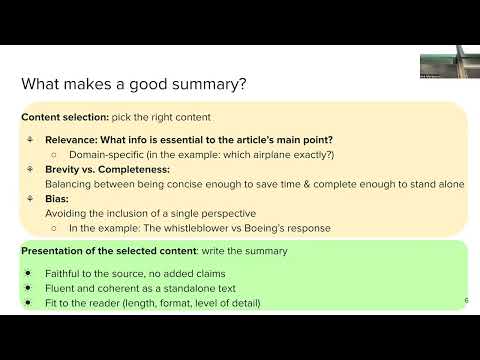
- A summary of the Boeing 787 article can preserve its central point by stating that federal regulators are investigating a whistleblower’s claims about assembly flaws, without reproducing the full article.
- Context selection depends on the summary’s purpose: Salehpoor’s long tenure as a Boeing engineer may be important, while the date he went public may be expendable.
- Summaries must trade off brevity against useful specificity, including whether the exact aircraft model, Boeing’s response, or technical details belong.
- Extractive summarization uses unchanged source snippets, while abstractive summarization permits paraphrase; the latter became more prominent as pretrained decoder-only transformers improved.
- Abstractive summaries can be generated with next-token prediction, but they still need to be faithful, coherent, and appropriate for their intended format.
- Evaluating summary quality is part of the broader challenge of evaluating text generation, which also includes tasks such as machine translation and LLM responses.
Chapters
- The example article reports that federal regulators are investigating claims about flaws in Boeing 787 Dreamliner assembly.
- Sam Salehpoor’s role as a long-time Boeing engineer may matter to readers assessing the credibility and significance of his claims.
- Including every detail about fuselage assembly and possible consequences would make a summary too long; the writer must decide which technical details are essential.
- Whether to include Boeing’s pushback raises questions about representing multiple perspectives and how a summary handles power dynamics.
- Context selection means deciding which text or information is essential to understanding the article’s main point; its opening sentence may already convey the core claim.
- A summary must balance concision with enough specificity, such as retaining the Boeing 787 model when the exact aircraft is relevant.
- Rephrasing must remain faithful to the source and produce fluent, coherent presentation rather than introduce unsupported claims.
- The appropriate detail and format depend on where the summary will appear, such as in a news article or an LLM chatbot response.
- Extractive summarization selects unchanged snippets from the source, sometimes arranging them as bullet points; it was historically easier and common in pre-2020 research.
- Abstractive summarization allows the source to be rewritten and re-expressed, making it easier to choose a precise level of detail and produce coherent prose.
- Neural abstractive summarization can generate a summary token by token through next-token prediction, using the generation methods covered earlier in the course.
- The next topic is evaluating generated text, including summaries and machine translations; evaluation also applies broadly to LLM-generated responses.
Transcript excerpt
0:00 So, we have covered one, uh gigantic family of task, question answering, right? Like, I hope it now it's clear why, uh you know, we had uh that question answering landscape uh uh cover covered first. Um another classic NLP task is uh summarization. Um so, what I want to do today by the end of the class is kind of cover summarization, and it's going to be fairly quick because to do summarization uh we don't have these pipelining approaches where you do something first and then you generate, rather we are going to mostly be using uh just generating given an, you know, piece of text generating a summary. So, because we have uh you know, spent so much time understanding how generation
0:48 with neural LLMs work, we are kind of in a really good place to quickly understand them. Um but I do want to go into, you know, summarization will be exactly what you think a summarization is, but there will be certain terms that we um use uh in the in NLP that's are going to be relevant to know. So, summarization, as you can imagine, uh you get some article, for example, here, a news article. This is from a while back, you know, when Boeing was crashing all the time that we were afraid to fly. That was from that uh period of uh uh time, and many more terrible things have happened, so we probably have forgotten uh as as we do. Uh but uh you know, in 2024 uh we had Boeing had um all these technical issues with their aircraft,
1:37 and one article says uh Boeing whistleblower raises fresh concern about the 787, and the FAA investigates. Um so, let's let's go do this uh maybe uh exercise together. We are going to read
This is the start of the transcript. Save this video free for the whole transcript, searchable and time-coded.
In this course
Related notes
Summary, takeaways, and chapters were generated by AI from the video's transcript and may contain errors. The video belongs to its creator, UofU Data Science.