The Secret Lives of Hummingbirds | Narrated by David Attenborough | Nature Documentary
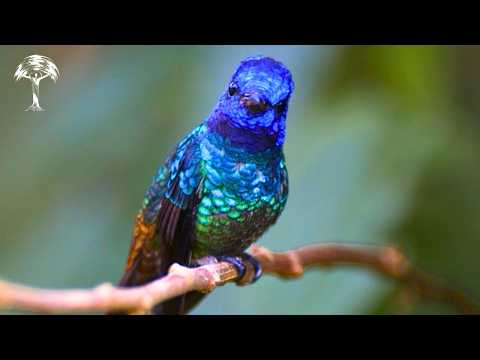 Watch on YouTube →
Overview
Hummingbirds evolved in South America from likely insect-eating ancestors into specialized pollinators, adapting their bills, tongues, size, and flight to reach nectar-rich flowers. Their high-speed lives demand extraordinary energy management, from wings beating up to 80 times per second and a flight heart rate of 1,200 beats per minute to nightly torpor; high-speed cameras and Doppler radar reveal behaviors and migrations that remain partly mysterious.
Key takeaways
- Hummingbirds and flowers coevolved: long, narrow blooms offer nectar to precise hoverers while directing pollen onto birds that carry it between plants.
- Hummingbird flight generates lift on both wing strokes, enabling hovering and backward flight but demanding exceptional oxygen delivery and energy.
- A hummingbird’s energy budget is so tight that it must feed about every 15 minutes by day and use torpor at night, reducing its heart rate from around 400 to 40 beats per minute.
- Specialized flower partnerships can shape individual species: the sword-billed hummingbird reaches deep angel’s trumpet nectar, while the sickle-billed hummingbird’s curved bill fits heliconia flowers.
- Migrating ruby-throated hummingbirds build fat rapidly before crossing at least 800 kilometers of the Gulf of Mexico, a journey scientists have partially tracked with Doppler radar.
Chapters
0:00
South American Origins of the Hummingbird-Plant Partnership
- Flowering plants evolved more than 60 million years ago and initially relied on insects to carry pollen.
- Cold, damp mountain mornings made insects unreliable pollinators, creating an advantage for warm-blooded birds.
- Hummingbirds may have emerged around 50 million years ago from insect- and spider-eating ancestors with heavier bills.
5:00
How Nectar Feeding Reshaped Hummingbird Bodies
- Early hummingbirds likely visited flowers for insects before also feeding on nectar and transporting pollen.
- Over millions of years, bills became lighter and thinner, tongues lengthened, and birds became smaller and more agile.
- Their legs and feet became so reduced that hummingbirds perch rather than hop or walk.
- More than 8,000 kinds of plants now depend on hummingbirds as pollinators.
10:00
Red Flowers, Nectar Rewards, and the Cost of Hovering
- Hummingbirds consume more than their body weight in nectar each day, while their flowers supply abundant liquid.
- Many red and orange flowers are conspicuous to birds but less visible to red-green colorblind bees.
- Long, narrow flowers at branch tips restrict access to animals capable of precise hovering.
- Hovering creates an energy balancing act: high-calorie nectar must offset the cost of obtaining it.
13:00
The Wing Rotation Behind Hummingbird Flight
- Unlike most birds, hummingbirds rotate their wings at the shoulder and generate lift on both the forward and backward strokes.
- This flight mechanism enables hovering, backward flight, and rapid rotation in place.
- High-speed footage reveals wingbeats reaching 80 times per second and flight heart rates rising from about 400 to 1,200 beats per minute.
- A robotic hummingbird built by a California technology company copied the two-stroke flight pattern and provoked an Allen’s hummingbird defending its feeder.
18:20
Rest, Flower Memory, and Protein-Hunting Flights
- Hummingbirds spend about 80 percent of the day perched, conserving energy and grooming their feathers.
- They need to feed roughly every 15 minutes, so remembering recently visited flowers helps avoid wasted trips.
- Nectar alone is insufficient: hummingbirds catch flies and other small insects in midair to obtain protein for muscles and feathers.
- Their extraordinary oxygen demand reflects the costs of sustained hovering and rapid flight.
23:00
Courtship, Nesting, and Nightly Torpor
- A male wire-crested thorntail performs a courtship display lasting only seconds, which high-speed cameras made visible.
- Females build nests and tend eggs, lowering their body temperature to spend less time away feeding.
- Chicks receive a rich mixture of nectar, pollen, and insects, yet few survive to adulthood.
- At night, torpor drops a hummingbird’s heart rate from about 400 to 40 beats per minute and reduces energy use to roughly one-hundredth of its flying level.
28:10
Iridescent Territory Battles and Brazil’s Afternoon Cactus Flowers
- Many hummingbirds defend flower patches because losing access to nectar can put their survival at risk.
- Microscopic air bubbles in feathers refract and reflect sunlight, producing iridescent colors that change with the viewing angle.
- In Northern Brazil, cactus flowers open in the afternoon, and hummingbirds return when their remembered nectar supply becomes available.
- The birds carry sticky cactus pollen between flowers while competing for short-lived feeding territories.
35:10
Andean Adaptations: Giant Wings, Sword Bills, and Sickle Bills
- As the Andes rose about 17 million years ago, high-altitude habitats offered new opportunities and challenges, including thinner air and less oxygen.
- The giant hummingbird uses broad wings and sweeping strokes to generate lift at high elevations.
- The sword-billed hummingbird’s bill is longer than its body, letting it reach nectar deep inside 20-centimeter angel’s trumpet flowers.
- A sickle-billed hummingbird’s curved bill matches a heliconia flower, allowing exclusive nectar access and pollen transfer without territorial defense.
43:10
Two-Gram Woodstars and Their Insect-Like Flight
- Some hummingbirds evolved into micro-hummingbirds weighing as little as 2 grams, comparable to a penny.
- Woodstars fly in an insect-like manner and feed across a range of forest flowers.
- Larger territorial emerald hummingbirds may ignore woodstars because their small size and flight make them seem unlike rival hummingbirds.
- One proposed explanation is that woodstars exploit larger birds’ reluctance to approach insects resembling bees or wasps.
47:30
Ruby-Throated Hummingbirds Prepare for the Gulf Crossing
- Ruby-throated hummingbirds travel south as northern flowers disappear; some reach Rockport, Texas, after flying more than 3,000 kilometers from Canada.
- Before crossing the Gulf of Mexico, migrants feed intensely and can nearly double their weight in three days by converting nectar sugar into fat.
- Their nighttime Gulf crossing covers at least 800 kilometers without stopping.
- U.S. National Weather Service Doppler radar can track flocks of small birds, but their route beyond radar range remains uncertain.
Summary, takeaways, and chapters were generated by AI from the video's transcript and may contain errors. The video belongs to its creator, Terra Mater.