Let's Be Honest About Tribalism | 26FA Class #19 Full Lecture
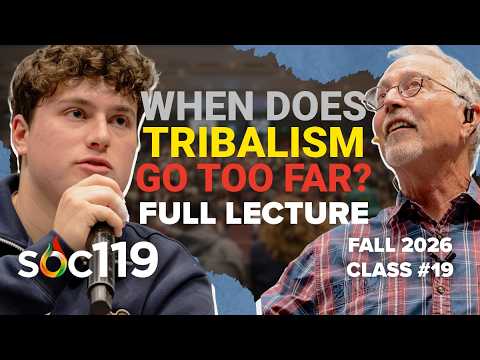 Watch on YouTube →
Overview
The lecture uses sports fandom to examine tribalism as a source of belonging, shared emotion, and cooperation, but also as a force that can create arbitrary rivalries, hostility, and misplaced priorities. Examples from Penn State, the Philadelphia Eagles, Bayern Munich, and Steelers-Ravens fandom show how family, place, and chance shape group identities, while comparisons with military imagery and religious insults reveal how team loyalty can be intensified or turned against outsiders.
Key takeaways
- Sports fandom can turn strangers into temporary allies: Eagles fans, for example, may celebrate together despite differences in politics, nationality, or religion because they share a team goal.
- Team allegiance is often shaped by family, geography, and chance: students linked Eagles fandom to growing up near Philadelphia and Penn State support to a parent’s college ties.
- The same tribal identity that creates belonging can also produce outgroup hostility, from irritation at Cowboys or Astros gear to harassment of Ravens fans in Pittsburgh.
- Sports imagery and language borrow from military ideas of sacrifice and enemies, even though losing a game is not comparable to soldiers facing life-threatening danger.
- Fandom can provide emotional release and social connection, but it becomes harmful when it displaces family, education, work, or civil behavior.
- The lecture presents tribalism as neither inherently good nor bad: its effects depend on whether shared identity bridges differences or is used to justify hostility.
Chapters
- Repeated audio fragments of the word “Heat” fill the opening minutes before class begins around 6:57.
- The lecture shifts from announcements and class logistics into a discussion of groups, movements, and sports fandom.
- Exam Two is scheduled for the following Thursday, in class, with 25 questions compared with 23 on the previous exam.
- While the instructor spends two and a half weeks in Korea, students will attend one guest-speaker class and watch three recorded SOC 119 lectures.
- Each recorded lecture ends with a Canvas quiz: students answer three questions from a question bank, and the quiz stays open for two minutes.
- SOC 119 students can join Zoom dialogues with peers in Colombia, Afghanistan, and Iraq, including participants in Mosul and Baghdad.
- Afghan women may face serious risks if authorities discover they are speaking with international students, so sign-ups carry a responsibility to attend.
- Students must join on time, participate from an appropriate setting, and sign up to earn the block’s World in Conversation points.
- After the announcements and quiz setup, the class turns toward sports, teams, and fandom.
- Students define a fan as someone who is passionate and loyal through both winning and losing.
- Penn State and Philadelphia Eagles fans describe shared teams as sources of community, excitement, and something to anticipate between games.
- Abdul Aziz connects his Bayern Munich fandom to visiting the stadium in Munich when he was about 10.
- A student who plays club field hockey distinguishes being part of a team from supporting a favorite team.
- An Eagles fan recalls crying with his father when Philadelphia won its first Super Bowl, illustrating the depth of fandom’s emotional investment.
- Season-ticket holders can develop family-like bonds with people they regularly sit beside, even when they began as strangers.
- Penn State’s White Out games make some fans feel less like individuals and more like part of a moving crowd.
- Abdul Aziz says football and soccer fandom helped him make many of his friends at Penn State.
- The instructor questions why a person’s team should feel meaningful when birthplace, family, or college choice could have produced a different allegiance.
- Students connect Eagles loyalty to growing up near Philadelphia and Penn State loyalty to family ties, including a parent who attended Penn State.
- Abdul Aziz describes supporting a Saudi team from Jeddah and says the rivalry can include genuine dislike for the opposing side.
- The discussion contrasts inherited or locally rooted loyalties with the possibility that many affiliations are ultimately contingent.
- Penn State is investing about $700 million in a stadium project, with the instructor raising the possibility of total related costs reaching $1 billion over five or six years.
- Students suggest that a larger stadium could bring greater atmosphere, more excitement, and bragging rights, though they question whether it improves team performance.
- One student argues that stadium expansion is driven by revenue and attracting more students, not only by fan experience.
- Students describe superfans as people who travel to games, make fandom central to their identity, and devote increasing time to a team.
- The class distinguishes intense but harmless devotion from behavior that displaces family, education, or work.
- A student recalls reports of a fan becoming violent after a spouse interrupted a game, illustrating how obsession can cross into serious harm.
- Betting and drinking are raised as possible contributors to extreme behavior, though students also describe fandom as an authentic emotional attachment.
- Students say a game can offer an emotional intensity that a book or board game may not provide for a committed fan.
- The instructor asks whether devotion to sports can draw attention away from civic knowledge, such as knowing a congressional representative or vice president.
- One student argues that sports become a problem when they take priority over family, education, or work.
- The roar of 110,000 fans at a Penn State White Out is presented as collective energy released in a stadium rather than directed at one another.
- Fraternities and sororities are compared with sports teams: affiliation can begin through chance and become a lifelong identity expressed through colors and letters.
- BTS fans call themselves ARMY, while Taylor Swift fans are known as Swifties, showing how fan groups develop shared names.
- Students differ on whether they display team loyalty constantly or mainly wear jerseys and gear on game days.
- One student says a real fan should not feel ashamed to show support, linking visible symbols to loyalty.
- The lecture compares Marine recruitment imagery with images of football players entering a field, noting that both frame participation as a demanding commitment.
- Soldiers deploying to Afghanistan and athletes entering a stadium are presented as images that emphasize relying on the people beside and behind you.
- A field hockey player cautions that losing a game is not equivalent to the life-or-death risks faced by soldiers.
- Sports language such as “war,” “enemy,” “attack,” and “destroy” can make ordinary student competitors seem like existential opponents.
- A student says Eagles fans can celebrate with a stranger whose politics or nationality differs from their own because both share a team goal.
- Bayern Munich fandom can create a sense of kinship in a stadium even among people with sharply different backgrounds or religious beliefs.
- The lecture concludes that tribalism is not inherently good or bad: shared identity can bridge differences, but it can also intensify division.
- Students discuss how religious insults from sports fans can shift a game from support into disrespect and provoke serious conflict.
- One Eagles fan says seeing a Cowboys jersey can trigger immediate dislike, while another recalls irritation toward Astros fans after the Phillies lost the World Series.
- A Cowboys fan who grew up outside Philadelphia says his allegiance came from his father and that he has grown accustomed to local hostility.
- The class identifies a tribalism tradeoff: tight in-group bonds can be strengthened by treating rival fans as outsiders.
- A student suggests that tribalism reflects the human instinct to compete, which grows stronger when a group shares the desire to win.
- A field hockey player says cheering fans increase motivation and make athletes want to perform better.
- A student from Pittsburgh describes the Steelers-Ravens game with playoff stakes, where Ravens fans were harassed and local rivalry felt tied to cultural identity.
- The discussion closes by recommending live sporting events to international students, with Penn State’s White Out offered as a memorable example.
- The Steelers-Ravens story shows how sports identities can feel personal enough that teasing a team is perceived as disrespecting a community.
- The class compares the atmosphere of a Penn State football game with attending a Bayern Munich match, reinforcing sports fandom’s role in culture and belonging.
- The lecture ends by returning to the central tension: sports can create powerful shared experiences, but loyalty can also encourage resentment toward rival groups.
Transcript excerpt
0:00 Heat. Heat. Heat. Heat. Heat. Heat. Heat.
1:07 Heat. Heat. Heat. Heat. Heat.
1:59 Heat. Heat. Heat. Heat. Heat. Heat.
3:17 Heat. Heat. Heat. Heat. Heat. Heat.
5:29 Heat. Heat. I'm just trying to get something out for
6:18 you. I'm just trying to give you something. I'm just trying to give you something I do for you. I'm just going to give you something. Okay, let's uh grab a seat and let's I have a we have a I have a bunch of announcements I want to make. So um so let's
7:10 let's let me get started with that. So, first off, um again, if you go if you're interested in this uh the course in Korea, um you can go to the social 19 website and just click up above. There's a link for get involved where you apply to volunteer and different things and you can um uh you'll find information, lots of information about this. Okay. Um second slide. Uh exam two is a week from Thursday. Next Thursday that would be. So um is there anything? It's just like the
7:56 other exam exactly like it. Uh all right. So, uh, 20 except the other one was 23 questions. This is 25. It's the I think the the readings, materials. You don't want to you definitely don't want to start reading or watching videos until maybe Sunday. Um, yeah, don't get started too early. I don't even even know if they're open yet. So, so it's in class. You have to be in class. You have to be here to take the exam.
8:45 Okay, we good. Just like the last one. All right, here's now this is the important announcement. So, yo, you need everyone needs to now pay attention to me. So, look, I'm on Friday morning. I'm leaving uh I'm going to be spending two
This is the start of the transcript. Save this video free for the whole transcript, searchable and time-coded.
Related notes
Summary, takeaways, and chapters were generated by AI from the video's transcript and may contain errors. The video belongs to its creator, SOC 119.