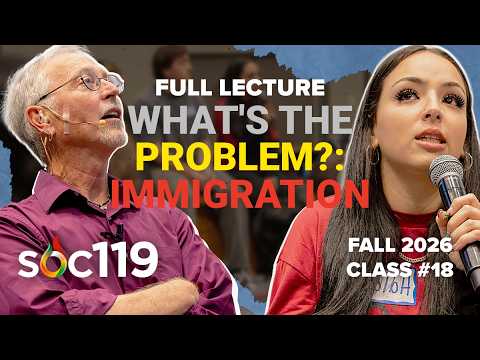
Desperation & Immigration | 26FA Class #18 Full Lecture
 Watch on YouTube →
Overview
The lecture examines immigration as a conflict between humanitarian obligations, national capacity, public consent, and the pressures that drive people to take dangerous routes. It connects Western Europe’s changing migrant population and aging demographics with examples from Ceuta and Melilla, Nicaragua, Sudan, Ethiopia, and Morocco, arguing that migration policy cannot be separated from desperation, historical responsibility, integration, and the limits of available resources.
Key takeaways
- The lecture’s central policy conflict is between protecting residents’ limited housing and public resources and responding to people whose desperation can drive them onto dangerous sea routes.
- Migration policy is connected to destination countries’ own demographic needs: the cited median ages are 43.1 in Western Europe and 19 in Africa, while aging European populations need younger workers.
- The cited crises in Sudan and Ethiopia show why migration cannot be reduced to individual preference: Sudan is described as having 21 million people facing severe food insecurity, and Ethiopia 15.5 million.
- Integration is presented as a shared responsibility: newcomers may learn the local language while retaining cultural practices, but public acceptance also affects whether they can participate in society.
- The lecture distinguishes the 150 million to 200 million estimate of Africans in desperate conditions from the number who would actually migrate; the scale illustrates the limits of treating admission alone as a complete solution.
- Political leaders face conflicting demands from voters, making simple promises about both expanding aid and restricting migration difficult to reconcile with finite budgets and domestic needs.
Chapters
- The opening minutes contain repeated sound and room checks before the lecture begins.
- No substantive immigration argument is introduced until the class starts around 10:01.
- The class acknowledges Jason, a longtime viewer who had visited office hours, and announces a Korea study-abroad course.
- The lecturer recounts meeting an elderly woman in Sapoá, Nicaragua, in 1987, during the country’s civil war.
- After her home was damaged in fighting involving a side supported by the United States, she asked him to teach students about people affected by international events.
- Ceuta and Melilla are Spanish cities on Morocco’s northern coast, and their residents are Spanish citizens.
- The lecturer describes thousands of people responding to social-media reports that reaching Melilla could lead to an asylum hearing.
- Some migrants tried to swim around border fencing extending into the sea; Spanish authorities eventually pushed people back.
- Four students are asked to make decisions as Western European leaders responsible for immigration policy.
- Their initial considerations include why people are leaving, how many can be admitted, and whether housing, jobs, and public services are available.
- The discussion also raises how local residents will respond and whether newcomers can participate in society.
- A chart shows Europe’s migrant population growing by nearly 41 million over 25 years.
- The class compares country populations of roughly 70 million in the UK, 48 million in Spain, and 83.5 million in Germany with migration figures shown on the chart.
- Students question how quickly countries can provide housing and employment, and where newcomers are coming from.
- The lecture argues that most people prefer to remain near family and community, and cites an estimate that 15 percent would permanently leave their place of residence if they could.
- A student with Moroccan parents describes her family’s homesickness and plans to return to Morocco after her younger brother finishes high school.
- Support for immigration may come from labor needs, cultural contributions such as food, tourism, and a desire to help people fleeing hardship.
- Migration flows into Western Europe are shown from regions across Africa, South Asia, and West Asia, including Afghanistan, Pakistan, and Iraq.
- The lecture defines desperation as a loss of hope that can lead people to take reckless actions.
- Students consider the danger of crossing the sea by boat, including the possibility of death, and identify famine and lack of jobs as possible motives.
- Students weigh a policymaker’s duty to protect residents against the moral impulse to help people risking their lives to reach safety.
- One proposal is to use some resources to improve conditions in migrants’ countries of origin, rather than relying only on admission after people flee.
- The discussion asks what newcomers need, including housing, employment, safety, and a viable path to participate in the receiving country.
- Students distinguish adapting to a country, such as learning its language, from abandoning one’s original culture.
- Hala describes speaking Arabic with her mother, eating Moroccan food at home, and being reminded that she was Moroccan while growing up in the United States.
- She recalls choosing the Western name Jennifer as a child to fit in, illustrating the tension between Moroccan and American identities.
- A student asks how colonialism, neocolonialism, and Western involvement in wars affect European countries’ responsibility toward displaced people.
- The class debates whether origin or personal circumstances should influence admission, including comparisons between single parents and married couples.
- A question about religious leaders handling domestic-violence disputes prompts comparisons with Catholic confession and Amish community practices.
- The demographic figures put median age at about 19 in Africa, 32 in Latin America, and 43.1 in Western Europe.
- A younger population can mean more young adults seeking work or education, while students note that some migrants accept difficult jobs and build opportunities over time.
- Europe’s older population and low birth rate create demand for younger workers, making immigration a potential demographic resource as well as a policy challenge.
- The lecture cites 21 million people facing severe food insecurity in Sudan, 10 million children out of school, and nearly 4.5 million people who have fled the country.
- For Ethiopia’s Tigray conflict, it cites 15.5 million people facing severe food insecurity and 1 million asylum seekers.
- These examples frame migration as a response to conditions that can make ordinary survival increasingly difficult.
- The lecture cites an estimate of 150 million to 200 million Africans living in desperate conditions, while clarifying that this is not a count of people all trying to reach Europe.
- Students argue that admitting people alone cannot resolve the conditions producing displacement and discuss development support in countries of origin.
- The class rejects a simple total shutdown as a solution, while recognizing that boat arrivals without documents make identification and admission difficult.
- Students debate whether countries should admit some people while sharing responsibility across multiple European states.
- The discussion weighs the needs of migrants against residents facing housing shortages, high living costs, and limited access to food.
- One student argues that blocking safe routes could make destination countries morally responsible for leaving desperate people with more dangerous options.
- The class asks how policymakers can distinguish legitimate capacity concerns from fear of unfamiliar cultures.
- The lecturer states that violent-crime rates among migrants are generally lower than among native-born populations, while noting that property crime may differ.
- He argues that integration matters for social stability and requires both newcomers’ participation and local residents’ willingness to accept them.
- Hala contrasts a four-year legal immigration process with irregular arrivals and says individual backgrounds matter without justifying generalizations about whole nationalities.
- A hypothetical arrival of 5,000 Texans in Tangier prompts discussion of whether local Moroccans would accept outsiders who changed local businesses and culture.
- Students identify war and climate change as forces likely to increase migration and ask how countries can balance assistance abroad with support for residents at home.
- The lecture argues that politicians face pressure to promise incompatible outcomes because different voters want more aid, tighter borders, or greater support for citizens.
- A New York example contrasts promises of free public transportation with tax cuts, raising the question of how to fund expensive policies.
- The closing discussion returns to the possibility that focusing only on migrants overlooks powerful actors who take disproportionate shares of resources.
Transcript excerpt
3:29 Heat. Heat. Heat. Heat. Heat.
4:57 Heat. Heat. Heat. Heat. Heat. Heat.
5:55 Heat. Heat. N. down. Heat. Heat.
7:05 Heat. Heat. Heat. Heat. Heat. N.
8:28 Black Street clean. Heat up here.
10:01 Okay, y'all. Let's uh let's do it. Let's do it. >> Oh, yeah. Hey, we had a we have a a guy who was um longtime viewer of the class and uh actually came into the classroom or came into office hours one time. His name was Jason. So, uh yeah, shout out to Jason, man. Hope you're out there watching still. Anyway, he passed away the other day. Um, okay. Let me make this um announcement to again this if you're interested in
10:52 doing a May master study abroad class. Uh, you can go to the social 19 website and at the top where it says get involved. Um, there's information on the Korea study abroad class. So, it's cool. It's a very very cool experience. Okay. All right. Hey, let's uh tone it down. Grab a seat. I I have something I want to say before we start that's kind of serious. All right. So,
11:42 back in 1987. I was uh I was in Costa Rica doing some preparatory research for my PhD dissertation and I was traveling to this little town called Urivas in Nicaragua and I stopped at the border and had to walk across the border. It was about 1 kilometer and there was a civil war going on in Nicaragua at the time and I stopped at in this little tongue called Sapoa
12:31 and I was walking down the road because I didn't have a place to stay and I was looking for a bed and a meal and I there was this woman really very old woman sitting on her porch and that's not a
This is the start of the transcript. Save this video free for the whole transcript, searchable and time-coded.
Related notes
Summary, takeaways, and chapters were generated by AI from the video's transcript and may contain errors. The video belongs to its creator, SOC 119.