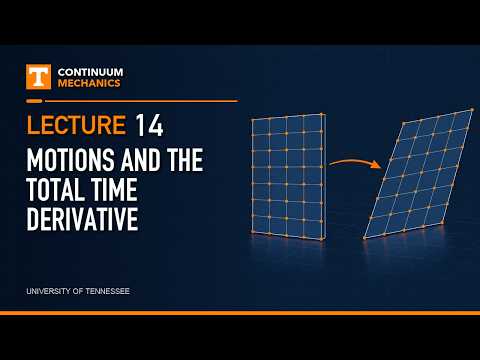
Lecture 14: Motions and the Total Time Derivative
 Watch on YouTube →
Overview
Steven M. Wise develops the kinematics of motion by distinguishing material and spatial descriptions, defining the total time derivative, and deriving its spatial form as a partial time derivative plus transport by velocity. He applies the framework to velocity and acceleration, then defines rate-of-strain and spin tensors, works through a rotating-and-stretching motion, and shows that rigid motion has zero rate of strain but nonzero rotation.
Key takeaways
- Material and spatial fields encode the same physical quantity in different coordinates: convert material to spatial with the inverse motion s, and spatial to material with the forward motion φ.
- The total time derivative follows a particle with fixed material label X; in spatial coordinates it becomes ∂Q/∂t + ∇ₓQ · v for a scalar field.
- Spatial acceleration contains both local change and transport: a = ∂v/∂t + (∇ₓv)v, the form used in fluid mechanics.
- The velocity gradient splits into a symmetric rate-of-strain tensor L and a skew-symmetric spin tensor W, separating deformation from rotation.
- Vorticity curl v is the axial vector of 2W, connecting the curl of velocity to the local rotational part of the velocity gradient.
- For rigid motion φ(X,t) = c(t) + R(t)X, the velocity gradient is skew-symmetric, which makes L = 0 while preserving rotational spin.
Chapters
- Steven M. Wise waits for a critical mass of students before beginning the mechanics lecture.
- Students discuss sparse attendance, office-hour access, and the upcoming third homework assignment.
- A motion maps a material point and time to a spatial point through a smooth function φ.
- At every time, the deformation must be one-to-one, onto, and have a positive deformation-gradient determinant.
- The initial condition φ(X, 0) = X makes the motion start from the identity configuration.
- The configuration Bₜ is the image of the initial body B under φ at time t.
- Smooth motions do not create holes, cracks, tears, or ruptures in a body.
- For each fixed time, the inverse map s returns a spatial point x to its material label X, so s(φ(X,t),t) = X.
- A material field ω(X,t) becomes a spatial field by composition with the inverse map: ωₛ(x,t) = ω(s(x,t),t).
- A spatial field γ(x,t) becomes a material field through the motion: γₘ(X,t) = γ(φ(X,t),t).
- Temperature and pressure can be represented in either coordinate system while describing the same physical information.
- Wise distinguishes the material gradient ∇ₓ from the spatial gradient ∇ₓ, with capital X denoting material coordinates and lowercase x denoting spatial coordinates.
- A time derivative in material coordinates holds the initial particle label X fixed.
- A spatial description introduces time-dependent coordinates x, so its time derivative requires care about what is held fixed.
- For a material field, the total time derivative is the ordinary partial derivative with respect to time at fixed X.
- For a spatial field, Wise defines the total derivative by converting to material coordinates, differentiating there, and converting back.
- The definition tracks how a field changes for an observer following a particle identified by its original material coordinate.
- The material velocity is the time derivative of the motion, V(X,t) = ∂φ(X,t)/∂t.
- The material acceleration is the time derivative of V at fixed X.
- These derivatives are unambiguous because the material label X does not change with time.
- Spatial velocity and acceleration are obtained by evaluating their material fields at X = s(x,t).
- The spatial velocity is therefore v(x,t) = V(s(x,t),t), with the same conversion applied to acceleration.
- Spatial descriptions are useful in fluid dynamics, including the form used for the Navier–Stokes equations.
- For a spatial scalar field Q, the total derivative is ∂Q/∂t + ∇ₓQ · v.
- For a spatial vector field W, the corresponding formula is ∂W/∂t + (∇ₓW)v.
- The partial time derivative here holds the spatial coordinate fixed, unlike the total derivative that follows a moving particle.
- Wise proves the scalar formula first because the vector result follows by applying it component by component.
- In an orthonormal frame, ∇ₓQ is assembled from partial derivatives with respect to x₁, x₂, and x₃.
- The gradient of a vector field is a second-order tensor whose components are the spatial derivatives of the vector components.
- The derivation first rewrites Q as a material field by substituting x = φ(X,t).
- Taking the time derivative at fixed X produces chain-rule terms involving ∂Q/∂xᵢ and the corresponding particle velocity components.
- Converting back to spatial coordinates turns the particle velocity into v and yields the spatial transport formula.
- Spatial acceleration is the total derivative of spatial velocity: a = ∂v/∂t + (∇ₓv)v.
- The transport term accounts for velocity changes caused by a particle moving through spatially varying flow.
- Wise identifies this acceleration as a component of the Navier–Stokes equation and notes that density factors and nondimensionalization will be treated later.
- The rate-of-strain tensor L is the symmetric part of the spatial velocity gradient: L = ½(∇v + (∇v)ᵀ).
- The spin tensor W is its skew-symmetric part: W = ½(∇v − (∇v)ᵀ).
- Together, L and W decompose the velocity gradient into stretching or shearing and rotational contributions.
- The worked motion rotates the first two coordinates with angular frequency ω while stretching the third coordinate by a factor involving 1 + αt.
- For α > 0 and t ≥ 0, the deformation remains invertible because 1 + αt cannot vanish.
- Computing ∇v and splitting it into symmetric and skew parts shows that L captures the axial stretch while W captures rotation about the third axis.
- Spatial vorticity is defined as curl v.
- The curl definition shows that vorticity crossed with an arbitrary vector equals the action of twice the spin tensor on that vector.
- By uniqueness of the axial vector of a skew-symmetric tensor, vorticity is the axial vector of 2W.
- A rigid motion has the form φ(X,t) = c(t) + R(t)X, where RᵀR = I and det R = 1.
- Its spatial velocity can be written as a rotational term about c(t) plus the translational velocity ċ(t).
- The velocity gradient is skew-symmetric, so a rigid motion has zero rate-of-strain tensor and a nonzero spin tensor representing rotation.
Transcript excerpt
3:03 No here today. >> Yeah, looks like I got to start taking points off. Just saying. >> Yep. Uh well, tendance is a little sparse today. We still got like a couple minutes, right? >> Yeah, >> like two minutes. [laughter] >> Um, one minute. Exactly. You want to zoom there?
4:31 I had a class one time there were two people in it but that was the m that was the enrollment and then one guy dropped [laughter] and then u the professor just skipped teaching the course because he what else are you going to do? >> Yeah. I also already got permission to uh run the course. So we just it was it was um mechanics not continue mechanics but mechanics. Trying to think better at a class like that. I had my very first class in college was a uh was an introger German class and uh >> it was an 8 am class so getting up every
5:20 day obviously sucked but uh the professor he was a visiting professor uh >> he brought us like coffee and tea so >> yeah it made it worth it made it worth going there >> not to mention we had to [laughter] >> was it optional huh No. [laughter] >> Jeez. Where is everyone? >> Really? >> Maybe people are at the tea time. >> Maybe. So, are you coming from tea time?
6:07 No, it just takes me a long time to walk up hills. Gotcha. >> Do you go to te two time much? Cuz I haven't been to two time three years now. >> I go once a month or >> I really think they should try to get bigger variety of people there. Yeah, there was a guy, a grad student Chris Helman years ago. Um, when he hosted tea
This is the start of the transcript. Save this video free for the whole transcript, searchable and time-coded.
In this course
Related notes
Summary, takeaways, and chapters were generated by AI from the video's transcript and may contain errors. The video belongs to its creator, Steven M. Wise.