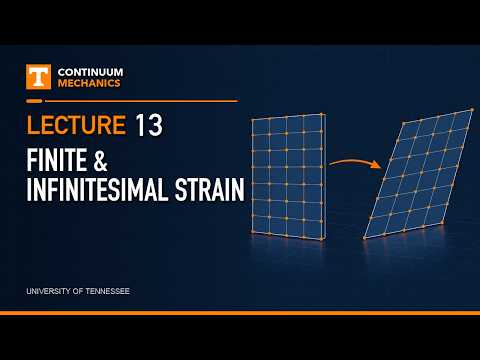
Lecture 13: Finite and Infinitesimal Strain
 Watch on YouTube →
Overview
Steven M. Wise distinguishes deformation from strain, then develops the right Cauchy-Green tensor C = FᵀF as a rotation-independent measure of finite stretch and shear. He derives principal stretches from the polar decomposition, illustrates the measurements with a unit simple-shear example, and shows how small displacement gradients reduce the finite-strain description to the infinitesimal strain tensor ε = ½(∇u + ∇uᵀ).
Key takeaways
- The right Cauchy-Green tensor C = FᵀF isolates finite stretch from rotation: under F = RU, it equals U² and has principal values λᵢ².
- Directional stretch is computed locally as √(E · CE); the largest possible value is the largest principal stretch λ₁, attained along its principal direction.
- Changes in angle between material directions define shear, and orthogonal principal directions have zero shear, making C diagonal in the principal basis.
- For the simple shear map x₁ = X₁ + X₂, the deformation preserves area, produces coordinate-direction stretches 1 and √2, and changes a right angle by 45 degrees.
- When the displacement gradient is small, its quadratic contribution is second order, so infinitesimal strain is approximately ½(C − I) and equals the symmetric displacement gradient.
- A rigid finite motion has φ(X) = c + QX and C = I, while an infinitesimally rigid motion has u(X) = c + WX with W skew-symmetric and ε = 0.
Chapters
- A deformation maps a body's reference configuration to its deformed configuration, but strain requires changes in the relative positions of neighboring particles.
- Doubling the distance between particles creates stretch, and changing the angle between material directions creates shear.
- A rigid rotation changes orientation without changing relative distances or angles, so it produces no strain.
- The deformation gradient F admits a right polar decomposition F = RU, where R is a proper rotation and U is symmetric positive definite.
- The left polar decomposition uses a symmetric positive definite V; U and V share eigenvalues but generally have different eigenvectors.
- Admissibility, including det F > 0, ensures F is locally invertible and the stretch tensors are positive definite.
- For a symmetric positive definite matrix A = QΛQᵀ, its square root is QΛ¹ᐟ²Qᵀ, with square roots taken entrywise on the diagonal eigenvalue matrix.
- The eigenvalues λᵢ of U and V are the principal stretches associated with F, and their eigenvectors are the right and left principal directions.
- Unlike F, which need not be symmetric or have real eigenvalues, U and V have positive real eigenvalues and orthonormal eigenvectors.
- At each material point X, the right Cauchy-Green strain tensor is C(X) = F(X)ᵀF(X), a symmetric positive definite tensor.
- Using F = RU gives C = U², so C retains the stretch information while eliminating the rigid rotation R.
- C has the same principal directions as U and eigenvalues λᵢ², the squares of the principal stretches.
- An orthonormal eigenbasis u₁, u₂, u₃ for U yields U = Σ λᵢ uᵢ ⊗ uᵢ and C = Σ λᵢ² uᵢ ⊗ uᵢ.
- The eigenvalue ordering λ₁ ≥ λ₂ ≥ λ₃ ranks the principal stretches, allowing repeated values when directions have equal stretch.
- This representation shows that C's eigenstructure directly encodes the magnitudes and directions of finite deformation.
- Wise considers a reference ball of radius α centered at X and two points X + αE and X + αD, where E and D are unit directions.
- The deformation maps these nearby points to spatial positions, whose distances and included angle may differ from their reference values.
- Shrinking α toward zero isolates the local deformation at X, rather than a measurement dependent on a finite separation between points.
- The stretch in unit direction E is λ(E) = √(E · CE), obtained as the limit of deformed segment length divided by reference length.
- The deformed angle θ between directions E and D satisfies cos θ = (E · CD) / √[(E · CE)(D · CD)].
- These limits turn finite-neighborhood measurements into local, direction-dependent stretch and shear measures at X.
- For a principal direction uᵢ, the stretch formula gives λ(uᵢ) = λᵢ because Cuᵢ = λᵢ²uᵢ.
- Writing any unit direction E in the orthonormal principal basis shows λ(E)² is bounded above by λ₁².
- The maximum stretch is λ₁ along u₁; if the largest principal stretch is repeated, the maximizing direction need not be unique.
- The shear angle γ is the signed difference between the reference angle Θ of E and D and their limiting deformed angle θ.
- Unlike stretch, which is positive and indicates elongation or compression, shear has directionality and may take either sign.
- Any two distinct orthonormal principal directions of U have zero shear angle, so their right Cauchy-Green representation has no off-diagonal terms.
- In an arbitrary orthonormal frame, diagonal components satisfy Cᵢᵢ = λ(Eᵢ)².
- For distinct directions, the off-diagonal components encode both directional stretches and angular change, with Cᵢⱼ = λ(Eᵢ)λ(Eⱼ) sin γ for the stated angle convention.
- In the principal basis, shear vanishes and C becomes diagonal with entries λ₁², λ₂², and λ₃².
- The planar map x₁ = X₁ + X₂, x₂ = X₂ leaves the third coordinate unchanged and has F = [[1, 1], [0, 1]].
- Its right Cauchy-Green tensor is C = [[1, 1], [1, 2]], and det F = 1 confirms that the deformation preserves area, and volume in the three-dimensional extension.
- The coordinate-direction stretches are 1 and √2; the initially right angle becomes π/4, giving a 45-degree shear.
- The eigenvalues of C are the squares of the principal stretches, distinguishing C's eigenvalues from those of U.
- A homogeneous rigid deformation has the form φ(X) = c + QX, where c is a translation and Q is a proper rotation.
- Here F = Q, so C = QᵀQ = I and every directional stretch equals 1.
- Because C = I, all angles are preserved and the deformation introduces no finite strain.
- The displacement field is u(X) = φ(X) − X, and its gradient satisfies ∇u = F − I.
- The infinitesimal strain tensor is ε = sym(∇u) = ½(∇u + ∇uᵀ), a coordinate-free definition.
- Symmetrization removes the skew rotational part of the displacement gradient, retaining the component associated with local stretching and shearing.
- The exact relation is ε = ½(C − I − (∇u)ᵀ∇u), linking infinitesimal strain to the right Cauchy-Green tensor.
- When ∇u is order ε-small, the quadratic product (∇u)ᵀ∇u is order ε² and can be neglected, giving ε ≈ ½(C − I).
- In the small-strain approximation, diagonal strain components track directional stretch as λ(Eᵢ) − 1, while off-diagonal components are approximately half the shear angle for small angles.
- An infinitesimally rigid displacement has u(X) = c + WX, where Wᵀ = −W.
- Since ∇u = W, its symmetric part is zero and ε(X) = 0 throughout the body.
- Zero infinitesimal strain corresponds to no first-order stretch or shear and, through ε ≈ ½(C − I), to C ≈ I in the small-deformation regime.
Transcript excerpt
0:05 All right. Well, then welcome back to continuum mechanics. We're talking about strains and uh talking about different uh ways of measuring uh what we mean by strain in the system. The way you should think about a strain is a deformation is a map which tells how the body moves. But strain just because you move a body doesn't mean that we are going to um that that motion is going to give or that deformation is going to give rise to strain. Strain only happens when we kind of misalign particles with respect to their neighbors. So for example, if we take two particles that were normally sitting one inch apart and we in their deformed state they're two inches apart, then we say there's some stretch strain. If we take
0:54 an angle in a body and we deform the state so that the angle opens up or closes then we say that there's kind of a a shear strain in the in that body. But if I rigidly rotate a body so that the points uh relative to each other don't see any change then I introduce no strain in the body. Okay. So some deformations give rise to the state of what we're calling strain and some do not. And so we're trying to characterize when this happens and how to measure it. So we've already talked about the uh deformation gradient. So that was the gradient of the map by which maps the reference configuration into the
1:43 deformed configuration. Now we're going to talk about the Koshi green strain tensor and this uh we need a little bit of machinery to understand this. So I want to get this out of the way first. I want to talk about principal stretches principal directions and then before we introduce the Koshy
This is the start of the transcript. Save this video free for the whole transcript, searchable and time-coded.
In this course
Related notes
Summary, takeaways, and chapters were generated by AI from the video's transcript and may contain errors. The video belongs to its creator, Steven M. Wise.