Immunology Fall 2026: Lecture 25 Peripheral T cell Effector Function and B cell Effector Function
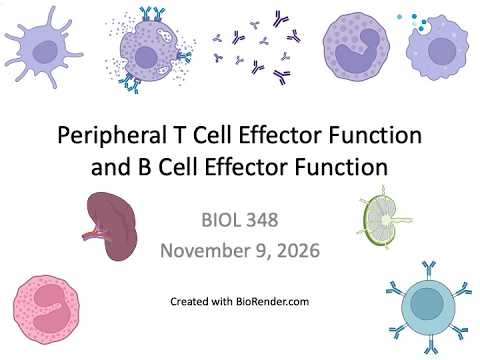
Overview
CD4 T cells polarize into distinct helper subsets according to cytokine signals received during activation, with each subset defined by a polarizing cytokine, a master transcription factor, and characteristic effector cytokines. The lecture compares TH1, TH2, TH17, TFH, and regulatory T cells, then introduces peripheral B-cell activation, follicular dendritic cells, and why T-cell-dependent responses are needed for class switching, memory, affinity maturation, and strong antibody production.
Key takeaways
- CD4 helper T-cell identity follows a signal-to-program chain: a polarizing cytokine induces a master transcription factor, which drives effector cytokines suited to a particular immune response.
- TH1 cells use IL-12, T-bet, and interferon-gamma to enhance macrophage killing and CD8 T-cell responses against intracellular pathogens.
- TH2 cells use GATA-3 and IL-4, IL-5, and IL-13 to activate mast cells and eosinophils, promote mucus and smooth-muscle responses, and target parasites, but can also drive allergy.
- TH17 cells require TGF-beta plus an inflammatory cytokine, induce ROR-gamma-t and IL-17, and recruit neutrophils against extracellular bacteria and fungi.
- Tregs can develop in the thymus from intermediate-high-affinity self-reactive cells or be induced in the periphery by TGF-beta; FOXP3, IL-10, and CD25-mediated IL-2 consumption support their regulatory function.
- Follicular dendritic cells retain free antigen on their surfaces for B-cell recognition, while TFH help enables class switching, memory, affinity maturation, and strong antibody production.
Chapters
- Adaptive responses require antigen presentation, T-cell signaling, cytokine production, proliferation, and differentiation before effector cells reach peripheral tissues.
- Activated CD8 T cells become cytotoxic T lymphocytes, while activated CD4 T cells become helper T cells.
- The lecture plan covers CD4 effector functions and begins peripheral B-cell responses, which continue in the next class.
- Cytokine production is the central effector function shared by CD4 helper T cells.
- Helper T cells can align with target cells and secrete cytokines directionally, similar to the directed granule release of CD8 cytotoxic T cells.
- Different helper T-cell subsets produce different cytokines, making subset identity important to the type of immune response.
- A naive CD4 T cell receives a polarizing cytokine as signal 3, often from an antigen-presenting cell responding to a pathogen-sensing pattern-recognition receptor.
- The polarizing cytokine induces a master transcription factor that directs the subset's effector cytokine production.
- Subset comparisons use four linked features: polarizing cytokine, transcription factor, effector cytokine, and the pathogen or immune response addressed.
- For TH17 polarization, TGF-beta must be paired with IL-6 or IL-23; IL-2 is not treated as a defining polarizing signal.
- IL-12 polarizes naive CD4 T cells toward TH1, inducing the master transcription factor T-bet.
- T-bet drives production of interferon-gamma, the major TH1 effector cytokine.
- Interferon-gamma activates macrophages to kill ingested microbes and supports CD8 T-cell responses against infected cells.
- TH1 activity is useful against intracellular pathogens but can also contribute to inflammatory disease.
- IL-4 is the classical TH2 polarizing cytokine and induces the transcription factor GATA-3; IL-33 may also contribute to TH2 polarization.
- TH2 cells produce IL-4, IL-5, and IL-13, which support mast-cell and eosinophil activity, mucus production, and smooth-muscle contraction.
- Mast cells can degranulate when antigen cross-links antibodies bound to their Fc receptors, helping attack large extracellular parasites such as worms.
- Mucus, sneezing, vomiting, and diarrhea can help expel parasites, while excessive TH2 activity is associated with allergies.
- TH1-derived interferon-gamma and TH2-derived IL-4 influence B-cell class switching; examples discussed include IgG3 and IgG2a for TH1-associated responses and IgG1 and IgE for TH2-associated responses.
- T-bet and the TH1 program inhibit GATA-3 and TH2 cytokines, while GATA-3 and the TH2 program inhibit T-bet and interferon-gamma.
- The balance between TH1 and TH2 activity can redirect the broader immune response, including its antibody isotypes.
- A differentiated TH1 or TH2 cell has already encountered antigen and received its polarizing signals in a lymph node.
- TH17 polarization requires TGF-beta together with an inflammatory signal such as IL-6 or IL-23; TGF-beta alone leads to a different outcome.
- The transcription factor ROR-gamma-t drives the TH17 program, whose defining effector cytokine is IL-17.
- IL-17 promotes neutrophil activity and helps control extracellular bacteria and fungi.
- TH17 responses are inflammatory and are associated with some autoimmune diseases distinct from those linked to TH1 cells.
- TFH means follicular helper T cell: these cells enter B-cell follicles in lymph nodes, where B-cell activation occurs.
- IL-6 or IL-21 can polarize TFH cells, inducing the transcription factor BCL-6.
- TFH cells commonly produce IL-21 and provide the help required for effective peripheral B-cell activation.
- Regulatory T cells, or Tregs, inhibit other immune responses; earlier work called similar cells suppressor T cells.
- The suppressor-cell concept lost credibility after the proposed J-gene was not found in the genome, and the cells were later studied again under the name regulatory T cells.
- FOXP3 is the defining transcription factor that helped establish Tregs as a distinct cell type.
- IL-10 is a prominent cytokine through which Tregs can inhibit other cells.
- Unlike TH1, TH2, TH17, and TFH cells, Tregs can arise through two routes: peripheral induction by TGF-beta alone or development in the thymus.
- Thymic Tregs can form from cells with intermediate-high self-antigen affinity, between cells that are positively selected and those eliminated by negative selection.
- Both routes induce FOXP3, which establishes the regulatory T-cell program.
- The thymic pathway diverts potentially risky self-reactive cells into a role that can restrain immune responses.
- Tregs express high levels of CD25, the alpha chain of the high-affinity IL-2 receptor.
- By consuming IL-2, Tregs can deprive other T cells of a growth signal, in addition to suppressing them through IL-10 and other mechanisms.
- TH1, TH2, and TH17 programs can inhibit one another, while Tregs can suppress multiple response types.
- The balance among helper subsets helps determine the overall character of an immune response.
- B cells leaving the bone marrow enter secondary lymphoid organs, using homing mechanisms such as selectins, chemokines, and integrins to reach them through high endothelial venules.
- After entering a lymph node, B cells move to follicles while T cells occupy a separate T-cell zone.
- Like T-cell activation, B-cell activation begins when the cell recognizes its antigen and starts signaling.
- Free antigen can enter lymph nodes through lymphatic vessels without first being presented on MHC.
- Free antigen is captured in B-cell follicles by follicular dendritic cells, which are distinct from conventional dendritic cells despite their name.
- Follicular dendritic cells do not present antigen on MHC class II; instead, their extensive surface processes provide large antigen-binding surfaces.
- Antigen-binding receptors let follicular dendritic cells retain antigen on their exterior, making it available for B cells to recognize.
- The cells function like antigen-coated scaffolds within the follicle rather than conventional antigen-presenting cells.
- T-cell-independent B-cell responses can occur, but the lecture contrasts them with the more powerful T-cell-dependent response.
- T-cell help is required for the strong proliferation, class switching, memory formation, and affinity maturation associated with effective B-cell responses.
- Somatic hypermutation and production of large quantities of antibody are among the features linked to T-cell-dependent activation.
- TFH help is therefore essential when the goal is to generate high-affinity antibodies or build an antibody-producing cell response.
Transcript excerpt
0:00 All right. Um, hi everybody. Go ahead and get started. Um, just a couple of uh schedule related things um to start out with. So, if you look at um the slides I posted for today, um they have some stuff about peripheral uh T- cells, particularly CD4 cells. Um, and then they go into information about peripheral B cells. Um, and I'm planning on using these slides both today and Wednesday. Um, so know that this one set of slides that I've posted will be for both days. Um, so I expect to talk about the CD4s today and be able to at least get a
0:47 little teensy bit of B cells and then we'll do the rest of the B cells on uh, Wednesday. Um if you look at the schedule um it also has us doing a paper this week on Friday. Um and I have posted a paper um and what you will notice is that the paper that I have posted um and which also of course has some accompanying questions very much relates to today and Wednesday. Um it it fits in really well with the things that are coming up in these other two lectures. And I find this paper um very intriguing though who knows if you will agree with me. Um so we left off thinking about te- cells in the periphery. Um and so we've really been thinking about you know what the heck
1:35 takes so long in our adaptive immune responses. Um we need our antigen presenting cell and our T- cell to both get to the same place of the lymph node. We need our antigen presenting cell to present antigen to acquire the antigen and present it. And then we saw our CD8T cell. Then we needed actual signaling to
This is the start of the transcript. Save this video free for the whole transcript, searchable and time-coded.
In this course
Related notes
Summary, takeaways, and chapters were generated by AI from the video's transcript and may contain errors. The video belongs to its creator, Brianne Barker.