cs6465 Advanced OS - Lecture 05 - Xen Safe Device Access
 Watch on YouTube →
Overview
Anton Burtsev explains how Xen’s split device-driver design reduces the security risk of running complex, bug-prone hardware drivers inside a hypervisor. A guest front-end driver exchanges requests with a back-end in an isolated driver VM through shared ring buffers; Xen grant tables authorize temporary page access, while Xen mediates device interrupts, port I/O, and DMA access. The lecture also covers PCIe MMIO and reports historical overheads of about 8% for safe driver access, rising to roughly 19% on some benchmarks.
Key takeaways
- Xen’s split-driver architecture confines a hardware-driver compromise to a separate driver VM instead of exposing every guest to code running in the hypervisor.
- Shared ring buffers make front-end and back-end communication asynchronous, while event channels provide notifications without requiring a hypervisor exit for every request.
- Grant tables let the guest control policy by authorizing a specific driver domain to map selected pages, while Xen enforces those permissions as the mechanism.
- Safe device access requires restrictions in both directions: drivers must be limited to their assigned hardware, and devices must be prevented from DMA or interrupting arbitrary guest domains.
- The historical evaluation measured about 8% overhead for safe driver access, with some workloads near 19%; that cost becomes more significant as network devices reach 100 Gbps.
- Linux in the driver domain provides existing device-driver compatibility, but it also means the isolated domain retains a substantial operating-system code base.
Chapters
- The lecture examines Xen’s 2004-era safe device-access design, whose ideas remain relevant to Xen, KVM, and Linux.
- Xen introduced split device drivers, with a front-end in a guest and a back-end in a separate driver domain.
- The design trades some I/O overhead for stronger isolation from vulnerable hardware-driver code.
- The original Xen ran as a type-1 hypervisor in ring 0 on 32-bit x86 hardware, before Intel VT-x virtualization support existed.
- Because x86 had sensitive instructions that did not reliably trap, guest operating-system kernels had to be modified to cooperate with Xen.
- Xen Linux variants, including Xenolinux, used explicit hypercalls or shared state to handle operations such as interrupt control.
- Putting a full hardware driver in the hypervisor let guest I/O reach devices without implementing a separate driver for every guest.
- Trap-and-emulate for each device operation was too expensive, so Xen used asynchronous ring-buffer requests instead.
- A guest could enqueue characters or references to DMA buffers and notify the driver domain in batches.
- When a device driver runs in a privileged host kernel or hypervisor, an exploitable driver bug can expose all tenant VMs.
- Drivers are especially risky because they combine hardware-specific complexity with concurrency, interrupts, and power-state transitions.
- A single compromised shared network driver could affect guests belonging to multiple tenants.
- A guest’s front-end driver submits requests through a device channel to a back-end driver in a separate VM.
- The back-end passes requests to the real operating-system driver, which controls the physical network card or disk.
- The separation limits the impact of a real driver compromise to its driver domain rather than the entire virtualized platform.
- Running Linux or FreeBSD in the driver domain reuses existing hardware-driver support instead of reimplementing drivers from device specifications.
- A modern network adapter’s specification can span thousands of pages, while its Linux driver may contain tens of thousands of lines of code.
- The driver domain still has a larger trusted software base than ideal, but the guest-facing back-end and front-end layers can remain relatively small.
- Moving a driver into a separate VM is not sufficient: Xen must restrict which physical devices and memory that VM can access.
- A network driver domain must not control another network card or reach unrelated hardware.
- The physical device must also be prevented from DMA-writing into guest memory or sending interrupts directly to another VM.
- Xen restricts a driver domain’s I/O ports, MMIO mappings, and interrupt configuration to its assigned device.
- The device is confined to DMA and interrupt targets associated with its driver domain, rather than arbitrary guest memory.
- Grant tables let a guest authorize access to selected pages instead of giving the driver domain broad access to guest memory.
- PCIe devices communicate with the CPU through a PCIe controller, which routes device messages and can turn interrupt messages into CPU interrupts.
- Legacy x86 port I/O uses IN and OUT instructions with a 16-bit port number, while modern devices primarily use memory-mapped I/O.
- A device’s BAR reserves an MMIO region; reads and writes to that region are translated into PCIe messages rather than ordinary DRAM accesses.
- A driver allocates request rings in memory and configures device registers in the BAR to point to those rings.
- Updating a device’s doorbell register tells it that new work has been queued.
- The device uses DMA to read or write payload buffers without the CPU copying every byte.
- Xen can map a device’s BAR region directly into its assigned driver domain so the driver can access MMIO registers efficiently.
- In the system discussed, hardware interrupts first entered Xen, which then injected virtual interrupts into the appropriate domain.
- This mediation prevented devices from delivering interrupts directly to unrelated guests.
- Xen used x86 I/O-permission bitmaps in the task-state segment to restrict guest access to port I/O.
- On 32-bit Xen, guest kernels ran in ring 1 and guest applications in ring 3; ring and segmentation behavior affected how port permissions could be enforced.
- Later configurations trapped and emulated port accesses, while most modern device drivers relied on MMIO BAR mappings instead.
- The front-end and back-end map the same physical page containing a ring buffer into both domains.
- A producer index marks newly queued requests, while the consumer tracks which entries it has processed.
- Xen event channels can notify the other domain when requests are pending or a ring needs attention.
- A ring entry can carry a grant reference to a payload page rather than copying the payload into the ring.
- The guest’s grant table records which domain may map a page and whether that access is read-only or read-write.
- The back-end asks Xen to map the granted page; Xen checks the grant, tracks active mappings, and permits access only while authorization remains valid.
- The front-end places a grant reference and disk operation in the shared ring, then can signal the back-end through an event channel.
- The back-end asks Xen to map the authorized page, configures the disk device’s DMA request, and later unmaps the page.
- A completion entry reports the result; the front-end then revokes the grant so the back-end cannot map the page again.
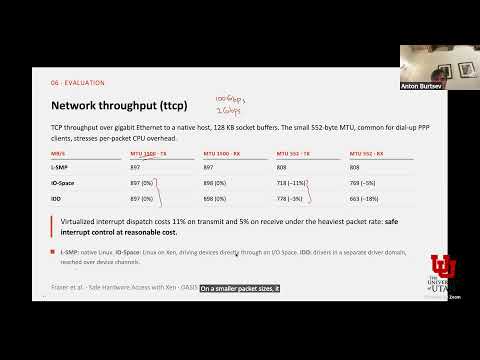
- The paper’s Linux 2.4.26 evaluation found roughly 7% overhead for its I/O-space configuration and about 8% for isolated safe driver access.
- Some workloads, including an HTTP performance benchmark, reached roughly 19% overhead; larger network packets generally showed lower overhead than small packets.
- As device speeds increased toward 100 Gbps, per-batch mapping and communication costs mattered more, motivating direct device assignment and later discussion of VirtIO and passthrough.
Transcript excerpt
0:14 Okay, recording is on. Let me start this. Okay. So today we're discussing this paper and in general like a more general concept of how we implement device drivers in this virtualized architectures. And um like despite the fact that the paper is from 2004,
1:01 it still makes a lot of sense because uh roughly KVM and Linux and many other hypervisors including Zen use something very very similar today. So it's kind of worth paying attention just to to understand that like this is how everything is running. And uh today I want to talk about this paper which is like again a little archaic but uh it introduced this idea of split device drivers but we will come back to it uh hopefully on Monday and then I will explain really how like it's done with what's the difference between this paper and vertio which is currently used in industry like a de facto standard for virtual like for fast uh efficient IO access right and there will a paper
1:50 about vert although like a little bit older paper but still it's worth reading. So anyway so the paper we're talking about today is uh developed by people uh who actually built exam hypervisor. It's a team from Cambridge and uh what they did uh like there is a progression of this work right and uh like let me maybe quickly explain the original XAN architecture like XAN as I was mentioning earlier was arguably the first virtual machine which became programmatically practical meaning that you say look if I have a cloud then uh is the answer to my
2:38 virtualization problems. Right? The reason for that was that uh back then this VMX architecture which we were discussing for the last couple of weeks specifically the hardware support for
This is the start of the transcript. Save this video free for the whole transcript, searchable and time-coded.
In this course
Related notes
Summary, takeaways, and chapters were generated by AI from the video's transcript and may contain errors. The video belongs to its creator, Anton Burtsev.