CS110A Week 1 Day 1 lecture
Overview
Indika Walimuni introduces CS110A as a beginner-friendly computer science course that requires no prior coding or HTML experience and begins Python programming in week four. He explains how to navigate Canvas modules and zyBooks, use course support, manage the roughly 12-hour weekly workload, and learn programming through input-process-output models and step-by-step algorithms.
Key takeaways
- CS110A requires no prior coding experience, and Python programming begins in week four after students study foundations such as hardware, binary, and computer history.
- Canvas modules are intentionally sequential, and launching zyBooks through Canvas helps ensure scores transfer to the Canvas gradebook.
- Although late work is not penalized, completing each module week by week helps prevent assignments from accumulating into an unmanageable backlog.
- A four-credit course represents about 12 hours of weekly effort: four hours in class and eight hours outside class, with Indika Walimuni reporting that four to six focused outside hours often supports success.
- The course teaches students to plan algorithms in English before translating them into Python, using ordered real-world procedures such as making a sandwich or a smoothie.
- Python Turtle provides visible feedback by turning code into drawings, giving beginners a concrete way to connect program instructions with results.
Chapters
- Indika Walimuni says students need no previous coding or HTML experience to begin CS110A.
- Python is the programming language for the course because its syntax is beginner-friendly and relatively close to English.
- Coding begins in week four; early modules introduce foundations such as computer history, binary, and hardware.
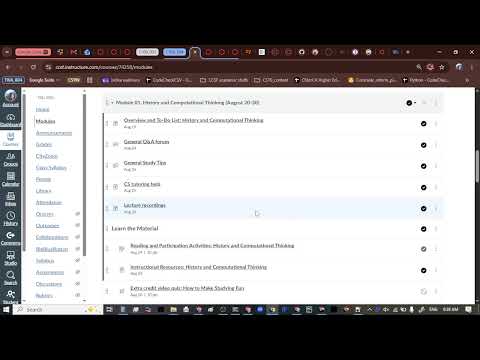
- Canvas modules are designed to be completed in sequence, starting with an overview and ending with a summary.
- The Previous and Next buttons help students follow the intended sequence instead of cherry-picking pages.
- An open circle indicates an item has not been viewed; opening it changes the module status to a check mark.
- Indika Walimuni recommends completing each week's work within that week, even though late work does not lose points.
- The first module extends into the following week because the course begins midweek.
- He expects three teaching assistants and offers office hours and additional meetings by arrangement.
- Students should use the Canvas help or discussion area for logistical problems that may affect the whole class.
- Posting a screenshot alongside a clear description helps document a problem for other students and course staff.
- The module includes lecture recordings and tutoring information, with tutor details to be updated as department hiring proceeds.
- zyBooks is the interactive course textbook, priced at $69 after department negotiations reduced its earlier cost.
- Indika Walimuni says more than 90% of past students recommended the book.
- Course modules also contain lecture recordings, supplemental resources, and video quizzes, including activities worth extra credit.
- Students should open zyBooks from Canvas after logging into Canvas, allowing the external tool to use the active session.
- If zyBooks cannot pass a score back, the grade may appear in zyBooks but not in the Canvas gradebook.
- The launch button may become unavailable after use; refreshing the Canvas page can restore it.
- Students work with a partner on graded team discussions, which receive at least 20 minutes of class time in a typical session.
- Indika Walimuni solves the discussion problem in the next class and posts a solution students can restate in their own words.
- A graded module reflection asks students to consider what went well, what went wrong, and how to improve; it has no right or wrong answers.
- Indika Walimuni holds office hours in the classroom from 11:00 a.m. to 12:30 p.m. after class and is open to one-on-one Zoom meetings.
- He describes mentoring CCSF students applying for internships, including placements at Berkeley National Laboratory and SLAC.
- Students can pursue honors by agreeing with the instructor on an additional project, such as a Python graphics project using Turtle.
- A four-credit class is planned around approximately 12 hours of total effort each week: four hours in lectures and eight outside class.
- The semester outline estimates 210 total course hours across 17.5 weeks, including 70 lecture hours and 140 hours of independent work.
- Indika Walimuni says students who spend roughly four to six hours outside class have generally done well, especially when they study efficiently.
- A Thomas Frank study-skills video argues that studying will not always be fun, but students can make it more engaging.
- Build interest by starting with an accessible or entertaining introduction before tackling technical details.
- Adopt a growth mindset: treat difficult coursework as an opportunity to improve rather than a verdict on fixed intelligence.
- A useful study partner stays focused and checks that both people understand a solution before moving on.
- A pleasant, low-distraction environment can include a preferred study location, suitable background music, or a regular drink-making ritual.
- Plan meaningful rewards in advance, such as time with friends or a game, to create anticipation for completing a study session.
- Python's Turtle package lets students see code produce drawings, such as shapes, as the turtle moves across the screen.
- Indika Walimuni plans to use Turtle after programming starts in week four, making it a visual way to connect code with results.
- The approach applies the study video's advice to make learning more engaging through visible, hands-on outcomes.
- Indika Walimuni describes a basic program as taking input, processing it, and producing output.
- An email example traces typed text and a Send click through an email program and server to a recipient's inbox.
- Input examples include keyboards, microphones, mice, touchscreens, and files; outputs include screens, speakers, and printers.
- Students will first write a problem-solving plan or algorithm in English, then translate it into Python.
- Indika Walimuni calls this the UMPiRE interview strategy and connects it to students solving technical whiteboard problems.
- An algorithm is an ordered sequence of instructions; making a peanut butter and jelly sandwich illustrates why step order matters.
- The class postpones a Turtle exercise and a smoothie-making algorithm activity until the next Tuesday session.
- Indika Walimuni explains that classroom activities are designed to prepare students for assignments in the same module.
- Students are encouraged to make a careful, fine-grained plan for a real-world task before writing code.
- A sample Python Turtle program draws a fish, including its body, eye, and mouth; students are told they can build similar work gradually.
- The displayed code includes loops and imports the Turtle package, but understanding those details is not required for the first exercise.
- Indika Walimuni estimates that students will be able to create this kind of drawing around weeks 11 or 12.
- Students pair with a neighbor, or form a group of three, to follow instructions for the introductory Turtle activity.
- For the next class, students should complete the zyBooks reading and participation work before arriving rather than trying to do it during class.
- The assignment practice involves copying code from Trinket into a Canvas discussion reply; downloading the code is not needed for this initial task.
- Indika Walimuni plans to demonstrate the submission process again on Tuesday and begin solving the same problem with the class.
- Students are encouraged to attend the next Tuesday and Thursday meetings before deciding whether the course is a good fit.
- The first session ends with a reminder that students can ask for help as course activities become more advanced.
Transcript excerpt
0:00 read through the syllabus. Um, this is uh an intro class. If you don't know anything about the computer, this is the class for you to take at city college. Okay? So, uh don't worry about having previous skills of coding. Even HTML you don't need to have. We're going to learn all of them. Okay. Uh actual coding, we're going to use um Python as a um programming tool. uh which is a really educational friendly language. So we request to English. Okay. So um we'll be using that but we're going to um start learning to code starting in week four. Till then we are doing something related stuff like you will see in the first chapter right. So
0:49 uh like um history and then all those stuff and binary and then hardware those stuff right? So um the module structures over here. So let me uh show you that I'm going to collapse all. Okay. All right. These are all the modules I have published all the way up to module four. Okay. So I'll be publishing the rest uh as we move along. Okay. So all of those content are ready. I just need to uh adjust few things like dates right like for example this one February this is coming from the last semester right so I need to change those I'll be changing those okay all right so um so basically this is where you should come
1:36 I would say like you know every day for like 30 minutes right and then do uh do things uh in um in your uh class right so you basically Let's say uh start off with uh this one. So it's the every module has the getting started uh like like you know summary page and you read
This is the start of the transcript. Save this video free for the whole transcript, searchable and time-coded.
In this course
Related notes
Summary, takeaways, and chapters were generated by AI from the video's transcript and may contain errors. The video belongs to its creator, indika walimuni.