Calculus 1000: Indeterminate form 0 over 0 (when quotient law does not work)-(Sec 007, September 28)
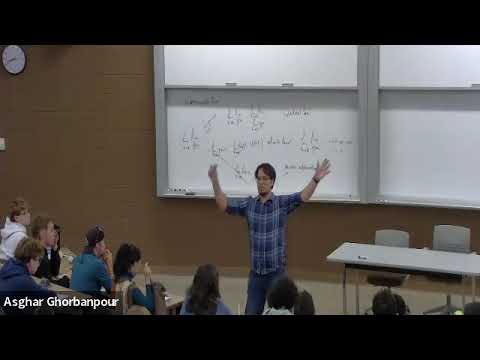 Watch on YouTube →
Overview
Asghar Ghorbanpour explains how to handle quotient limits when the denominator approaches zero: first check the numerator, then distinguish an infinite limit from the indeterminate form 0/0. For 0/0, he uses algebraic transformations—especially factoring and canceling common vanishing factors, conjugates, and trigonometric identities—then reapplies the limit rules to the simplified expression.
Key takeaways
- The quotient law requires the denominator’s limit to be nonzero; if it is zero, evaluate the numerator’s limit before choosing a method.
- A nonzero numerator limit over a denominator approaching zero leads to an infinite-limit analysis, and a sign chart may be needed to determine the one-sided signs.
- The form 0/0 is indeterminate, not an answer; for polynomial quotients, factoring and canceling common vanishing factors is the central technique.
- After simplifying a 0/0 expression, restart the limit decision process rather than assuming the simplified quotient’s limit.
- Conjugates can expose cancelable factors in radical expressions, while identities such as 1 − cos²θ = sin²θ can do the same for trigonometric limits.
- A canceled factor may be zero at the approach point because limits depend on nearby values, not on whether the original expression is defined at that exact point.
Chapters
0:00
Why the Quotient Law Requires a Nonzero Denominator Limit
- Ghorbanpour reviews that the quotient law applies only when the denominator’s limit is not zero.
- A zero denominator limit does not mean the original limit is impossible; it means a different method is needed.
- The main lesson is framed as choosing another tool when the quotient law does not fit.
5:00
Branching from a Zero Denominator: Infinite Limits or 0/0
- When the denominator limit is zero, the next check is whether the numerator limit is zero or nonzero.
- A nonzero numerator over a denominator approaching zero can produce positive or negative infinity, depending on signs.
- If both numerator and denominator approach zero, the expression has the indeterminate form 0/0—not a limit value.
10:00
Recognizing 0/0 in a Polynomial Quotient at x = 1
- Ghorbanpour evaluates the numerator and denominator separately at x = 1 to identify the 0/0 case.
- He emphasizes that writing 0/0 as the answer is incorrect; it signals that the calculation must continue.
- For a polynomial that vanishes at x = a, the factor theorem identifies x − a as a factor.
15:00
Factor and Cancel the Vanishing Factor, Then Recheck
- The polynomial example is factored to expose a shared x − 1 factor, which is canceled before evaluating the limit again.
- After cancellation, Ghorbanpour restarts the decision process by checking the simplified denominator’s limit.
- Canceling is valid in a limit calculation because the point x = 1 itself is excluded while x approaches 1.
20:00
Applying the 0/0 Recipe to a Quotient Near x = 0
- Students work through a quotient of polynomials near x = 0, first testing its denominator and then its numerator.
- Direct substitution shows both limits are zero, so the quotient law still cannot be used.
- Ghorbanpour says L’Hôpital’s rule is not available yet; the class must use algebraic factoring instead.
25:00
Using a Sign Chart to Determine One-Sided Infinite Limits
- After factoring and canceling powers of x, the simplified quotient has a nonzero numerator over a denominator approaching zero.
- A sign chart tests intervals using values such as x = −1, 1, and 3 to track denominator signs around its zeros.
- At x = 0, the worked analysis gives +∞ from the left and −∞ from the right, so the two-sided limit does not exist.
32:00
Transforming a Radical 0/0 Form with a Conjugate
- For a quotient involving √(x² + 4) − 2 over x² as x approaches zero, direct substitution produces 0/0.
- Multiplying numerator and denominator by the numerator’s conjugate uses (a − b)(a + b) = a² − b².
- The transformation exposes a common x² factor and reduces the quotient to one with a nonzero denominator limit.
38:00
Evaluating the Simplified Radical Limit
- After canceling x², the radical example becomes 1/(√(x² + 4) + 2).
- The denominator now approaches 4 as x approaches zero, so the quotient law applies.
- Direct evaluation of the simplified expression gives the limit 1/4.
43:00
Resolving tan²θ/(1 − cos θ) with Trigonometric Identities
- At θ = 0, both tan²θ and 1 − cos θ approach zero, so the original quotient is indeterminate.
- Writing tan θ as sin θ/cos θ and multiplying by 1 + cos θ uses 1 − cos²θ = sin²θ.
- Canceling the resulting sin²θ factors produces (1 + cos θ)/cos²θ, whose limit at zero is 2.
- Ghorbanpour closes by restating the workflow: check the denominator, classify the case, transform 0/0, and apply limit laws again.
Summary, takeaways, and chapters were generated by AI from the video's transcript and may contain errors. The video belongs to its creator, Asghar Ghorbanpour.