10/21/26: Lect-08 (cont.)
 Watch on YouTube →
Overview
Joseph Zambreno connects the evolution of CNN architectures, including VGG, Inception, ResNet, and DenseNet, to practical computer vision tasks. He explains transfer learning and the mechanics of object detection, segmentation, and neural style transfer, emphasizing how pretrained CNN features can be reused and adapted for applications beyond ImageNet classification.
Key takeaways
- ResNet identity shortcuts let deeper CNN blocks learn residual changes or act approximately as no-ops, reducing the risk that added depth degrades performance.
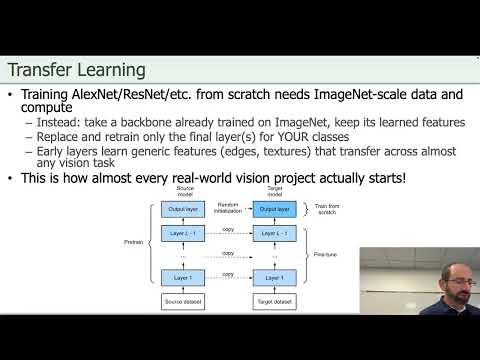
- Transfer learning reuses features learned from ImageNet and adapts a task-specific output layer, avoiding the data and compute demands of training a deep CNN from scratch.
- Object detection combines class prediction with localization: IoU measures box overlap, and non-maximum suppression removes redundant high-overlap predictions.
- Two-stage detectors such as Faster R-CNN separate region proposals from classification, while one-stage methods such as SSD and YOLO predict boxes and classes in one pass for faster detection.
- Segmentation requires pixel-level outputs, so FCNs combine CNN feature extraction with upsampling, often using transposed convolutions to return predictions to image resolution.
- Neural style transfer freezes a CNN and optimizes the input image pixels, using feature activations to balance content preservation against style matching.
Chapters
- VGG stacks 3×3 convolutions to build higher-level features without relying on large kernels.
- Inception processes parallel paths, such as 1×1 and 3×3 convolutions and pooling, then combines their output channels.
- ResNet adds identity skip connections so a block can learn a residual change or approximate an identity mapping.
- Residual connections address degradation in which deeper networks, such as a 56-layer model, can perform worse than a 20-layer one.
- DenseNet connects layers by concatenating feature maps, in contrast to ResNet's additive identity shortcuts.
- ResNet-50 refers to 50 convolutional layers, excluding some activation and normalization layers.
- By the later ImageNet challenge years, leading CNNs reached roughly 2% to 3% error on a benchmark with known dataset limitations.
- ImageNet classification was treated as effectively solved within its constrained benchmark setting, shifting attention toward efficiency and other vision tasks.
- Training AlexNet, ResNet, or DenseNet from scratch requires large datasets and substantial compute, while pretrained models already encode useful image features.
- Transfer learning reuses a pretrained backbone and adapts its output layer to a new dataset or set of classes.
- In fine-tuning, earlier backbone layers may continue updating with a smaller learning rate while a newly initialized output layer learns faster.
- Model choice should fit the task's constraints, such as maximizing accuracy or running a lightweight model on a laptop.
- MobileNet uses depthwise separable convolutions, including one filter per channel, to reduce parameter count.
- EfficientNet scales a model family to create small, medium, and large versions.
- Vision Transformers became dominant around 2021 by representing images as tokenized patches, while CNNs remained useful rather than obsolete.
- The 2022 ConvNeXt study found CNNs could become competitive with Vision Transformers when updated training recipes and data augmentation were applied.
- MixUp blends images and labels, while CutMix combines image regions, extending augmentation beyond flipping, rotation, and brightness changes.
- Training on mixed examples, such as a person-and-cat hybrid, encourages models to handle combinations of visual evidence.
- CNN layers build feature maps with different receptive fields and levels of detail, from local patterns to broader structures.
- Those hierarchical representations make CNNs useful backbones for detection, segmentation, and other computer vision tasks.
- Image classification predicts a label or probability vector for an entire image; object detection identifies multiple objects and their locations.
- A detection output pairs a class prediction, such as bicycle, with a bounding box represented by xmin, xmax, ymin, and ymax or by center, width, and height.
- A sliding-window baseline would pass many image crops through a classifier, but evaluating numerous windows is inefficient.
- Detection must score both the predicted class and how accurately its box encloses the object.
- Intersection over Union, also called the Jaccard index, divides the overlap area of predicted and reference boxes by their union area.
- An IoU of 1.0 means boxes match exactly; low overlap, such as 0.01, indicates a poor localization despite a possible correct class.
- Anchor-based methods generate candidate boxes at multiple locations and sizes, then refine promising boxes; an IoU threshold of 0.5 is a common match criterion.
- Non-maximum suppression sorts detections by confidence and removes boxes that overlap too much with a higher-scoring box.
- Original R-CNN resizes proposed image regions to a CNN's expected input dimensions and runs the CNN separately on each region.
- R-CNN uses CNN-extracted features for classification, but repeated CNN passes make the approach slow.
- Fast R-CNN runs the CNN once on the full image, then pools features corresponding to each proposed region.
- Faster R-CNN further integrates region proposals with CNN feature maps, while retaining a two-stage proposal-then-classification design.
- One-stage detectors predict classes and box offsets in a single forward pass, prioritizing speed over the early accuracy of two-stage methods.
- SSD, or Single Shot MultiBox Detector, predicts scores and box offsets for anchors across multiple feature-map scales.
- Using intermediate feature maps helps detect objects at different sizes, from a large nearby dog to a small distant one.
- YOLO divides an image into a grid and predicts boxes and class probabilities directly, then uses non-maximum suppression to remove duplicate detections.
- Detection benchmarks compare accuracy with speed, often measured in frames per second; early two-stage detectors were generally more accurate, while one-stage models were faster.
- Continued work on one-stage architectures and training recipes narrowed the accuracy gap and enabled real-time video and robotics applications.
- YOLOv3, published in 2018, was presented as a state-of-the-art detector with the deliberately understated title An Incremental Improvement.
- Research papers can be difficult to translate into working code, so the lecture recommends textbook explanations and reproducible implementations for deeper study.
- Unlike classification's single image label or detection's set of boxes, segmentation assigns a class to every pixel.
- Semantic segmentation labels categories such as cat, grass, tree, and sky; instance segmentation additionally distinguishes individual detected objects.
- A fully convolutional network (FCN) maps deep feature channels to class scores, then upsamples its coarse output toward the original image resolution.
- Transposed convolutions can learn this upsampling; an FCN ResNet-50 is an example of a pretrained backbone adapted for pixel-level predictions.
- Neural style transfer combines a content image with a style image to produce an output that preserves content while adopting visual style.
- The method freezes a pretrained CNN and uses backpropagation to optimize the input pixels, calculating gradients with respect to the image rather than the model weights.
- Content and style losses use feature activations from selected CNN layers, with weights controlling the balance between the two images.
- Style-transfer results can vary with optimization and loss weighting; the lecture closes by noting the upcoming exam covers material through this topic.
- The next class week includes Exam 2, with a review planned for Monday and possibly Wednesday.
- Exam 2 follows the format and question count of Exam 1 and covers the next four course topics, through neural style transfer.
- Students are encouraged to choose a personally interesting mini-project and define a feasible measure of success.
Transcript excerpt
0:00 But, let's go ahead and get started. So, Monday we were starting to talk about uh both sort of the evolution uh of convolutional networks as well as uh you know, the corresponding performance they had on image classification task. We continue with that just for a little bit today. There's just a couple uh that we didn't talk about on Monday, and then we'll also slightly transition into uh what the label of this lecture is, which is modern computer vision, which is to say for roughly the same kind of architectures. And uh we'll stop talking about the architectural details and start more about the task of what other tasks are enabled by these modern convolutional uh neural networks. So, uh model-wise, uh there's a couple new things here, but then otherwise it's take whatever you consider reasonably state-of-the-art model, what other things can one do with that model? So,
0:48 it's a slight transition um where we left off in terms of models, we were talking about the the inception block in GoogleNet, which I think was a fairly clever idea, and it does directly lead into this idea. Uh some of the discussion and and sort of negotiation in that period of time was a debate about you know, what kernel sizes made the most sense. Do you start large, work your way small? Do you start small, stay small? And some of those uh evolutionary kind of solutions uh showed that you you can kind of have your cake and eat it, too, in that field, which is the VGG approach showed that, you know, just go with 3 by 3 and just stack a bunch of them, and you get a lot of the same ability to extract higher-level features just by having multiple stacked smaller
This is the start of the transcript. Save this video free for the whole transcript, searchable and time-coded.
Related notes
Summary, takeaways, and chapters were generated by AI from the video's transcript and may contain errors. The video belongs to its creator, Joseph Zambreno.