Why Greece Needed Mythology: Zeus, King of the Gods (Episode 1)
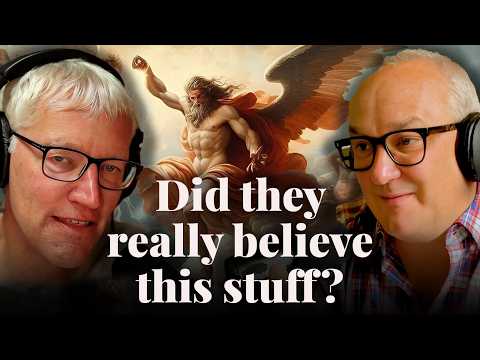 Watch on YouTube →
Overview
Hesiod’s Theogony gives Zeus a canonical origin story, while the episode argues that Greek myth is more than a collection of entertaining tales: Homeric and Hesiodic poetry organized diverse traditions and helped create a shared Greek cultural identity. Zeus’s family violence, authority, sexual misconduct, and divine children also reveal how Greek myths combined older Indo-European and Babylonian influences with the needs of a world divided among competing city-states.
Key takeaways
- Hesiod’s Theogony and Homer’s epics helped give culturally diverse Greek communities a shared mythic framework, even though Greece had no single religious authority.
- The Greek alphabet, adapted from Phoenician writing, made it possible to preserve and reread poetry that had previously circulated orally.
- Zeus’s name connects Greek Zeus Pater with Roman Jupiter and Sanskrit Dyaus Pitar, evidence of a shared Indo-European linguistic inheritance.
- Babylonian traditions appear in Greek myths about divine succession, a twelve-god pantheon, and the division of the cosmos, while the heroic age is presented as a distinctively Greek development.
- Local cities used descent from Zeus’s mortal children—such as Macedon, Megaros, and Arcas—to establish distinctive origins while sharing a universal chief god.
- Greek myths portray Zeus both as a wise enforcer of justice and as a sexually coercive, unfaithful ruler; classical Athenian writers later explored this conflict.
Chapters
0:00
Opening: Zeus, Greek Mythology, and the Episode Setup
- The introduction promises a four-episode exploration of Greek myths, their origins, and what they reveal about ancient Greece.
- An Adobe Express promotion highlights templates, generative AI, and real-time collaboration.
- The hosts announce April live shows about the Titanic in Belfast, Dublin, and Cork.
2:12
Rhea Hides Zeus from Cronus
- Rhea conceals the newborn Zeus in a cave on Crete and gives Cronus a stone wrapped in swaddling clothes.
- Cronus swallows the stone, not realizing Zeus will survive and eventually overthrow him.
- The violent family feud introduces the episode’s central question: where did Greek myths come from?
5:00
Hesiod, the Alphabet, and the Foundations of Greek Poetry
- Hesiod’s Theogony, composed around the eighth century BCE, traces the origins and succession of the gods.
- The Greek alphabet, adapted from the Phoenicians, let poets preserve and circulate works that had previously been oral.
- Hesiod’s account of his family land near Ascra in Boeotia, his dispute with his brother Perses, and his encounter with the Muses on Mount Helicon presents poetry as divinely inspired.
- Homer and Hesiod gave scattered Greek communities a common store of stories and helped shape a shared sense of Greekness.
14:00
Greek Myth as Literature—and a Question of Belief
- Homer’s Iliad and Odyssey focus on heroic action, while Hesiod’s Theogony supplies a deeper backstory about the gods and the cosmos.
- The Greek poets were not priests or scriptural authorities; different cities could preserve different accounts of the gods.
- The episode compares Greek belief in the gods to taking the economy or market for granted: an unseen power that can bring benefits but must be reckoned with.
- Poetic stories could differ without eliminating the widespread conviction that Zeus had a coherent divine reality.
19:35
Gaia, Uranus, and Cronus’s Violent Rise to Power
- In Hesiod’s origin story, Gaia, the Earth, gives birth to Uranus, the Sky, and then to the twelve Titans.
- Uranus confines his children, including the Cyclopes and the hundred-handed beings, provoking Gaia to make an adamantine sickle.
- Cronus castrates Uranus; the blood gives rise to Giants, while sea foam from Uranus’s severed genitals produces Aphrodite.
- The story’s conflicting traditions include Aphrodite’s alternative genealogy as a daughter of Zeus.
23:00
Zeus’s Birth, the Titanomachy, and the Division of the Cosmos
- Cronus swallows his children Hestia, Demeter, Hera, Hades, and Poseidon to prevent a prophecy that one will overthrow him.
- Rhea saves Zeus with the swaddled-stone deception; later traditions place his hiding place in a cave on Crete, protected by armed dancers and fed by the goat Amalthea.
- Zeus frees the Cyclopes, receives their thunderbolts, and leads the Olympians to victory over the Titans after a ten-year war.
- The brothers divide the cosmos by lot: Poseidon receives the sea, Hades the underworld, and Zeus the heavens; Zeus then rules Olympus with Hera.
28:20
Metis, Athena, and the Contradictions in Zeus’s Character
- Zeus swallows the pregnant Metis to avert a prophecy that her child could overthrow him; her wisdom remains within him.
- Athena, Metis’s daughter, emerges fully armed from Zeus’s head and becomes one of his most powerful children.
- Hesiod and Homer portray Zeus as a fatherly guarantor of justice, yet his affairs and assaults—including his relationship with his sister Demeter—make his conduct deeply troubling.
- A mid-episode sponsor break for the London Review of Books and Uber separates the discussion’s first and second halves.
37:13
Why Greek Gods Seem So Human—and Where Zeus Came From
- Greek gods are distinctive for their human bodies and intensely human motives, including jealousy, deceit, desire, and rivalry.
- The poets’ synthesis of divine contradictions helped make Zeus and the Olympians enduring literary characters.
- Sir William Jones’s 1786 comparison of Greek, Latin, and Sanskrit helped establish their shared Indo-European linguistic roots.
- Zeus Pater, Roman Jupiter, and Sanskrit Dyaus Pitar preserve related forms of the name of an ancient sky-father; the episode associates Zeus’s origins with Indo-European peoples from the region of present-day Ukraine.
43:30
Babylonian Influences and the Greek Idea of Heroes
- Greek stories of divine generations overthrowing one another, the division of sky, sea, and underworld, and a pantheon of twelve show parallels with Babylonian traditions.
- Hesiod presents Zeus as driving the Theban and Trojan wars, echoing traditions in which gods bring about successive human disasters.
- The Greek idea of heroes adds a distinctive category: mortals descended from immortals who stand between humans and gods.
- Zeus’s divine children help explain his role in creating a heroic age and then bringing it to an end.
48:00
Zeus’s Heroic Descendants: Perseus and Heracles
- Independent cities claimed descent from Zeus through local heroes, including Macedon, Megaros, and Arcas, gaining a prestigious lineage without claiming Zeus as a local-only god.
- Perseus kills Medusa using Athena’s and Hermes’s help, rescues Andromeda, and becomes king of Argos.
- Heracles completes twelve labors, defeating monsters such as the Nemean lion and Hydra and capturing Cerberus.
- Zeus’s children by Danaë and Alcmene embody his role in cleansing the world of monsters; Heracles later saves the gods from the Giants and becomes a god himself.
57:00
The Moral Problem of Zeus and the Next Episode
- The episode leaves open whether Zeus’s deceitful and coercive affairs can be reconciled with his role as guarantor of justice.
- That tension became a major subject for fifth-century BCE Athenian poets and writers.
- The next episode turns to Thebes, Oedipus, and one of Greek myth’s most dysfunctional families.
- A final membership promotion invites listeners to join the Rest Is History community for early access and other benefits.
Summary, takeaways, and chapters were generated by AI from the video's transcript and may contain errors. The video belongs to its creator, The Rest Is History.