Why 95% of Australia is Empty
 Watch on YouTube →
Overview
Australia has a population of just over 26 million across land comparable in size to the contiguous United States, with roughly 90% living in urban areas covering only 0.22% of its territory. Its sparse settlement reflects arid climate, unreliable rainfall, limited river flows and poor soils, but also geographic isolation and a relatively late, restrictive immigration history; despite these constraints, Australia has extensive farmland and major agricultural exports.
Key takeaways
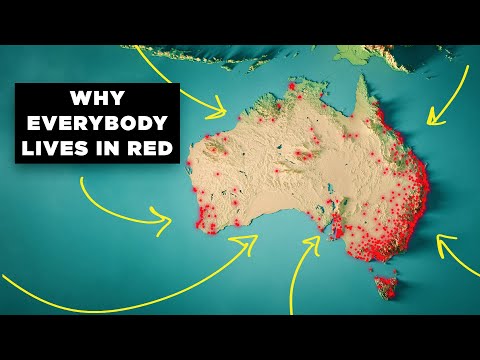
- Australia’s population is exceptionally concentrated: around 90% live in urban areas occupying just 0.22% of the continent, and about 85% live within 50 km of the coast.
- Australia’s dryness results from interacting geographic and atmospheric factors: cold ocean currents, the Great Dividing Range’s rain shadow, low average elevation, subtropical high pressure and El Niño-driven drought.
- The Murray-Darling Basin is vital despite its modest flow: its roughly 24,000 gigalitres of annual water support about 3 million people and Australia’s agricultural heartland.
- Australia is not short of arable land relative to its population: about 6% of its territory is arable, amounting to roughly 1.9 arable hectares per resident, although water and soil quality constrain use.
- Australia’s population growth was shaped by isolation, British colonization beginning in 1788, restrictive immigration policies from 1901 to 1973, and later large-scale migration from Europe and Asia.
- A sparse population has not prevented Australia from becoming a major food exporter, including a leading producer of sheep, wool and beef.
Chapters
- Australia has a little over 26 million people across an area comparable to the contiguous 48 US states, which have more than 300 million residents.
- Sydney, Melbourne, Brisbane, Perth and Adelaide together house nearly two-thirds of Australians; around 90% live in urban areas covering just 0.22% of the land.
- About 85% of Australians live within 50 km of the coast, while the Shire of East Pilbara is roughly Japan-sized but has only a little over 10,000 residents.
- The Pastoral Unincorporated Area is roughly France-sized with about 3,750 residents, and Anna Creek Station is a cattle ranch larger than Israel staffed by only eight full-time employees.
- Cold Southern Ocean currents reduce evaporation over western Australia, while the Great Dividing Range blocks Pacific moisture and casts a rain shadow over the interior.
- Mount Kosciuszko, mainland Australia’s highest point, reaches only 2,228 m, and the continent has the lowest average elevation of any continent.
- Much of Australia lies in the subtropics, where the global subtropical high-pressure belt warms and dries air, making rain formation less likely.
- El Niño can weaken moisture-bearing winds and intensify drought; desert or desert-like conditions cover about 35% of Australia.
- Darwin averages more than 1,800 mm of rain annually, but most falls during the December-to-March wet season; tropical rainfall can vary dramatically between years.
- The Murray-Darling Basin averages about 24,000 gigalitres of annual flow, compared with roughly 530,000 gigalitres for the Mississippi Basin, yet supplies drinking water to around 3 million Australians and supports the agricultural heartland.
- Rising temperatures increase evaporation in the Murray-Darling Basin, while sections can remain dry for months and drought threatens agricultural production.
- Only about 6% of Australia is arable, and ancient, heavily weathered soils make much of northern Australia poor for farming; nevertheless, Australia has roughly 1.9 arable hectares per resident.
- The first people reached Australia around 50,000 years ago, when lower sea levels connected Australia and New Guinea within the prehistoric continent of Sahul.
- Rising seas submerged the land bridge around 10,000 years ago, leaving Australia more isolated; evidence cited includes dingoes arriving from New Guinea and Indian ancestry in some Aboriginal Australian DNA.
- Dutch ships reached Australia in 1606, but the Dutch established no lasting settlement; survivors of the 1656 Vergulde Draeck shipwreck disappeared along the Western Australian coast.
- Britain established a permanent settlement near modern Sydney in 1788, when Australia’s total population was estimated at about 650,000.
- The 1851 gold rush drew migrants from Britain and Ireland, and immigration during the 1850s more than doubled Australia’s population.
- The White Australia policy, introduced in 1901, restricted immigration by race and favored British migrants; the policy was overturned in 1973.
- After World War II, Australia encouraged European immigration, and about 3 million mainland Europeans had arrived by the 1960s.
- By 2022, nearly one in three Australians was born overseas; the population was projected to reach about 36 million by 2050, with ongoing immigration and water stress among the challenges.
- Despite environmental constraints, Australia is a major agricultural producer, with more than 104 million sheep and rankings as the world’s second-largest sheep and wool producer and fifth-largest beef producer.
- Australia contains slightly more than half of the world’s certified organic farmland and is a major producer of almonds and lentils.
- The closing segment promotes HelloFresh meal kits, describing pre-portioned ingredients, reduced shopping and preparation time, and a pecan-crusted chicken recipe.
- The sponsor offer cited is code REIFEL16 for up to 16 free meals and three additional gifts.
Transcript excerpt
0:00 of all the world's continents Australia may be the smallest but it's also the only one to be entirely controlled by just a single country almost everybody knows though that while Australia is a huge place in terms of land it's also a pretty small place in terms of population but few people really understand the absolute scale of how sparsely populated the Australian continent actually is to help put the numbers into some perspective Australia is of a compar able size to the lower 48 US states these 48 US states have a population of more than 300 million people while Australia only has a population of little more than 26 million this means that there are two American states that have more people
0:48 than the entirety of the Australian continent California with more than 39 million and Texas with more than 28 million from our European perspective the population of only England without factoring in any of the rest of the UK is more than double the entire population of Australia despite being an entire continent there are actually seven significantly smaller Islands across the world that have higher populations than Australia Great Britain of course along with honu Luzan mindo Java Sumatra and Madagascar Java alone has nearly six times Australia's tiny population despite being an island that is 6 times smaller than Australia the continent but it still gets even crazier because there's also a bunch of cities
1:38 across the world that right now have more people than the entire continent as well the Tokyo Jakarta and Delhi metropolitan areas all have greater populations than the entirety of Australia well the Shanghai and sole Metro areas have roughly similar populations sou Paulo Mexico City New York City Cairo Lagos Mumbai and Mos all have largely comparable Metropolitan
This is the start of the transcript. Save this video free for the whole transcript, searchable and time-coded.
Summary, takeaways, and chapters were generated by AI from the video's transcript and may contain errors. The video belongs to its creator, RealLifeLore.