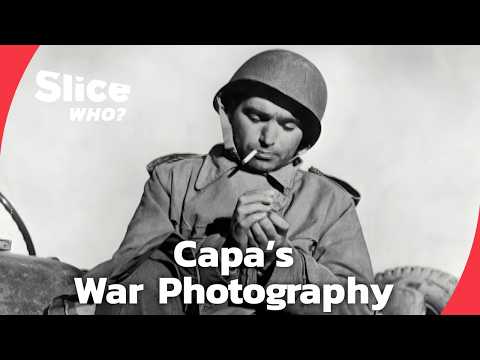
War Through His Eyes: The Intrepid Life and Tragic End of Robert Capa | SLICE WHO | FULL DOCUMENTARY
 Watch on YouTube →
Overview
Robert Capa, born Endre Ernő Friedmann, built his reputation through photographs from five conflicts: the Spanish Civil War, the Sino-Japanese War, World War II, Israel’s War of Independence, and the First Indochina War. His close-range approach produced iconic images—including 11 surviving frames from Omaha Beach on D-Day—while his invented American identity, Gerda Taro’s death, Magnum Photos, and disputed questions about staging reveal the personal and ethical costs of turning war into a career.
Key takeaways
- Robert Capa’s frontline method was built around proximity: his maxim that a photograph could be inadequate if the photographer had not come close enough shaped his work from Spain to Indochina.
- The D-Day archive illustrates both Capa’s risk and the fragility of photographic history: he made about 11 surviving Omaha Beach images after a drying error destroyed most of the submitted film.
- Capa’s career began with an invented identity: Endre Ernő Friedmann and Gerda Taro created the fictional American photographer Robert Capa to improve the marketability of their work.
- The Falling Soldier remains contested: missing negatives, inconsistent accounts, similar frames, and testimony about staged attacks raise doubts, but the documentary presents a case rather than conclusive proof.
- Magnum Photos, co-founded by Capa in 1947, challenged magazine norms by giving photographers control over their images and negatives.
- Capa died in 1954 while covering the First Indochina War, killed by a mine after choosing to accompany soldiers into danger with his camera.
Chapters
0:00
Omaha Beach: Capa’s D-Day Landing and the 11 Surviving Frames
- On June 6, 1944, Robert Capa joined the first wave at Omaha Beach with the 116th Infantry Regiment’s 2nd Battalion.
- Capa stayed on the beach for about 90 minutes, using waterproofed cameras to photograph the assault under fire.
- Of roughly 75,000 photographs made during his career, only 11 D-Day images survived after a darkroom drying error damaged the film.
- After Capa’s death, his brother Cornell restricted access to the archive, while Magnum Photos guarded copyrights and access to the work.
5:50
Endre Friedmann, Gerda Taro, and the Invention of Robert Capa
- Hungarian-born Endre Ernő Friedmann arrived in Spain in April 1936 as a correspondent for the French magazine Vu.
- Gerda Taro, a German Communist exile, helped develop Friedmann’s photography and shaped the polished persona he used professionally.
- To sell photographs at better prices, Friedmann and Taro invented the supposedly American photographer Robert Capa.
- Friedmann’s direct, empathetic images of ordinary people made him a prominent witness to the rise of fascism.
10:00
Spain’s Civil War and the Disputed Falling Soldier Photograph
- Capa and Taro photographed Republican forces and civilian suffering as Franco’s forces attacked during the Spanish Civil War.
- Capa’s 1936–37 Spanish work included the famous image commonly called The Falling Soldier, published as a militiaman was hit by a bullet.
- The photograph’s authenticity has been disputed, with questions about the missing negative, inconsistent accounts, and the soldier’s identity.
- The documentary also cites two similar images and a combatant’s account of staged attacks, presenting evidence that the scene may have been posed rather than settled proof.
18:00
Gerda Taro’s Death, China’s War, and the Fall of Republican Spain
- Gerda Taro died in July 1937, aged 26, after being crushed by a tank while covering the Spanish conflict.
- Her death left Capa grieving and feeling responsible for introducing her to photography and to the war.
- In 1938, Capa photographed Japan’s invasion of China, documenting civilian casualties, hunger, and atrocities including the aftermath of the Nanjing massacre.
- He returned to Spain for the Republicans’ final defeat and photographed fighters crossing into exile in France in March 1939.
24:00
Exile, New York, and Capa’s Long Wait to Return to War
- After Germany invaded Poland in 1939, Capa was in Paris without a new war assignment and was forced into exile again.
- Although he later became an American citizen, Capa felt alienated from the United States and missed Europe and frontline reporting.
- He covered the London Blitz in 1940, but when he reached London in 1942, the bombing raids had largely ended.
- Capa’s wartime absence sharpened the contradiction at the center of his life: he hated war’s suffering yet wanted to be present to photograph it.
30:00
North Africa and Italy: Capa Chases the Image That Made Him Famous
- In spring 1943, Capa travelled with troops to North Africa and photographed the fighting around El Alamein.
- He later covered Allied operations in Italy, including the landings and the destruction left among civilians.
- Capa’s guiding principle was that a photographer had to get close enough; he measured later work against his celebrated Spanish image.
- In October 1943, he photographed the coffins of children killed in the war, an image of civilian loss that stayed with him.
36:00
Normandy’s Campaign and Capa’s Emotional Return to Liberated Paris
- Capa accompanied the 82nd Airborne Division after D-Day, photographing wounded soldiers, ruined towns, and German prisoners.
- On August 25, 1944, he followed General Leclerc’s forces into Paris and kissed a baby offered to him, overcome by emotion.
- Capa’s photographs of Paris’s liberation were less formally composed than some of his combat images, but the city’s freedom felt personal to him.
- After years as a stateless wanderer with a refugee passport, Capa described the liberation as a moment of coming home.
41:00
Ingrid Bergman, Capa’s Public Persona, and Magnum Photos
- After the war, Capa began an affair with Ingrid Bergman, but he quickly rejected Hollywood and returned to photographic work.
- Capa acknowledged that Robert Capa was an invention layered over Friedmann; photographer Myron Davis recalled his careful daily effort to inhabit the persona.
- In 1947, Capa helped found Magnum Photos so photographers could retain control over their images and negatives.
- The agency’s ownership model challenged magazine practices and followed Capa’s anger at seeing his work used without permission in an antisemitic publication.
45:00
Israel’s War of Independence and Capa’s Growing Disillusionment
- Capa travelled to Tel Aviv in 1948 to photograph Israel’s War of Independence, his fourth conflict.
- His images traced Holocaust survivors’ arrival and the mixture of grief and hope among people building a new state.
- Despite his renewed creative energy and Magnum’s success, friends described Capa in the early 1950s as exhausted, financially reckless, and trapped by his celebrity.
- Capa had witnessed so much death that the identity of the fearless war photographer increasingly felt like a burden.
47:00
Indochina: Capa’s Fatal Fifth War and the Mine Blast
- In 1954, Capa agreed to replace a colleague covering French forces in Indochina, despite recognizing that each new war reduced his chance of survival.
- He moved through rice fields with soldiers as French forces were being routed by Vietnamese troops, continuing to photograph under shellfire.
- Capa wandered away from his group and stepped on a mine; he was found with fatal chest and leg injuries, still holding his camera.
- His earlier description of war reporting as a gamble ended with the choice he had made throughout his career: to get close and risk his life for the image.
Summary, takeaways, and chapters were generated by AI from the video's transcript and may contain errors. The video belongs to its creator, SLICE Who?.