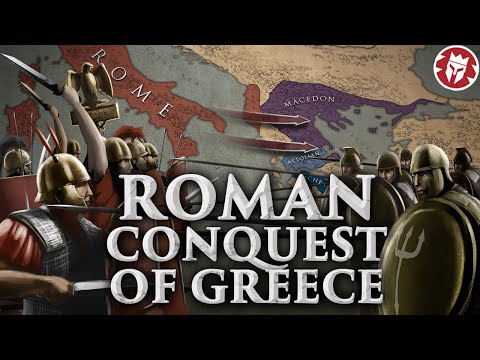
How Rome Conquered Greece - Roman History DOCUMENTARY
 Watch on YouTube →
Overview
Rome’s involvement in Greece grew from the 229 BC intervention against Illyrian piracy into a sequence of wars that dismantled Macedonian and Greek independence. The account traces how Roman alliances, naval power, and the flexible legion defeated Philip V at Cynoscephalae, Antiochus III at Magnesia, and Perseus at Pydna, before Rome made Macedonia a province and crushed the Achaean League at Corinth in 146 BC.
Key takeaways
- Rome’s initial intervention in the eastern Mediterranean grew from the 229 BC campaign against Illyrian piracy, but the Republic used the resulting alliances and informal client relationships to gain lasting influence.
- The Roman Senate repeatedly relied on local rivals, especially the Aetolian League, Pergamon, Rhodes, and later Philip V, to contain enemies before Roman forces could be committed in strength.
- At Cynoscephalae and Pydna, the phalanx could dominate when it remained formed on suitable terrain, but Roman manipular flexibility and close-quarter fighting exploited broken ground and gaps in the pike line.
- Roman sea power was central to the defeat of Antiochus III: victories at Corycus, Eurymedon, and Myonessus isolated Seleucid forces and enabled the Roman crossing into Asia Minor.
- Rome’s victories shifted from imposing client status and territorial restrictions to dismantling states outright: Macedonia became a Roman province after the Fourth Macedonian War, and Corinth was destroyed after the Achaean War.
- Rome’s postwar punishments, including the enslavement of about 150,000 Epirotes and the economic restrictions imposed on Macedon, fostered resentment even as Rome secured control over Greece.
Chapters
- In the 230s BC, Agron united the Ardiaei with allies including Demetrius of Pharos as Epirus weakened.
- Illyrian forces seized Phoenice, while Agron’s death left his wife Teuta governing as regent for his son.
- Piracy from Illyrian coastal bases threatened Roman merchants and prompted the Senate to send the Coruncanius brothers to demand that it stop.
- After a Roman envoy was killed and Teuta refused Rome’s demands, the Republic sent about 22,000 troops and 200 ships in 229 BC.
- Demetrius of Pharos defected to Rome, and Teuta accepted a 228 BC treaty that restricted piracy and fragmented Illyrian power.
- Rome withdrew its troops but left its amicitia, a nominal friendship that functioned as informal client status for allied states.
- Demetrius married Triteuta and became regent, effectively rebuilding the kingdom Rome had weakened.
- He raided Roman-allied territory and, in 220 BC, sent 90 light galleys on a major Adriatic piracy expedition.
- Rome captured Dimallum in seven days in 219 BC; Demetrius escaped by sea and joined Philip V of Macedon.
- Antigonus II Gonatas maintained Macedonian power through a strong fleet and fortresses including Demetrias, Chalcis, and Corinth.
- After Demetrius II died in 229 BC, Antigonus Doson served as regent for the young Philip V and drove Illyrians from Macedon.
- Doson defeated the Aetolian League, secured Macedon’s borders, and died in 221 BC after leaving Philip a resurgent kingdom.
- During the Social War of 220 to 217 BC, Demetrius of Pharos urged Philip V to take the Illyrian coast and attack Italy.
- After Hannibal defeated Rome at Lake Trasimene and Cannae, Philip negotiated an alliance with Carthage.
- Rome discovered the pact when the envoy Xenophanes was captured carrying the treaty back to Macedon.
- Philip attacked Illyria, but Roman commander Laevinus relieved Apollonia and retook Oricum, denying Macedon ports that could threaten Italy.
- When Philip seized Lissus in 212 BC, Rome lacked troops to fight him directly while Hannibal remained in Italy.
- Rome allied with the Aetolian League in 211 BC, offering it captured towns while allowing other anti-Macedonian allies to join.
- After Rome defeated Carthage at Zama in 202 BC, Philip exploited Ptolemaic weakness and expanded into the Cyclades and Asia Minor.
- Rhodes and Pergamon fought Macedon, then appealed to Rome over Philip’s aggression and a reported pact with Antiochus III.
- The Roman assembly initially rejected war, but Consul Publius Sulpicius Galba won approval by comparing Philip’s threat to Pyrrhus and Hannibal.
- Rome demanded that Philip stop making war on Greek states and compensate Pergamon; Philip refused.
- The Second Macedonian War began in 200 BC as Philip captured besieged Abydos, where residents chose mass suicide over Macedonian rule.
- Consul Galba landed about 20,000 Romans at Apollonia, while 50 Roman warships were based at Corcyra.
- Titus Quinctius Flamininus replaced Publius Villius Tappulus after mutiny among 2,000 Roman veterans serving far from home.
- At the Aous River, Philip refused Flamininus’s demand to relinquish Thessaly, which had been Macedonian for about 120 years.
- An Epirote guide, Charops, led 4,300 Roman infantry over a mountain route, forcing Philip to abandon his defensive position and baggage train.
- At Cynoscephalae in 197 BC, Flamininus commanded about 32,000 troops against Philip’s army of roughly 26,000, including 16,000 sarissa-armed phalangists.
- Fog turned an initial skirmish on the ridge into an encounter battle; Philip’s formed right wing pushed back the Roman left.
- A Roman tribune led 20 maniples, about 2,500 men, around the ridge and struck Philip’s victorious phalanx from behind.
- Macedonian losses reached about 8,000 killed and 5,000 captured, while the Romans lost roughly 700.
- At the 196 BC Isthmian Games, Flamininus declared the Greek states free, ungarrisoned, untaxed, and autonomous.
- The declaration won Flamininus public honours, but Rome warned Antiochus III to withdraw from Greek cities and stay out of Greece.
- Antiochus had just expanded through the Fifth Syrian War, taking Ptolemaic territories including Coele-Syria and holdings in Asia Minor.
- Antiochus crossed the Hellespont, took Chersonesos and Madytos, and rebuilt Lysimacheia to secure the Gallipoli Peninsula.
- Rome demanded that he leave Europe and return former Ptolemaic territories, while Antiochus argued that his marriage to Ptolemy V’s daughter secured peace with Egypt.
- Antiochus cultivated Cappadocia and Galatia; exiled Carthaginian general Hannibal arrived at his court in 194 BC.
- The Aetolians, wary of Rome’s ties to the Achaean League, invited Antiochus to liberate Greece and settle their dispute with Rome.
- Antiochus crossed the Aegean in 192 BC and was elected leader of the Aetolian League, but found few other Greek states willing to join him.
- The Achaean League stayed with Rome, and conflict between pro-Roman and pro-Seleucid factions in Athens ended with the Roman-aligned side prevailing.
- Roman praetor Marcus Baebius brought more than 20,000 troops to Apollonia to deter Antiochus and keep Macedon in check.
- When Baebius sent 500 legionaries to reinforce Chalcis, Antiochus blocked the Euripus Strait and moved south.
- Seleucid forces surrounded and destroyed the Roman detachment near Delium, marking the beginning of the Seleucid War.
- After gaining control of parts of Euboea and Thessaly, Antiochus chose Thermopylae, a narrow pass that could be outflanked by mountain routes.
- In 191 BC, consul Manius Acilius Glabrio attacked frontally while Marcus Porcius Cato and Valerius Flaccus led separate forces toward the passes.
- Cato’s force broke through at Mount Callidromus; the Seleucid phalanx lost its rear, and Antiochus fled with his cavalry.
- More than 10,000 Seleucid and Aetolian troops were killed or captured, and Rome later took Heraclea after a 23-day siege.
- After Thermopylae, Antiochus returned to Asia in May 191 BC as Roman forces retook Greek territory and an allied fleet attacked his supply routes.
- The Aetolians continued resisting with Seleucid money, while Roman praetor Gaius Livius Salinator assembled a fleet of more than 100 ships.
- At the Battle of Corycus, a combined Roman and Pergamene fleet of about 160 ships defeated Polyxenidas and captured the initiative.
- Seleucid admiral Polyxenidas surprised a Rhodian fleet near Samos, but the success did not prevent the Roman-Pergamene fleet from pursuing him.
- Hannibal assembled a 50-ship fleet for Antiochus, but Rhodes defeated it at Eurymedon, the last naval battle of Hannibal’s career.
- At Myonessus, Roman boarding tactics and heavier ships cost Polyxenidas about a third of his fleet, leaving the Seleucids outnumbered at sea.
- Consul Lucius Cornelius Scipio, accompanied by his brother Scipio Africanus, led the Roman campaign into Asia Minor in 190 BC.
- Macedonian king Philip V supported Rome with supplies and 2,000 troops in exchange for relief from war indemnities and the release of his son Demetrius.
- After crossing the Hellespont, the Scipios rejected Antiochus’s offer to pay half of Rome’s war costs and surrender only some territories.
- Roman and Seleucid forces clashed at the Hermos and Phrygius rivers as Antiochus concentrated troops near Magnesia.
- At Magnesia in December 190 BC, modern estimates put both armies near 70,000, despite ancient claims that the Seleucids had twice Rome’s numbers.
- Seleucid scythed chariots lost cohesion when Roman skirmishers scattered, and camel archers’ animals panicked the chariot horses.
- King Eumenes of Pergamon broke the Seleucid left, while Antiochus’s cavalry initially routed the Roman left but failed to prevent the center from encircling the phalanx.
- Antiochus’s defeat led to a 189 BC settlement requiring withdrawal beyond the Taurus Mountains, a 15,000-talent indemnity, a 10-ship navy, and 20 hostages.
- Rome defeated the Aetolian League in 189 BC, stripping it of about half its territory and requiring Roman approval for foreign policy.
- Philip V’s son Demetrius returned from Rome as a Romanophile, creating a court faction opposed to Perseus and Philip’s supporters.
- Philip ordered Demetrius poisoned in 181 BC after accusations of plotting to flee to Rome, intensifying tension with the Republic.
- Perseus became king in 179 BC and sought recognition from Rome while renewing alliances with Greek states.
- He married into the royal houses of Bithynia and the Seleucids, alarming Pergamon and its king, Eumenes II.
- Eumenes warned Rome that Macedon had rebuilt its strength, and Roman envoys used a false appearance of peace to gain time to prepare for war.
- The Third Macedonian War began in 171 BC as consul Publius Licinius Crassus led Rome’s campaign against Perseus.
- At Callinicus, Thracian cavalry under Cotys IV broke the Roman right, while Perseus’s elite agema troops routed the center.
- Perseus withdrew instead of committing his phalanx; Roman losses were about 2,000 infantry and 200 cavalry, compared with roughly 60 Macedonian dead.
- Roman forces suffered setbacks through 169 BC, while Perseus raided the fleet at Oreus and damaged Roman ships and grain supplies.
- Consul Lucius Aemilius Paullus took command in 168 BC with about 22,000 legionary heavy infantry, 4,000 cavalry, and 22 elephants.
- Paullus sent Publius Cornelius Scipio Nasica through a mountain pass with about 8,500 troops to threaten Perseus’s position near Mount Olympus.
- After the pass fell, Perseus withdrew and formed a new defensive line near Pydna, behind a river and on ground favorable to his phalanx.
- Perseus brought about 44,000 infantry and 4,000 cavalry to Pydna, including 21,000 phalangists; Paullus commanded a smaller Roman-allied force with 22 elephants.
- After an eclipse unsettled the Macedonians but not the Romans, a fight over a runaway mule sparked the battle.
- Paullus first withdrew from the phalanx’s advance, then used elephants and cavalry against Perseus’s exposed left as the phalanx entered rough terrain.
- Gaps opened in the Macedonian line, allowing Roman legionaries to attack at close quarters; about 20,000 Macedonians died and 11,000 were captured, including Perseus.
- Rome dissolved the Antigonid monarchy and split Macedon into four semi-states barred from independent foreign policy, interregional trade, and intermarriage.
- Restrictions on mining, logging, and shipbuilding, along with tribute payments, weakened Macedon’s economy.
- Rome destroyed 70 Molossian cities and enslaved about 150,000 Epirotes for supporting Perseus, deepening anti-Roman resentment.
- In 150 BC, Andriscus claimed to be Philip, son of Perseus, and sought support to restore the Antigonid monarchy.
- After failing to gain support in Macedon and being briefly detained, Andriscus found allies among Thracian chiefs opposed to Roman influence.
- He defeated pro-Roman Macedonian forces in Odomantice in 149 BC and took the throne as Philip VI, beginning the Fourth Macedonian War.
- Andriscus invaded the Roman-allied Thessalian League while Rome’s strongest forces were occupied at Carthage and in Spain.
- Praetor Quintus Caecilius Metellus landed in Macedon in 148 BC using Pergamene transports, threatening Andriscus’s kingdom from an unexpected direction.
- At Pydna, Andriscus’s cavalry initially gained the advantage, but commander Telestes defected and exposed the Macedonian center to attack.
- Metellus captured Andriscus, ended the Fourth Macedonian War, and established the province of Macedonia in 148 BC.
- After Sparta sought Roman help to leave the Achaean League, Rome demanded that Argos, Corinth, and Orchomenus be separated from it.
- The Achaeans rejected Rome’s terms and declared war in 146 BC; Metellus defeated Critolaus at Scarpheia, and Lucius Mummius crushed Diaeus near Corinth.
- Rome destroyed Corinth, killed its men, enslaved its women and children, and disbanded the Achaean and Aetolian Leagues.
- The region was added to the province of Macedonia; Roman rule lasted for centuries while Greek culture continued to shape later Roman and European history.
Transcript excerpt
0:06 History of the human race has thousands of different conquests across ages, regions, and cultures, but it is difficult to find one that played such a decisive role in the future events as the conquest of Greece by the Roman Republic, as its effects echoed through the millennia. Welcome to our video that will cover the first Roman involvement in the Greek affairs, four Macedonian Wars, Seleucid War, Aetolian War and Achaean War. These long videos take forever to make, so please kindly consider sharing it in your social media. The year is 231BC and the Mediterranean world is a land of continuous warfare and political upheaval. Just ten years before, the burgeoning power of the Roman Republic had defeated Carthage in the First Punic War, establishing naval dominance on the sea.
1:01 In the east, the Hellenistic kingdoms - Macedon, Ptolemaic Egypt and the Seleucid Empire vie for dominance over their border territories. Sandwiched between these greater polities are a number of smaller states, such as Pergamon and the nominally independent Greek city-states. This is the world of the late 3rd century BC, but soon a series of conflicts between two rising powers - Rome and Macedon, will change the fate of the region forever. The which was Illyria - currently modern Albania and Dalmatia, was regarded in the mid to late third century as a thoroughly barbarian region, only half civilised by contact with its Greek and Macedonian neighbors. Though contact with the Greek world had led to a degree of urbanisation in the south and along the coast, the region in a political sense was still made up of many small tribal
1:55 chieftains. The population of Illyria had been regarded since their initial encounters as turbulent and warlike by the more traditionally civilised peoples who came to know them.
This is the start of the transcript. Save this video free for the whole transcript, searchable and time-coded.
Summary, takeaways, and chapters were generated by AI from the video's transcript and may contain errors. The video belongs to its creator, Kings and Generals.