Tissue Repair, Fibrosis & Healing 2of2 Fall 2026
 Watch on YouTube →
Overview
Robert Kellar explains how tissue healing progresses through coagulation and inflammation, cell migration and proliferation, and remodeling, distinguishing full regeneration from scar-forming repair while emphasizing that outcomes can blend and remain modifiable for about a year. He connects those phases to clinical technologies including Dermagraft, placental amniotic-membrane grafts, and cell-derived regenerative fluid, with examples involving chronic wounds, blood-vessel formation, cartilage, and bone.
Key takeaways
- Wound resolution restores tissue structure and function, while repair closes damage with altered collagen and fibrosis; real outcomes can contain both processes.
- Perfusion strongly shapes healing: vascularized bone and skin recover more readily than poorly vascularized tendons and ligaments, and Dermagraft-associated fibroblasts promoted VEGF-linked vessel formation.
- Dermagraft combined a resorbable Vicryl scaffold with human dermal fibroblasts, and a reported diabetic heel ulcer that had persisted for six months closed after eight weeks of weekly treatment.
- Acellular fluid collected from cultured mesenchymal stem cells carries growth factors and cytokines without delivering living cells, enabling room-temperature storage and avoiding cell viability during shipment.
- Inflammation is necessary to initiate healing, but chronic inflammation can impede progress; Kellar's approach emphasized moderating it with factors such as interleukin-10 and interleukin-1 receptor antagonist rather than fully suppressing it with corticosteroids.
Chapters
0:00
Repair Versus Resolution: Regeneration and Scarring
- Robert Kellar distinguishes resolution, or regeneration with restored tissue function, from repair that closes a wound through scar tissue or fibrosis.
- The outcomes are not mutually exclusive: a wound can combine regeneration and repair, and its course may be modulated before healing approaches a steady state at roughly 360 to 365 days.
- The opening also covers course logistics, including post-quiz 3 due that evening and exam one scheduled for two weeks later.
6:00
Three Phases of Wound Healing and Collagen Remodeling
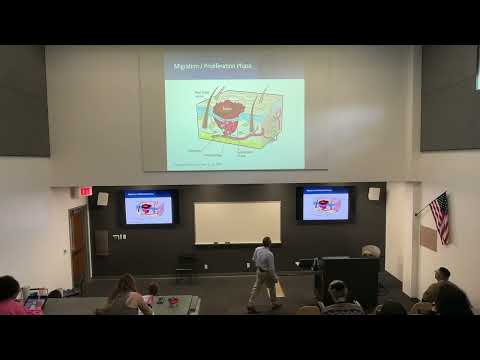
- The phases are coagulation and inflammation, migration and proliferation, then remodeling and maturation.
- Platelets release platelet-derived growth factor (PDGF), neutrophils arrive early, and monocytes entering tissue develop into macrophages.
- The migration and proliferation period is also called granulation because the wound contains many incoming cells.
- Remodeling deposits new collagen and scaffolding differently from the original tissue architecture, producing fibrosis or a visible scar.
12:00
Treating Full-Thickness Wounds with Closure and Grafts
- For a full-thickness wound that can be closed, clinicians approximate the margins, close deeper layers first, and finish with superficial sutures.
- Severe burns may prevent approximation, making autologous skin grafting a first choice because tissue taken from the same patient has a very low rejection risk.
- Alternatives include allografts from the same species, amniotic membrane from donated placenta, and porcine or bovine tissue.
- Cells are removed from many allografts and animal-derived grafts to reduce immune rejection triggered by foreign surface antigens.
17:00
Dermagraft: Fibroblasts on a Resorbable Vicryl Scaffold
- Advanced Tissue Sciences developed Dermagraft using human dermal fibroblasts seeded onto a bioabsorbable Vicryl scaffold.
- The fibroblasts came from screened, discarded circumcision tissue and could be expanded into a master cell bank for large-scale production.
- In a UCLA diabetic heel-ulcer example, the ulcer had remained open for six months before enrollment; weekly treatment continued for eight weeks, after which the wound was closed.
- Diabetic neuropathy can hide foot injuries, while poor perfusion makes ulcers especially difficult to heal.
23:00
Blood Flow, Vascular Growth, and a Facial Chainsaw Injury
- Kellar identifies perfusion as a key determinant of healing: vascularized bone and skin tend to recover better than poorly vascularized tendons and ligaments.
- Laser Doppler images of a diabetic foot wound show cool, low-flow regions initially and warmer colors entering the wound bed over about five weeks as new vessels form.
- Fibroblasts on the Dermagraft scaffold produced vascular endothelial growth factor (VEGF) and supported more vessel growth than the scaffold alone.
- A chainsaw injury crossing the nose and upper lip was treated with Dermagraft; at one year, hair follicles had regenerated in some areas while residual scarring and nasal symptoms showed the outcome was a blend of regeneration and repair.
30:00
Placental Amniotic Membrane and Cell-Derived Regenerative Fluid
- Kellar describes a later company that used donated placentas from consenting mothers, retaining the amniotic layer and discarding the more inflammatory chorionic layer.
- Amniotic membrane grafts were offered as single or double layers; the double layer provided greater tensile strength for applications requiring sutures.
- Mesenchymal stem cells isolated from the graft were cultured to release growth factors and cytokines, which were collected as an acellular regenerative fluid.
- Because the fluid contained no living cells, it avoided cell-preservation requirements and could be packaged at room temperature and shipped without dry ice.
37:00
Growth Factors and Regenerative Fluid Assays
- Time-lapse microscopy showed cultured stem cells releasing vesicles containing signaling molecules, including angiogenic and inflammation-modulating factors.
- The described signaling pathways included EGF for cell growth and differentiation, PDGF for proliferation, and TGF-beta for proliferation, extracellular-matrix production, and remodeling.
- In a 24-hour bench assay, regenerative fluid approximately doubled dermal fibroblast metabolic activity; cartilage-producing chondrocytes showed about a 20 percent activity increase.
- Synovial-cell assays reported increases in DNA per well of roughly 28 percent and 57 percent at measured time points, which Kellar linked to greater synovial activity and fluid production.
44:00
Angiogenesis, Matrix Regulation, and Controlled Inflammation
- In endothelial-cell network assays, regenerative fluid produced about a twofold to four-and-a-half-fold increase in network measures compared with controls, including VEGF as a positive control.
- Matrix metalloproteinases and their inhibitors help regulate remodeling; Kellar cites tissue inhibitor activity as a brake on excessive matrix breakdown associated with ventricular dilation.
- The fluid's reported antimicrobial mechanisms included neutrophil-derived myeloperoxidase and complement component C3b, which helps target bacteria.
- Kellar argues for modulating chronic inflammation with factors such as interleukin-10 and interleukin-1 receptor antagonist rather than eliminating inflammation with corticosteroids, because acute inflammation helps initiate healing.
48:00
A Chronic Ankle Wound Closed After About a Year
- A 47-year-old woman with diabetes, smoking and alcohol use, and other comorbidities had a surgical ankle wound that remained open for nearly a year.
- In August 2018, clinicians packed the wound with amniotic membrane and injected acellular regenerative fluid into the wound bed and margins.
- Releasing incisions helped approximate swollen tissue; the wound initially remained red, which Kellar interpreted as evidence of blood flow rather than a reason to suppress all inflammation.
- Follow-up through September 2019 showed complete closure, illustrating that a difficult chronic wound could take about a year to heal.
51:00
Bone Healing Shares Skin's Inflammatory and Remodeling Phases
- A 39-year-old man with a fibular fracture reportedly had no pain and full range of motion 30 days after treatment, faster than the commonly cited six-to-eight-week recovery.
- Kellar compares skin healing with bone healing: both involve inflammation, a proliferative or callus-forming phase, and later remodeling.
- Bone callus develops from soft to hard before remodeling, paralleling the broader wound-healing sequence.
- Across tissue types, improving blood flow to ischemic tissue is presented as a central strategy, including for organs such as the heart, kidney, liver, and spleen.
54:00
Axolotl Regenerative Medicine and an Ankle Arthritis Trial
- The company Axolotl took its name from a salamander known for regenerating limbs and substantial portions of its heart; the animal was a mascot, not an ingredient in its products.
- Kellar reports that the regenerative-fluid technology was used in joints, spine, surgical settings, and wounds, and that the company had five products on the market.
- After an FDA pre-IND meeting, a phase 1/2 study enrolled about 12 patients at three sites to investigate ankle arthritis, an area with limited options.
- For severe ankle arthritis, the options described were joint fusion or artificial ankle replacement; patients who were poor surgical candidates could have few alternatives.
58:00
Reported Safety, Aging, and Future Regenerative Therapies
- Kellar reports that roughly 30,000 patients had received the technologies, with about two dozen complaints, mostly temporary injection-site irritation or stinging.
- He argues that aging reduces the body's capacity to heal and that regenerative technologies may help older patients whose normal repair processes have weakened.
- His research path moved from discarded foreskin tissue to donated amniotic membrane and then umbilical cord tissue as sources for regenerative products.
- Kellar expects regenerative medicine and approaches that modulate the body's own healing response to become more widely used, while noting that the next class will cover the immune system.
Summary, takeaways, and chapters were generated by AI from the video's transcript and may contain errors. The video belongs to its creator, Robert Kellar, Ph.D..