The Thrilling Early Days of Motor Racing | Shell Historical Film Archive
 Watch on YouTube →
Overview
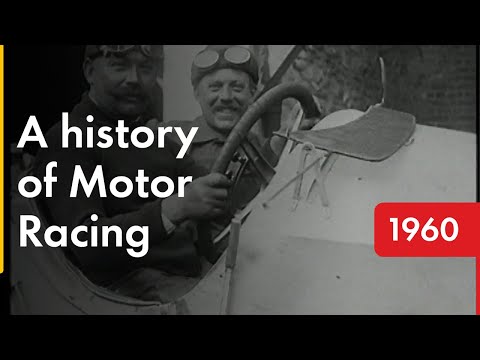
Early motor racing grew from city-to-city contests into international Grand Prix competition, pushing manufacturers to build faster cars and drivers to endure long, dangerous races. The history follows contests for the Gordon Bennett Trophy and French Grand Prix through drivers including Camille Jenatzy, Felice Nazzaro, Ferenc Szisz, and Georges Boillot, while showing how tire design, road holding, fuel rules, and car weight shaped results.
Key takeaways
- Early manufacturers often pursued speed with huge engines in lightweight chassis: some Grand Prix cars had 18-liter engines, while the 1908 French rules set a minimum weight of just over one ton.
- Equipment could decide races as decisively as engine power: detachable wheel rims reduced tire changes from as long as 15 minutes to about two minutes.
- Ferenc Szisz’s Renault won the 1906 French Grand Prix through steady performance over two days and roughly 800 miles, demonstrating the value of reliability and endurance.
- Fuel-consumption rules in 1907 and weight regulations in 1908 were attempts to address the danger and expense of racing, but neither eliminated the risks of high-speed competition.
- Georges Boillot’s Peugeot victories in 1912 and 1913 showed that road-holding and handling could defeat larger-engined cars, marking a shift in racing design priorities.
- The 1914 French Grand Prix ended with Christian Lautenschlager’s Mercedes leading a German 1–2–3, just as the era of pioneering prewar racing came to a close.
Chapters
0:00
City-to-City Racing and the Gordon Bennett Trophy
- The 1902 Paris–Vienna race drew more than 100 cars, from standard touring models to purpose-built racers designed around a one-ton weight limit.
- Early cars reached speeds of about 90 mph, with manufacturers pursuing speed through larger engines in lightweight chassis.
- After the deadly Paris–Madrid race was abandoned, the Gordon Bennett Trophy used closed-circuit racing; Camille Jenatzy won for Germany in a Mercedes in 1903.
4:00
Leon Théry Wins for France as the Grand Prix Era Begins
- The Gordon Bennett teams used trials to select entries, while national pride drew crowds and even the German Kaiser to the start.
- French driver Léon Théry’s Richard-Brasier outpaced Jenatzy’s Mercedes, returning the Gordon Bennett Trophy to France.
- France followed its success with the 1906 French Grand Prix, an 800-mile, two-day test of drivers and cars.
7:03
Ferenc Szisz and Renault Triumph in the 1906 French Grand Prix
- The Grand Prix field included 23 French cars alongside entries from Italy and Germany; some engines displaced as much as 18 liters.
- Renault driver Ferenc Szisz led through heat, dust, and mechanical failures, while tire changes exposed a major equipment advantage: detachable rims could cut a change to about two minutes, compared with as much as 15.
- Szisz won ahead of Felice Nazzaro in a Fiat, and his consistency earned him the nickname “the chronometer.”
13:25
Fuel Limits, the Kaiserpreis, and Mercedes’ 1908 Grand Prix Victory
- Germany’s Kaiserpreis offered a rival national showcase; Nazzaro won its 1907 race in a Fiat after passing Belgian driver Camille Jenatzy near the finish.
- The 1907 French Grand Prix limited fuel consumption, but drivers soon abandoned economy for speed; Nazzaro won again in a Fiat.
- For 1908, organizers imposed a minimum weight of just over one ton, yet Christian Lautenschlager’s Mercedes led a German sweep of first, second, and third.
20:43
Brooklands, Hill Climbs, and the Spread of British Motor Racing
- Brooklands, opened in 1907, gave British manufacturers a venue for sustained high-speed testing; Percy Lambert later became the first driver to cover 100 miles in an hour.
- Motorsport also grew through American track meetings, British hill climbs, and amateur events at venues such as Shelsley Walsh.
- Smaller voiturette cars gained attention as more than shopping vehicles, while accidents and improvised roadside repairs revealed the sport’s risks and demands.
23:51
Georges Boillot’s Peugeots and the Dramatic 1914 French Grand Prix
- After the 1911 Grand Prix at Le Mans failed to produce a full-distance finisher, racing returned with a shift toward smaller, more controllable cars.
- Georges Boillot won the 1912 and 1913 French Grand Prix in Peugeot cars, whose road-holding helped defeat larger-engined rivals; Sunbeams also placed strongly.
- In 1914, Mercedes driver Christian Lautenschlager recovered from early setbacks to beat Boillot, while Mercedes cars took the first three places in the final race before the First World War.
Summary, takeaways, and chapters were generated by AI from the video's transcript and may contain errors. The video belongs to its creator, Shell.