The secret to concentration - How to increase your attention span | DW Documentary
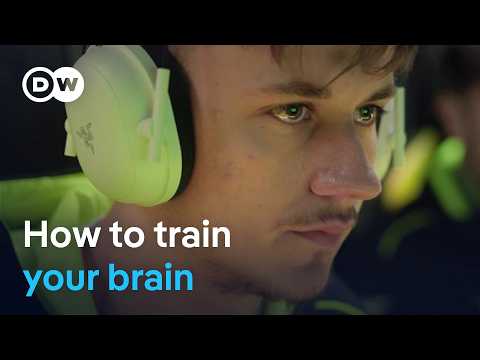 Watch on YouTube →
Overview
Neuroscientist Henning Beck explains concentration as repeatedly filtering distractions rather than maintaining uninterrupted focus, while athletes, an air traffic controller, and e-footballer Dennis show how routines, recovery, and deliberate practice help sustain performance. Researcher Corinna Peifer examines flow as a balance between challenge and skill, and the documentary argues that focus improves through conscious habits—but works best alongside rest and room for the mind to wander.
Key takeaways
- Concentration is not uninterrupted focus: Henning Beck describes it as a series of short attention sprints in which the brain repeatedly suppresses distractions.
- Routine reduces the energy spent on familiar decisions; Angelina Köhler uses consistent pre-race music and self-talk, while mental imagery helps her refocus during difficult training days.
- Multitasking imposes a switching cost because the brain must reorient after changing tasks, which can reduce processing capacity and increase mistakes.
- Flow is most likely when an activity is challenging but still manageable; trying too hard to force the state can create tension and undermine performance.
- Recovery is part of concentration: high mental demands call for downtime, and Köhler limits social media because endless scrolling makes her feel restless.
- The documentary’s central prescription is balance: build focus with practice and routines, but also allow breaks and mind-wandering, which can support creativity.
Chapters
0:00
Henning Beck Defines Concentration as Filtering Distractions
- Neuroscientist Henning Beck describes concentration as sorting sensory input and suppressing distractions to prioritize one task.
- Beck says focus depends on being rested and having a goal; the brain sustains it in short bursts, then must suppress new distractions again.
- Swimmer Angelina Köhler, the 2024 world champion in the 100-meter butterfly, describes rebuilding after the Paris Olympics, where she finished fourth.
4:00
Swimming Technique, Brain Control, and Air Traffic Alertness
- Köhler’s training requires precise technique: laps, breathing, and body position must be controlled or she loses speed.
- Beck links attention to the prefrontal cortex, which supports planning and self-control, and to dopamine’s role in motivation and concentration.
- Air traffic controller trainee Jan Peter Konopinski coordinates with pilots, airport staff, and ground vehicles while handling rapidly changing traffic.
- Konopinski must shift from quiet periods to complex situations within seconds; Beck says genes affect cognitive ability, but practice and environment matter too.
10:00
Routines and Visualization Help Köhler Manage ADHD
- Mental coach Thomas Baschab says repeated routines provide security and conserve mental energy by automating familiar decisions.
- Köhler uses a calming image of aspen leaves in sunlight for two or three minutes to regain focus when her thoughts drift during training.
- Sports psychologist Monika Liesenfeld works with Köhler on pressure and ADHD, which can make it harder to prioritize incoming stimuli.
- Before races, Köhler listens to familiar music, acclimates to the pool’s noise, and repeats encouraging self-talk.
16:00
E-Football Reveals the Cost of Multitasking
- Professional e-footballer Dennis trains for hours a day and must recall hundreds of controller combinations while making split-second decisions.
- Beck explains that multitasking is rapid task-switching, not doing multiple complex tasks simultaneously; each switch creates a “switching cost.”
- Reorientation after switching leaves the brain briefly less prepared, increasing the chance of mistakes in demanding situations.
- Air traffic controllers need frequent, extended breaks after intense shifts; Dennis uses real-world football to clear his head from e-sports pressure.
23:00
Digital Feeds, Mental Recovery, and Attention Balance
- Beck says the brain uses nearly 20% of the body’s energy despite making up about 2% of its weight; prolonged mental effort can contribute to tension and exhaustion.
- Köhler manages recovery with sleep, reading, and limits on social media, noting that scrolling Instagram and TikTok makes her restless.
- Endless-scroll platforms have no natural stopping point, while books and films do; Beck connects short bursts of media with difficulty sustaining attention on longer tasks.
- Beck argues that humans benefit from balancing focused attention with awareness of their surroundings, which can support exploration and new ideas.
28:00
Corinna Peifer Studies the Conditions for Flow
- Psychology professor Corinna Peifer defines flow as deep immersion in an activity whose demands are challenging but manageable.
- Because flow is subjective, researchers commonly use questionnaires; Peifer is investigating physiological markers that might detect it during a task.
- In a laboratory test, an algorithm detected flow during a reading task but not a math assignment, broadly matching the participant’s experience.
- The documentary describes flow as involving reduced self-consciousness and altered brain-wave patterns, with lower fear rather than simple euphoria.
33:00
Positive Self-Talk and Relaxed Effort Support Performance
- Baschab coaches against negative cues such as “don’t mess up” and encourages confidence-based phrases such as “you can do it.”
- Mental training can help people access flow more readily, but Peifer cautions that wanting flow too intensely can increase muscle tension and impair fine motor control.
- Köhler returns to competition at the German Team Championships in Essen after a six-week training period, facing noise and expectations as the reigning world champion.
- The documentary notes that elite mental training may yield only a 1–2% performance improvement, yet that margin can decide a win.
38:00
Competition Results and the Value of Focus–Wandering Balance
- Dennis wins an e-football match 2–1 and says he maintained control through the full 90 minutes; he also values outdoor football as a reset.
- Köhler takes confidence from competing in Essen after her Olympic break, despite not winning a medal at the meet.
- Konopinski hopes to qualify as an air traffic controller and later train future controllers; Köhler’s longer-term goal is an Olympic medal.
- The closing message is that routines and conscious attention can improve concentration, but allowing the mind to wander also supports creativity and good ideas.
Summary, takeaways, and chapters were generated by AI from the video's transcript and may contain errors. The video belongs to its creator, DW Documentary.