The longest path
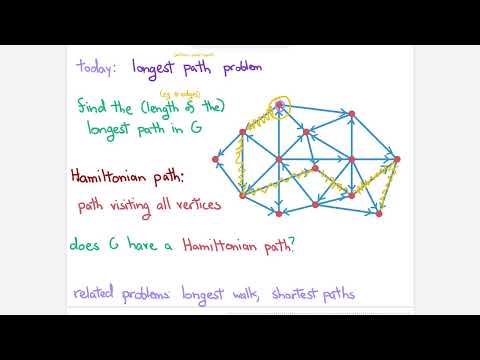 Watch on YouTube →
Overview
Kent Quanrud contrasts longest-path algorithms on directed acyclic graphs (DAGs) with the hardness of Hamiltonian path in general directed and undirected graphs. He derives a cached recurrence running in O(V+E) for DAGs, then sketches reductions from 3SAT to directed Hamiltonian path and from directed to undirected Hamiltonian path using variable ladders, clause detours, and in/out vertex gadgets. The lecture also connects Hamiltonian path to Hamiltonian cycle and shows how a general graph coin-collection problem can be reduced to a DAG problem by collapsing strongly connected components.
Key takeaways
- Longest path in a DAG is computable in O(V+E): use a sink base case, recurse over outgoing edges, and cache each vertex's result.
- Directed Hamiltonian path is hard because a path must cover every vertex without repetition; the 3SAT reduction encodes assignments as rung directions and clause satisfaction as mandatory detours.
- A reduction proof needs both implications: every satisfying assignment must produce a Hamiltonian path, and every Hamiltonian path must yield a satisfying assignment.
- Directed Hamiltonian path can be represented in an undirected graph by splitting each vertex into in- and out-copies and forcing traversal through the connecting gadget in the intended order.
- The coin-collection problem allows revisits, so strongly connected components can be collected wholesale and collapsed into a DAG; this structural reduction does not work for Hamiltonian path's no-repeat constraint.
- A problem on a general graph may still be tractable when its rules expose a DAG structure, as the SCC condensation does for coin collection.
Chapters
0:00
Why Simple Problems Can Encode SAT
- Kent Quanrud recalls reductions linking 3SAT, Max-2SAT, and Subset Sum to illustrate how apparently simple problems can encode Boolean logic.
- Subset Sum dynamic programming takes time proportional to the numeric target T, which is not polynomial in the number of bits needed to represent T.
- The central lesson is that a problem's surface appearance—such as adding numbers—does not reveal whether it can represent arbitrary logical constraints.
4:02
Longest Path, Hamiltonian Path, and Three Graph Settings
- The lecture asks for the longest path in a directed graph and distinguishes a path, which cannot repeat vertices, from a walk, which can.
- A Hamiltonian path visits every vertex exactly once; deciding whether one exists is a yes/no version of the longest-path problem.
- The three cases to compare are DAGs, general directed graphs, and undirected graphs; an algorithm for directed graphs would also apply to DAGs.
10:03
DAG Longest Walk via a Cached Recurrence
- For a vertex v, define the longest-walk value as 0 when v is a sink; otherwise take the maximum of 1 plus the value at each out-neighbor.
- A DAG has no cycles, so recursive subproblems cannot loop indefinitely and every reachable continuation can be evaluated.
- With memoization, each vertex is solved once and its outgoing edges are scanned once overall, giving O(V+E) running time.
16:39
Why Hamiltonian Path Makes General Directed Graphs Hard
- Quanrud focuses on directed Hamiltonian path: if longest path could be computed efficiently, its length would reveal whether a Hamiltonian path exists.
- The reduction goal is to transform a 3SAT instance into a graph whose Hamiltonian paths correspond to satisfying assignments.
- Unlike the DAG recurrence, a general graph has cycles and a Hamiltonian path must coordinate choices while preventing repeated vertices.
22:00
Variable Ladders Encode True-or-False Assignments
- Each variable is represented by a bidirectional rung that a Hamiltonian path must traverse in one of two directions.
- The chosen direction encodes the variable's truth value, such as left-to-right for false and right-to-left for true.
- Cross-edges link successive rungs, creating a ladder that lets a path make one assignment choice for each variable while covering the graph's backbone.
27:20
Clause Vertices Become Detours Along Variable Rungs
- Each clause receives a vertex that the Hamiltonian path must visit, making clause coverage part of the graph traversal.
- Edges let the path detour through a clause vertex when it traverses a variable rung in a direction that satisfies a literal.
- For a clause such as x1 OR NOT x2, the construction provides satisfying-direction detours for x1=true or x2=false while arranging the graph to prevent invalid backward traversal.
36:00
Proving the 3SAT-to-Hamiltonian-Path Reduction
- A satisfying assignment yields a Hamiltonian path by choosing each variable rung's direction and using satisfying detours to visit clause vertices.
- In the reverse direction, the gadget structure forces a Hamiltonian path into the intended rung-by-rung form, from which the variable assignment can be read.
- The proof must establish both directions—satisfying assignment implies Hamiltonian path, and Hamiltonian path implies satisfying assignment—to show equivalence.
- The constructed graph has roughly O(mn) vertices for m clauses and n variables, so its size remains polynomial in the formula size.
43:03
Why Undirected Hamiltonian Path Needs a New Gadget
- Simply erasing arrow directions from a directed graph can create undirected Hamiltonian paths that use edges in invalid directions.
- Strong connectivity does not solve the problem: mutual reachability among vertices does not guarantee a path visiting each vertex exactly once.
- A successful reduction must preserve each original vertex's distinction between incoming and outgoing edges after converting the graph to undirected form.
50:05
Split Each Directed Vertex into In and Out Copies
- Replace each original vertex with an in-vertex and an out-vertex, joined by a central connection that a Hamiltonian traversal must cross.
- Represent each original directed edge from u to v as an undirected connection from u's out-copy to v's in-copy.
- The split gadget aims to force a Hamiltonian path to enter through the in-side and leave through the out-side, preserving the direction of the original graph's edges.
56:40
Reading Hamiltonian Paths from the In-Out Construction
- A directed Hamiltonian path maps into the undirected construction by passing through each vertex's in-copy, central connection, and out-copy.
- For the reverse direction, show that any Hamiltonian path in the gadget must use the intended in-to-out traversal; otherwise it cannot cover all gadget vertices.
- Once that structure is established, the in- and out-connections identify the original directed edges and recover a directed Hamiltonian path.
59:25
Hamiltonian Cycle and the Cost of Endpoint Choices
- A Hamiltonian cycle visits every vertex exactly once and returns to its starting point, unlike a Hamiltonian path.
- Choosing a start or end vertex adds only polynomially many possibilities: trying all starts costs a factor of n, and trying endpoint pairs costs at most n².
- Therefore, removing endpoint choices does not by itself turn an intractable Hamiltonian-path problem into a polynomial-time one.
1:03:27
Turn Hamiltonian Path into Hamiltonian Cycle with a Supervertex
- Add a new supervertex connected in both directions to every vertex of the original directed graph.
- A Hamiltonian path becomes a Hamiltonian cycle by connecting its final vertex to the supervertex and the supervertex back to its first vertex.
- Conversely, remove the supervertex and its two incident cycle edges to recover a Hamiltonian path through all original vertices.
1:07:10
Coin Collection on Graphs and the Hidden DAG
- In the coin-collection problem, a walk may revisit vertices, but each vertex's coins are collected only once; the goal is to maximize coins gathered.
- On a DAG, a recurrence adds the coins at the current vertex to the best continuation, and memoization makes the computation efficient.
- For a general directed graph, strongly connected components can be collapsed into single vertices with their coin totals summed.
1:09:00
Strongly Connected Components Reduce Coin Collection to a DAG
- Within a strongly connected component, reaching one vertex makes every other vertex in that component reachable, so all its coins can be collected.
- Collapsing strongly connected components produces a condensation graph, which is always a DAG.
- The DAG recurrence then solves the general coin-collection problem, illustrating why its walk rules differ from the no-repeated-vertex constraint in Hamiltonian path.
Summary, takeaways, and chapters were generated by AI from the video's transcript and may contain errors. The video belongs to its creator, Kent Quanrud.