The ANTIKYTHERA MECHANISM
 Watch on YouTube →
Overview
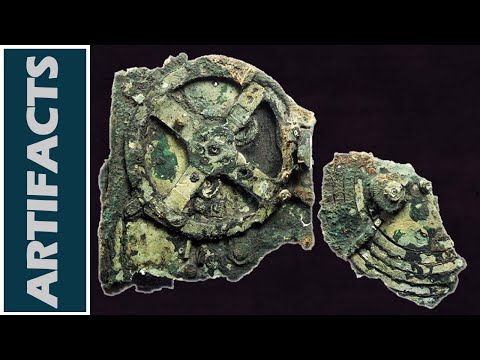
Tony Freeth explains how research using high-resolution 3D X-ray computed tomography and surface imaging transformed understanding of the Antikythera Mechanism, a bronze astronomical calculator recovered from a shipwreck dated to the mid-1st century BCE. Its surviving 82 fragments preserve evidence for a machine with about 69 gears that displayed celestial cycles, predicted eclipses using a 223-lunar-month cycle, and combined astronomy with calendars; its sophistication fits ancient Greek science rather than being anachronistic.
Key takeaways
- High-energy 3D X-ray CT, combined with surface imaging, let Tony Freeth's team reconstruct the Antikythera Mechanism's internal gearing and read thousands of characters hidden inside its corroded fragments.
- The reconstructed mechanism used about 69 bronze gears to calculate astronomical cycles, including the Moon's variable motion and a 223-lunar-month cycle used to predict eclipses.
- The upper back dial encoded a 19-year Metonic calendar with 235 lunar months, while its month names and games dial point toward intended use in Epirus, though they do not prove the place of manufacture.
- The front dial displayed the Sun, Moon, and five known planets, allowing users to calculate celestial positions by turning a handle rather than performing laborious trigonometry.
- Cicero and other ancient writers describe comparable devices associated with Archimedes and Posidonius, so the Antikythera Mechanism belongs to a broader tradition rather than appearing without historical precedent.
- The mechanism's survival is exceptional because bronze was routinely recycled; shipwrecks preserved many of the rare bronze artifacts known today.
Chapters
0:00
The Antikythera Mechanism and the 1900 Shipwreck Discovery
- The corroded bronze device, originally housed in a wooden box about one foot tall, is more than 2,000 years old and is displayed at Athens' National Archaeological Museum.
- In 1900, sponge diver Elias Stadiatos found marble sculptures and artifacts off Antikythera; a Greek-led underwater expedition began investigating the wreck in 1901.
- The wreck's artifacts date mostly to the 1st century BCE, with nothing later than the mid-1st century BCE, supporting a sinking date around that period.
7:35
Tony Freeth Challenges Derek de Solla Price's Reconstruction
- Mathematician Tony Freeth began studying the mechanism around 2000 and questioned Derek de Solla Price's model, which appeared to use overly complicated gearing for simple outputs.
- Freeth agreed with the established idea that the object was an astronomical calculating machine, but argued that its gearing and dials needed a better reconstruction.
- Researchers Michael Wright and Alan Bromley had also criticized aspects of Price's interpretation before Freeth's work.
11:56
3D X-Ray CT Reveals Gears and Hidden Inscriptions
- Freeth proposed combining Tom Malzbender's surface-imaging technique with high-energy X-ray computed tomography to reveal surface details and the mechanism's internal 3D structure.
- Earlier 2D X-rays by Price and Greek radiologist Charalambos Karakalos showed overlapping components, while the newer CT scans resolved features at roughly 0.1 millimeter.
- The mechanism broke into 82 fragments, representing about one-third of the original device; Freeth's latest reconstruction accounts for 69 gears.
- CT slices exposed thousands of previously hidden Greek characters, raising the readable inscription total from roughly 1,000 to 3,500 or 4,000.
17:00
Bronze Gearmaking, Archimedes, and Astronomical Cycles
- The bronze gears were likely made from sheet bronze, and UCL researchers Adam Wojcik and Myrto Georgakopoulou study how its intricate components were manufactured.
- Freeth argues that the design tradition may go back to Archimedes, while the surviving mechanism was likely built later by a scientific designer working with skilled craftspeople.
- Gear tooth counts encode astronomical cycles: a 38-tooth gear and a 127-tooth gear relate to the Moon's 19-year cycle and its 254 passages through the zodiac.
- Three gears with 53 teeth helped model the Moon's variable apparent speed, not just its average motion.
24:14
Fragment F Exposes the 223-Month Eclipse Prediction Dial
- CT analysis of museum fragment F revealed concentric scales, divisions, and groups of inscription characters called glyphs; combining it with fragments A and E allowed researchers to reconstruct the dial.
- The scale divisions indicated 223 months, the Babylonian-derived eclipse cycle in which a similar eclipse can recur after about 18 years.
- The back dial's glyphs predicted whether an eclipse would occur and its time of day, while associated inscriptions described features such as magnitude and color.
- Freeth describes eclipse prediction as one function among several, not the mechanism's sole purpose.
33:00
Metonic Calendar and Evidence for an Epirus Connection
- The upper back dial represented the 19-year Metonic cycle as a five-turn spiral containing 235 lunar months, an identification developed by Michael Wright.
- Month names inscribed around the dial point to a Corinthian-style calendar, but later analysis suggests the device was made for Epirus in northwestern Greece, not Syracuse.
- A games dial listed major Panhellenic competitions and included the Naa games at Dodona in Epirus and the Halieia at Rhodes.
- The calendar and games provide evidence about the intended user or region, but do not establish with certainty where the mechanism was manufactured.
36:57
Front Dials Display the Sun, Moon, and Five Known Planets
- The front displayed the positions of the Sun, Moon, and five planets known to ancient Greeks, as well as lunar phases and possibly the Moon's eclipse-related nodes.
- Users could set a calendar date and turn a handle to calculate celestial positions, mechanically performing calculations that would otherwise require laborious trigonometry.
- Freeth rejects the idea that it was primarily a navigation instrument, suggesting instead that it applied mathematical astronomy to calculate future positions.
- The mechanism may also have served as a sophisticated demonstration of astronomical theory, but Freeth considers that inadequate as its sole purpose.
42:47
Cicero's Ancient Devices and the Loss of Bronze Instruments
- Cicero describes two astronomical devices made by Archimedes and another associated with Posidonius; later writers including Pappus, Lactantius, Claudian, and Proclus also mention such instruments.
- Pappus reports that Archimedes wrote about how to build and operate these devices, showing that ancient accounts of geared astronomy predate the wreck's discovery.
- The mechanism was probably rare and costly, comparable to a luxury astronomical watch, because its many precise gears and inscriptions required extensive skilled labor.
- Bronze recycling explains why few examples survived: most ancient bronze sculptures were melted down, while shipwrecks preserved artifacts such as those from Antikythera.
45:32
Why the Mechanism Fits Ancient Greek Science
- Freeth argues that the mechanism is not anachronistic: its astronomical theories are attested in earlier ancient sources, and its Greek inscriptions fit a period from the late 3rd to early 1st century BCE.
- The device uses a geocentric model to represent how celestial bodies appear from Earth, regardless of whether its designer knew of Aristarchus' heliocentric proposal.
- The ship sank during the Roman Republic but was not necessarily a Roman vessel; lead analysis points to northern Greece and personal objects bear Greek names.
- Its significance lies in being the only known surviving example of this kind of ancient calculating machine, not in being an object without historical context.
49:23
The Ship's Greek Crew and the Mechanism's Historical Significance
- Chemical analysis of lead from the ship's equipment traces it to northern Greece, while Greek names etched on personal possessions suggest a largely Greek crew.
- Cicero's account describes an Archimedean sphere whose linked motions represented the unequal courses of celestial bodies and the Moon's changing position.
- The Antikythera wreck preserved rare Greek bronzes that would commonly have been melted down on land, providing crucial context for the mechanism and its cargo.
- The surviving device demonstrates ancient Greek and Roman scientific and technological capabilities, even though comparable mechanisms are known only from texts.
Summary, takeaways, and chapters were generated by AI from the video's transcript and may contain errors. The video belongs to its creator, World of Antiquity.