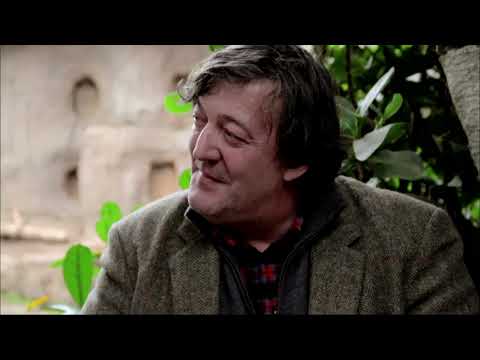
Stephen Fry's Planet Word episode 1 Babel
 Watch on YouTube →
Overview
Stephen Fry explores language as a defining human capacity, from its possible evolutionary role in cooperative hunting to the way children acquire grammar and communities develop distinct languages. Interviews and demonstrations—including Wolfgang Enard’s research on FOXP2, MRI scans of Fry’s brain, Ruby’s language development, Jean Berko Gleason’s Wug Test, and sign-language interpreters—show how biology, learning, and culture shape speech and linguistic diversity.
Key takeaways
- Tomasello’s account links the evolution of uniquely human communication to cooperation: coordinating food gathering and sharing would reward more flexible communication than the emotion-bound calls of other primates.
- FOXP2 is associated with speech disorders and offers clues about language biology, but Enard’s humanized-mouse experiments show that a gene’s effects are subtle and do not by themselves produce language.
- Children do more than imitate adults: Gleason’s Wug Test shows that young children apply abstract grammatical rules to words they have never encountered.
- Language acquisition depends on both innate learning capacity and social exposure; Victor of Aveyron’s case highlights a possible early learning window, while Ruby’s development shows language emerging through everyday interaction.
- Sign languages are full languages with their own grammars and regional differences, as shown by the lack of automatic understanding between American and German signers.
- Historical sound correspondences such as Latin pater and English father support the reconstruction of Proto-Indo-European, while the thousands of modern languages preserve distinct cultural expression.
Chapters
0:00
Language as a Human Capacity: From Everyday Speech to 7,000 Languages
- Speaking a single word involves about 70 muscles and hundreds of millions of brain cells, yet becomes effortless for most children.
- Fry introduces language as a shared human ability and visits a pastoral community whose children acquire a complex local language naturally.
- Around 7,000 languages are spoken worldwide, ranging from languages used by only a handful of people to those spoken by more than a billion.
5:02
From Animal Signals to Human Language
- Bird calls, elephant trumpets, dolphin clicks, and primate vocalizations communicate specific messages, but are not equivalent to human language.
- Evolutionary linguist Michael Tomasello argues that primate calls are largely hardwired to emotional states and have limited flexibility.
- Fifteen-month-old Ruby is followed as she begins the transition from babbling toward recognizable speech.
7:28
Cooperative Hunting as a Possible Origin of Language
- Tomasello proposes that ecological pressures made early humans collaborate to obtain food, creating a need to coordinate actions and share resources.
- Hunting larger prey, such as alligators in Brazil’s Xingu River region, illustrates why grunts and gestures may have given way to more precise communication.
- Language made it possible to share experiences, discuss the past, plan for the future, and pass knowledge between generations.
12:37
FOXP2, Mice, and the Genetics of Speech
- Geneticist Wolfgang Enard studies FOXP2, a gene on human chromosome 7 associated with severe speech disorders when mutated.
- Researchers created mice carrying the human version of FOXP2 and observed subtle differences in brain features and vocalizations.
- Enard cautions that these changes do not make mice speak; how genetic changes translate into brain and behavioral differences remains difficult to establish.
17:35
Brain Imaging and Recovery of Language After Stroke
- At University College London, Fry undergoes functional MRI while speaking so researchers can map language-related brain activity.
- Professor Cathy Price explains that language draws on interconnected brain regions involved in sensory information, memory, and responses.
- Writer Robert McCrum describes recovering speech after a stroke affected his basal ganglia; his brain reorganized, though speaking still required conscious effort.
23:25
Victor of Aveyron, the Critical Period, and Ruby’s First Words
- The feral child Victor of Aveyron received years of instruction from physician Jean Marc Gaspard Itard but never learned to speak fluently.
- Victor’s case suggests that language acquisition may become much harder after an early developmental window, though his background and condition were uncertain.
- MIT researcher Deb Roy filmed his son’s language development for three years; by about 24 months, children typically add roughly 10 words a day.
- Ruby’s recordings show her moving from early words such as “apple” and “banana” toward fuller sentences.
30:11
Steven Pinker and Jean Berko Gleason Explain Children’s Grammar
- Steven Pinker says children need exposure to the words used by their community, but also learn rules that let them create sentences they have never heard.
- Jean Berko Gleason’s Wug Test demonstrates that children apply grammar to invented words, forming plurals such as “wugs” and past-tense forms such as “binged.”
- Gleason emphasizes conversation, reading, listening, and opportunities to tell stories rather than relying chiefly on correction or drilling.
35:00
Klingon as a Constructed Language—and Why Use Matters
- Klingon, created for Star Trek, is one of more than 400 constructed languages and was used in a Klingon-language performance of Hamlet.
- Computational linguist D’Armond Speers raised his son with Klingon as an early language, using it for games, vocabulary, and a nightly lullaby.
- His son began answering in English and lost interest around ages two and a half to three, illustrating how a language’s practical use affects whether it persists.
39:02
Sign Languages Have Grammar, Regional Variants, and Wordplay
- Deaf signers explain that sign languages have vocabulary, sentence structure, and concepts—not merely improvised gestures.
- More than 200 sign languages have developed; American Sign Language and German Sign Language are distinct and are not automatically mutually intelligible.
- Signs for public figures can develop through community agreement and may encode recognizable traits or cultural references rather than simply spelling names.
45:27
The Tower of Babel, the Brothers Grimm, and Proto-Indo-European
- Fry contrasts the biblical Babel story with linguistic evidence that languages share historical relationships.
- Jacob Grimm helped establish historical philology; Grimm’s law describes systematic sound correspondences between Indo-European languages.
- One example is the relationship between p in Latin pater and f in English father, part of the evidence for Proto-Indo-European, a reconstructed ancestor of more than 2,000 languages.
50:16
The United Nations, Translation, and the Value of Language Diversity
- The UN has six official languages—English, French, Spanish, Russian, Chinese, and Arabic—and uses English and French as working languages.
- Simultaneous interpreters make multilingual diplomacy possible, while Fry considers whether a single world language would improve mutual understanding.
- An interpreter argues that each language carries distinctive music, imagery, and cultural expression; replacing them with one language would mean losing those qualities.
Summary, takeaways, and chapters were generated by AI from the video's transcript and may contain errors. The video belongs to its creator, Planet Fry.