STAT 3011 Fall 2026: Hypothesis Testing For Proportions
Overview
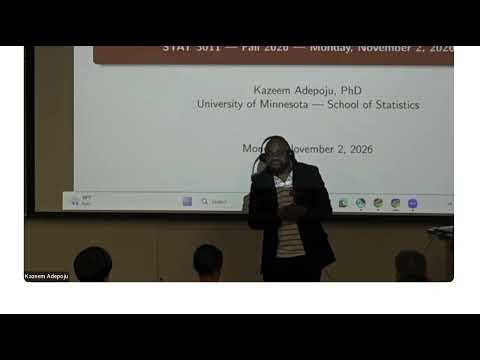
Prof. Kazeem Adepoju introduces one-proportion hypothesis testing, distinguishing the sample proportion from the population proportion and showing how to test a claim such as whether a majority of instructors oppose a proposed switch. Using a sample of 22 out of 40, he explains null and alternative hypotheses, one- versus two-tailed tests, significance level, the hypothesized-proportion standard error and Z statistic, and the P-value decision process.
Key takeaways
- The sample proportion p-hat = 22/40 = 0.55 describes the 40 sampled instructors; testing whether a majority of all instructors oppose the switch requires inference about population proportion P.
- For a one-proportion hypothesis test, the null hypothesis includes equality and the standard error uses the null value: √[p0(1 − p0)/n], not p-hat.
- The test statistic is z = (p-hat − p0) / √[p0(1 − p0)/n]; the alternative hypothesis determines whether the P-value comes from the left tail, right tail, or both tails.
- Adepoju's stated normal-approximation checks are n p0 ≥ 15 and n(1 − p0) ≥ 15, alongside random sampling and independence.
- At α = 0.05, reject H0 when P-value < 0.05; otherwise, fail to reject H0, which means the sample does not provide sufficient evidence against the null rather than proving it true.
- A poll's point estimate alone is not enough to assess a population claim; the margin of error and statistical significance help show how much sampling uncertainty remains.
Chapters
- The remote makeup and retake exam is available from Friday at 3:00 p.m. through Sunday at 11:59 p.m., with a 90-minute timer after starting.
- Students must join Zoom with video on before starting; sessions are recorded, and students should remain muted.
- A missed Midterm 1 can be made up for 100% of the exam score; a voluntary retake combines 70% of the new score with 30% of the old score, keeping the old score if the result is lower.
- Students who missed the exam can contact Adepoju about a paper exam; retakes must be remote.
- The lecture connects sampling distributions, confidence intervals, and hypothesis tests for a population proportion, P.
- Adepoju outlines one-tailed tests, including left- and right-tailed alternatives, and two-tailed tests.
- The objectives include checking Z-test conditions, interpreting P-values, and connecting tests to confidence intervals.
- A claim that a majority of instructors oppose a proposed element switch means the population proportion P is greater than 0.50.
- A random sample includes 40 instructors, of whom 22 oppose the switch.
- The sample proportion is p-hat = 22/40 = 0.55, or 55%; it describes the sample, not the entire population.
- Different random samples of 40 could produce different proportions, motivating a test of whether the observed result is more than sampling variation.
- A hypothesis is presented as an informed guess about a population parameter, such as a proportion.
- Hypothesis testing assesses the validity of a claim using sample evidence rather than surveying the entire population.
- Adepoju compares the process to a court case, where a decision is made from evidence and witnesses rather than every person in a community.
- The null hypothesis, H0, contains an equality, while the alternative, Ha, expresses the research direction.
- For a claim that a majority oppose the switch, the alternative is P > 0.50; the corresponding null is P = 0.50.
- An alternative of P < p0 is left-tailed, P > p0 is right-tailed, and P ≠ p0 is two-tailed.
- Greater-than and less-than alternatives are directional one-tailed tests; a not-equal alternative is nondirectional and two-tailed.
- A poll's point estimate, such as 55% support for a candidate, does not by itself establish a reliable population result.
- Adepoju recommends asking for the margin of error and considering whether a poll result falls outside its confidence interval.
- In hypothesis testing, alpha is the significance level; the standard example is α = 0.05.
- A 5% significance level corresponds to 95% confidence in the confidence-interval framework.
- The sample should be random and observations independent for the one-proportion Z test.
- Adepoju gives the normal-approximation checks as n p0 ≥ 15 and n(1 − p0) ≥ 15, using the hypothesized proportion p0.
- For a hypothesis test, the null-based standard error is √[p0(1 − p0)/n].
- For a confidence interval, the standard error instead uses the sample proportion, √[p-hat(1 − p-hat)/n]; the two formulas serve different purposes.
- The test statistic is z = (p-hat − p0) / √[p0(1 − p0)/n].
- Use p-hat from the observed sample in the numerator and the null-hypothesized p0 in the standard error.
- For the instructor example, the sample proportion is 22/40 = 0.55 and the null value is p0 = 0.50.
- Adepoju emphasizes using a Z test, rather than a t test, for the one-proportion procedure presented.
- The P-value is the probability, assuming H0 is true, of observing a test statistic at least as extreme in the direction specified by Ha.
- The alternative hypothesis determines the P-value tail: greater-than for a right-tailed test, less-than for a left-tailed test, and both tails for a not-equal test.
- For a right-tailed test, the R calculation is 1 − pnorm(z); the lecture demonstrates this with a Z value of about 0.6325.
- For a left-tailed test, use pnorm(z) rather than subtracting the cumulative probability from 1.
- Reject H0 when the P-value is less than α; otherwise, fail to reject H0.
- In the instructor-opposition example, the P-value is greater than 0.05, so the decision is to fail to reject the null.
- The appropriate conclusion is that there is insufficient evidence that a majority of instructors oppose the switch, not proof that the null claim is true.
- Adepoju closes by noting that the lesson will continue in the next class.
Transcript excerpt
0:53 Can you hear me? Everybody can hear me, right? Okay, so uh So, I want to welcome you to another month. Of course, today is Monday, November 2nd, right? Okay, so and I also want to welcome you to our statistical analysis class. Uh there's a lot of information for today. Before I get started, uh first of all, I think I I'm going to say I'm deeply honored, and highly delighted, and super excited to announce that I had a remarkable birthday celebration on Saturday. You know, I want to use
1:42 uh this opportunity, you know, to appreciate uh uh some students who who show up, and those who actually made a video and wish me you know, they gave my birthday wish. Uh I really appreciate every one of you, you know, for for doing that. I have the best birthday celebration of my life because my wife took me to cloud nine. So, uh, I really enjoyed that. So, uh, another announcement is this. I think I put something on announcement section last night about makeup and, um, retake. And I need everyone to pay attention
2:30 to that. If you check the announcement, if you check the announcement, um, that I made yesterday, the announcement is about, um, makeup. You know, there are some students who missed the makeup or who missed, uh, the real exam. So, uh, I'm providing the opportunity and for those, uh, who have seen results and the result is not satis- is satisfactory, of course, you can, you're also going to have opportunity for a retake. But this is the way it's going to happen. And I need every one of you to pay attention. The exam doesn't have a location. There's no location because it's going to be done remotely. But you know, this this is the way it's
This is the start of the transcript. Save this video free for the whole transcript, searchable and time-coded.
Related notes
Summary, takeaways, and chapters were generated by AI from the video's transcript and may contain errors. The video belongs to its creator, Prof Kazeem Adepoju.