SN1 vs SN2 Made Easy! | Reaction Mechanisms & Carbocation Rearrangements
 Watch on YouTube →
Overview
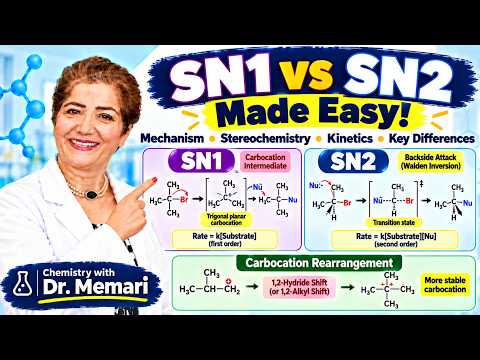
Dr. Memari compares SN1 and SN2 using nucleophile strength, alkyl-halide substitution, solvent, reaction steps, and stereochemical outcomes. The lesson then explains how hydride and methyl shifts can improve carbocation stability, and applies that reasoning to a water substitution example where rearrangement changes the predicted product.
Key takeaways
- A strong nucleophile and a primary alkyl halide usually point to SN2, whereas a weak nucleophile and a tertiary alkyl halide usually point to SN1.
- SN2 is concerted and proceeds with backside attack and inversion; SN1 forms a carbocation intermediate that can be attacked from either face.
- The typical substrate order for SN2 is methyl > primary > secondary, while SN1 favors tertiary > secondary because more substituted carbocations are more stable.
- Hydride shifts move hydrogen with its electron pair from an adjacent carbon; methyl shifts move an adjacent methyl group, and either can relocate the carbocation.
- Carbocation rearrangement is favored when a one-bond shift creates a more stable carbocation; SN2 reactions lack this carbocation-based rearrangement pathway.
- In the final example, water acts as a weak nucleophile, supporting SN1; accounting for rearrangement leads to product B rather than the unrearranged product.
Chapters
0:00
Choosing SN1 or SN2 from Substrate and Nucleophile
- Tertiary alkyl halides with weak nucleophiles such as H2O favor SN1; primary alkyl halides with strong nucleophiles such as OH− favor SN2.
- Primary allylic halides can use either pathway: a strong nucleophile favors SN2, while allylic carbocation stability can support SN1.
- SN2 is a one-step reaction without an intermediate; SN1 proceeds in two steps through a carbocation.
- Polar aprotic solvents support SN2, while polar protic solvents support SN1.
5:00
SN1/SN2 Rate Trends, Stereochemistry, and Carbocation Shifts
- SN2 substrate reactivity decreases with steric substitution: methyl > primary > secondary, while tertiary substrates are generally too hindered.
- SN1 favors carbocation stability: tertiary > secondary; primary carbocations are generally too unstable.
- SN2 attacks from the side opposite the leaving group, producing inversion of configuration; SN1 can give both configurations after the planar carbocation forms.
- A hydride shift transfers H with its bonding electron pair from an adjacent carbon, moving the positive charge and potentially converting a less stable carbocation into a more stable one.
10:00
Methyl Shifts and a Rearranged SN1 Product
- A methyl group can shift from an adjacent carbon to a carbocation center; the shift is favored when it improves carbocation stability.
- The lesson emphasizes one-bond hydride or methyl shifts and checks whether the adjacent carbon has a group available to migrate.
- For SN1, rearrangement can change the carbon skeleton before the nucleophile bonds; SN2 has no carbocation intermediate and therefore does not rearrange this way.
- In the closing alkyl bromide-and-water example, weak H2O indicates SN1, and the rearranged structure B is selected over the unrearranged alternative.
Summary, takeaways, and chapters were generated by AI from the video's transcript and may contain errors. The video belongs to its creator, Chemistry with Dr. Memari.