Section 6.4 - Combination, Composition of Functions, Inverse Functions - Part 1 - Questions 1 - 10
 Watch on YouTube →
Overview
Monica Brannan works through Section 6.4 problems 1–10, showing how to evaluate sums, differences, products, and quotients of functions before moving into domains and interval notation. The examples use absolute-value, polynomial, and radical functions, then rational functions whose domains require excluding denominator zeros; the transcript also contains sign and input inconsistencies in a few worked answers that should be checked.
Key takeaways
- For ordinary function operations, evaluate each component at the requested input first: for example, (f−g)(−6)=f(−6)−g(−6), while (fg)(3)=f(3)g(3).
- An even-root radicand must be nonnegative: √(4−x) requires x≤4, giving domain (−∞,4] unless the radical is itself a denominator.
- A radical in a denominator adds a stricter condition: 5x/√(4−x) excludes x=4 because it would make the denominator zero, so its domain is (−∞,4).
- For a product or quotient of rational functions, preserve restrictions from the original component functions even if algebraic simplification cancels a factor; Example 9 excludes −6, 5, and 6.
- The transcript has two answer checks worth noting: Example 5 states input 1 but calculates at −1, and Example 9’s simplification should be −1/(x+6), not 1/(x+6).
Chapters
0:00
Evaluating a Function Difference with Absolute Value
- For f(x)=3x and g(x)=|x−2|, Brannan rewrites (f−g)(−6) as f(−6)−g(−6).
- The inputs give f(−6)=−18 and g(−6)=|−8|=8, so the result is −26.
- Absolute value represents distance and therefore returns a nonnegative value.
4:48
Multiplying Function Values in Examples 2 and 3
- For f(x)=−3x and g(x)=|x+2|, (fg)(3)=f(3)g(3)=(−9)(5)=−45.
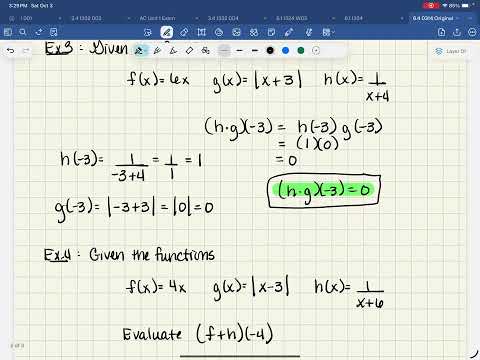
- For h(x)=1/(x+4) and g(x)=|x+3|, h(−3)=1 and g(−3)=0, so (hg)(−3)=0.
- The multiplication symbol means multiply the two function outputs at the same input; it does not indicate composition.
9:12
Adding and Dividing Function Values in Examples 4 and 5
- With f(x)=4x and h(x)=1/(x+6), (f+h)(−4)=−16+1/2=−31/2.
- For the printed functions f(x)=2x and g(x)=|x+5|, the stated input 1 gives g(1)/f(1)=6/2=3.
- The worked calculation instead substitutes −1 and obtains −2, so the example’s stated input and solution do not match.
14:01
A Zero Denominator Makes a Function Quotient Undefined
- For h(x)=1/(x−3) and g(x)=|x+6|, h(−6)=−1/9 while g(−6)=0.
- The quotient h(−6)/g(−6) has zero in its denominator and is therefore undefined.
- Brannan emphasizes checking the denominator after evaluating both component functions.
17:00
Example 7: Multiplying a Polynomial by a Square-Root Function
- The functions are p(x)=x²−2x and q(x)=√(4−x); their product is (x²−2x)√(4−x).
- A polynomial such as p(x) has domain (−∞,∞), since it has no variable denominator or even-root restriction.
- The product’s domain must satisfy the restrictions of both component functions.
20:20
Using Interval Notation for the Radical Domain
- For q(x)=√(4−x), require 4−x≥0, which gives x≤4.
- The interval notation is (−∞,4], using a bracket at 4 because the radicand may equal zero.
- For p(x)q(x), the combined domain is also (−∞,4], the more restrictive component domain.
30:16
Example 8: A Quotient with a Square Root in the Denominator
- With r(x)=5x and q(x)=√(4−x), the quotient is 5x/√(4−x).
- The radical requires x≤4, but the quotient’s denominator cannot be zero, so x=4 must also be excluded.
- The resulting domain is (−∞,4), with a parenthesis at 4.
36:55
Example 9: Simplifying a Product of Rational Functions
- Brannan multiplies s(x)=(x−5)/(x²−36) by t(x)=(x−6)/(5−x).
- Factoring x²−36 as (x−6)(x+6) allows cancellation of x−6; rewriting 5−x as −(x−5) reveals the remaining negative sign.
- The simplified result is −1/(x+6); the transcript’s final displayed answer appears to drop this negative sign.
42:45
Example 9: Excluding Every Forbidden Input from the Domain
- For s(x), x²−36 cannot equal zero, excluding x=−6 and x=6.
- For t(x), 5−x cannot equal zero, excluding x=5.
- The product’s domain is (−∞,−6)∪(−6,5)∪(5,6)∪(6,∞); canceled factors do not restore excluded inputs from the original functions.
47:05
Example 10: Dividing Rational Functions and Combining Domain Restrictions
- For s(x)=(x−4)/(x²−25) and t(x)=(x−5)/(4−x), s/t is formed by multiplying s(x) by the reciprocal of t(x).
- The domain excludes x=−5 and x=5 from s, and x=4 from t; the quotient also cannot use an input where t(x)=0.
- The combined domain is (−∞,−5)∪(−5,4)∪(4,5)∪(5,∞), and the simplified expression carries a negative sign from 4−x.
Summary, takeaways, and chapters were generated by AI from the video's transcript and may contain errors. The video belongs to its creator, Monica Brannan.