Ravens - Intelligent Rascals of the Skies | Free Documentary Nature
 Watch on YouTube →
Overview
Ravens and other corvids combine flexible problem-solving with complex social lives, adapting to alpine landscapes, farms, cities, and human-created food sources. Field studies at the Konrad Lorenz Research Station and observations across Central Europe show how ravens solve string tasks, recognize other birds, cache food, and learn from parents, while conservation efforts such as jackdaw nest boxes help counter habitat loss.
Key takeaways
- Common ravens demonstrate practical causal reasoning: in Anna Braun’s string experiment, Elias pulls a hanging snack upward rather than trying to reach it directly.
- Corvid intelligence operates in a social context: ravens maintain long-term friendships and lifelong pair bonds, while jackdaws use calls, gestures, and hierarchies to manage colony disputes.
- Food caching is both a survival tactic and a test of social awareness: ravens and crows hide food, monitor competitors, and can recover stores after other birds discover them.
- Human environments create both opportunities and pressures: city food and waste dumps sustain crow flocks, while sealed building openings and intensive farming reduce jackdaw nesting and feeding habitat.
- Targeted conservation can make a measurable difference: Comburg Castle’s 1990 nest boxes supported more than 30 jackdaw breeding pairs, and local monitoring helped rebuild populations.
- Strict protection helped common ravens recover from near-extinction across much of Central Europe by the 1980s, illustrating how policy can reverse declines.
Chapters
0:00
From Odin’s Ravens to Europe’s Birds of Ill Omen
- Norse tradition revered Odin’s ravens, Huginn and Muninn, as gatherers of information and symbols of wisdom.
- During the Middle Ages, battlefield and execution-site scavenging helped turn ravens into symbols of death and evil.
- Modern research is renewing attention to the intelligence behind the raven’s reputation.
4:38
Konrad Lorenz Station Tests Raven Social Bonds and Problem-Solving
- Researchers at the Konrad Lorenz Research Station in Grünau, Austria, study individually marked ravens; about 90 birds have colored tags.
- Young ravens form groups of up to 300, build long-term friendships, and leave when a pair secures its own territory; bonded pairs stay together for life.
- In Anna Braun’s string experiment, raven Elias pulls a suspended snack upward, demonstrating an understanding of how the string connects to the food.
- Young ravens examine and play with toys, hide prized objects, and sometimes retrieve items hidden by other birds.
10:38
Alpine Choughs and Carrion Crows Exploit Seasonal Food
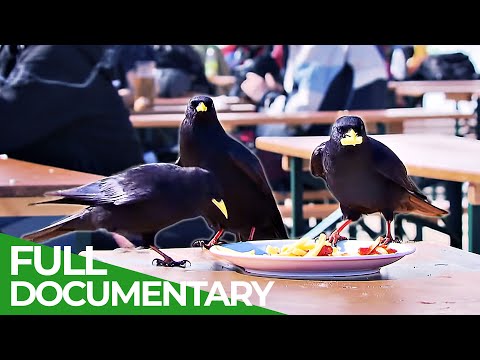
- Alpine choughs gather around ski-resort terraces in winter, where tourist food provides an abundant meal.
- Choughs use warm air currents for flight and communicate with specialized calls and wing tilts that help convey flight directions.
- In spring, carrion crows forage for earthworms and insects; a discovered nut quickly attracts competitors.
- A lower-ranking crow may hide a nut or fly away with it to avoid losing the food to stronger members of the group.
16:08
Rooks and Jackdaws Adapt to Cities, Farms, and Flocks
- Crows navigate busy roads with few reported collisions, while Limburg’s rooks collect nest material from nearby streets.
- Rook populations have fallen sharply in many areas; hunting reduced some colonies by as much as 90 percent.
- Rooks and jackdaws forage together in fields: larger rooks dig for insects and seeds, while jackdaws can glean leftovers and benefit from group vigilance.
- Jackdaws nest in human structures such as chimneys and old buildings, though nesting sites can be lost when openings are sealed.
22:33
Norderney Jackdaws Show Pair Bonds and Colony Cooperation
- On the German island of Norderney, jackdaws use abandoned rabbit burrows as dark, sheltered nest sites.
- Jackdaw colonies have hierarchies and use gestures and calls to settle disputes; paired birds remain together for life.
- Pairs signal territorial boundaries with synchronized movements, and occasional fights generally end without serious injury.
- Strong family and community ties allow birds to return quickly to feeding and breeding after conflicts.
25:17
Rook Parenting and Jackdaw Nest-Box Conservation
- Limburg rook parents feed chicks in the nest for about 30 days, then continue feeding them for roughly six more weeks.
- At Comburg Castle, installing nest boxes in 1990 helped jackdaws return after wire blocked traditional nesting sites; more than 30 pairs now breed there.
- Young jackdaws depend on nearby meadows for insects, and an estimated 60–70 percent die within their first five months.
- In Baden-Württemberg, jackdaw numbers fell from about 3,000 pairs in 1960 to around 1,000; conservationist Hans-Ulrich Stuber’s nest boxes and monitoring have helped local populations recover.
32:03
Harz Ravens Raise Chicks as Protection Reverses Population Decline
- Common ravens can reach 65 centimeters in body length and a 1.3-meter wingspan; established pairs often hold the same territory for life.
- A Harz cliff nest contains two fledglings, hatched from eggs laid in March and incubated for about three weeks.
- Ravens eat carrion and also hunt mice, chicks, insects, and earthworms; young birds remain with their parents until late summer.
- Strict protection measures helped the common raven recover after it had become nearly extinct across much of Central Europe by the 1980s.
37:02
Raven Fledglings Learn Caching and Risk Assessment
- A field biologist studying ravens since 1984 climbs 20–30 meters to tag chicks and gather data across a 2,000-square-kilometer research area.
- Raven fledglings first make short flights between neighboring trees before families begin ranging farther from the nest.
- Young ravens cache chunks of meat and can uncover food hidden by a sibling, showing that other birds’ actions can reveal a cache’s location.
- When a fox approaches, a raven retrieves its meat and ultimately flies away rather than risk a direct confrontation.
42:02
Anna Braun Uses a Touchscreen to Test Raven Recognition
- At the Konrad Lorenz Research Station, Anna Braun trains ravens Elias and Colombo with a touchscreen fish-and-flower sorting task.
- The recognition test presents eight wild ravens photographed from ten different angles and asks the test bird to identify four.
- Correct choices earn a reward, while images of the other four birds do not; Colombo answers several trials correctly but is still in training.
- The early results indicate that common ravens can distinguish individual birds across different photographic perspectives.
45:03
Winter Food Dumps and City Roosts Reshape Crow Behavior
- In autumn and winter, rooks, jackdaws, crows, and sometimes ravens gather at waste dumps, where food supports unusually large, less mobile flocks.
- Hooded crows, the gray-and-black eastern counterpart of the carrion crow, exploit warmer city streets and food left at markets and parks.
- Crows compete for walnuts, hide uneaten nuts, and can later remember where their caches are stored.
- Urban crows gather nightly at traditional communal roosts, including sites in Frankfurt am Main, continuing a close association with human settlements.
Summary, takeaways, and chapters were generated by AI from the video's transcript and may contain errors. The video belongs to its creator, Free Documentary - Nature.