Overview of Macromolecules, BIO105 Introductory Biology, David Champlin, USM
 Watch on YouTube →
Overview
David Champlin explains how covalent bonds build macromolecules while non-covalent interactions shape their folding and interactions with water and other molecules. He previews polysaccharides, nucleic acids, phospholipids, and proteins, then focuses on how phospholipids form a cell-membrane bilayer and how the transmembrane protein aquaporin provides a selective water channel.
Key takeaways
- Macromolecules rely on covalent bonds to connect their building blocks and non-covalent interactions to fold, bind, and interact with their environment.
- Glycogen stores glucose in animal cells, whereas cellulose is a plant polysaccharide; DNA and RNA are chains of nucleotides.
- A phospholipid’s hydrophilic head and hydrophobic fatty-acid tails cause bilayers to form with a water-repelling core between aqueous environments.
- The phospholipid bilayer acts as a selective boundary that helps cells maintain internal chemistry distinct from their surroundings.
- Aquaporin spans the membrane and combines a hydrophobic exterior with a water-conducting hydrophilic channel, allowing selective water transport.
- Phospholipids can spontaneously organize in water into bilayers or micelles without requiring covalent bonds between separate phospholipid molecules.
Chapters
0:00
Macromolecules: Covalent Chains and Non-Covalent Interactions
- Covalent bonds join small molecules into larger structures, such as amino acids linked into protein chains.
- Non-covalent interactions occur within folded molecules, between molecules, and between molecules and surrounding water.
- The chapter introduces four macromolecule groups: polysaccharides, nucleic acids, phospholipids, and proteins.
- Glucose chains form polysaccharides such as glycogen, which stores energy in animal cells, and cellulose in plants; DNA and RNA are nucleotide chains.
6:55
Phospholipid Bilayers Form the Cell’s Water-Resistant Boundary
- All cells—including plant, animal, bacterial, and yeast cells—are surrounded by membranes made primarily of phospholipids.
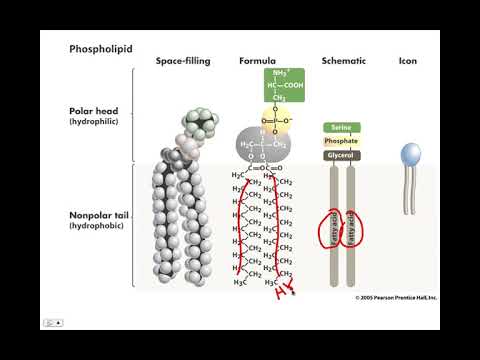
- Each phospholipid has a charged, hydrophilic head and two fatty-acid tails whose nonpolar carbon-hydrogen bonds are hydrophobic.
- In a bilayer, hydrophilic heads face water on both sides while hydrophobic tails pack together to form a water-fearing core.
- The thin hydrophobic core helps separate internal cell chemistry from the external environment, and non-covalent interactions hold the membrane together.
12:20
Aquaporin Channels and Spontaneous Phospholipid Assembly
- Aquaporin is a transmembrane protein: its hydrophobic exterior sits in the bilayer, while a hydrophilic channel allows water to pass selectively.
- Cells can contain thousands of aquaporin copies; plant roots use these channels to admit water.
- Phospholipids assemble spontaneously in water into structures such as micelles or bilayers, driven by their hydrophilic heads and hydrophobic tails.
- Champlin uses aquaporin to connect the upcoming study of membranes with later study of protein structure and chemistry.
Summary, takeaways, and chapters were generated by AI from the video's transcript and may contain errors. The video belongs to its creator, The New Evolution for Everyone.