Osmosis, BIO105 Introductory Biology, David Champlin, USM
 Watch on YouTube →
Overview
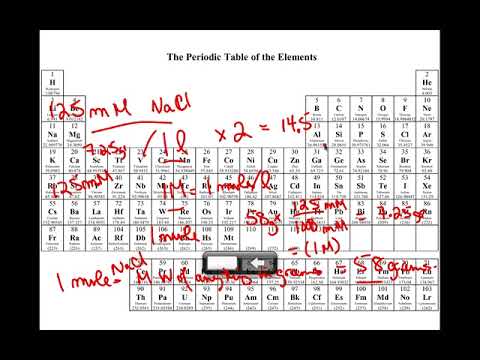
David Champlin explains osmosis as water diffusion across a selectively permeable phospholipid bilayer, where the hydrophobic core blocks ions such as sodium and chloride while water can cross. He demonstrates solution preparation with 125 mM NaCl (58 g/mol; 7.25 g per liter) and shows how total solute concentration determines water movement, equilibrium, and cell swelling or shrinking in hypotonic, isotonic, and hypertonic solutions.
Key takeaways
- Osmosis is the net movement of water across a selectively permeable membrane in response to differences in solute concentration.
- A phospholipid bilayer's hydrophobic core prevents charged sodium and chloride ions from passing freely, while water can cross the membrane.
- For 125 mM NaCl, using an approximate molecular weight of 58 g/mol gives 7.25 g of salt per liter; the required mass scales with solution volume.
- Isotonic, hypertonic, and hypotonic describe relative total solute concentrations and predict whether a cell maintains its size, shrinks, or swells.
- Equal concentrations produce dynamic exchange rather than stopped movement: water continues crossing in both directions at equal rates, so net movement is zero.
- Breaking one sucrose molecule into glucose and fructose increases the number of dissolved particles, illustrating why osmolarity depends on particle count rather than just the original molecule's concentration.
Chapters
0:00
Phospholipid Membranes and Preparing 125 mM Sodium Chloride
- Cell membranes are phospholipid bilayers whose hydrophobic cores make them selectively permeable; living membranes also use proteins to facilitate transport.
- Sodium chloride has an approximate molecular weight of 58 g/mol, calculated from sodium at 23 and chlorine at 35.
- A 125 mM NaCl solution requires 7.25 g per liter; preparing 2 liters requires 14.5 g, brought to a final volume of 2 liters.
5:27
Concentration Gradients, Water Movement, and Osmotic Equilibrium
- Salt cannot cross the illustrated artificial membrane, so a higher salt concentration outside creates a gradient that salt would diffuse down if a pore were opened.
- At equal concentrations, particles may continue moving in both directions, but equal rates make net diffusion zero.
- When outside salt concentration rises to 500 mM, water leaves the membrane-bound cell faster than it enters, shrinking the cell and raising its internal salt concentration until equilibrium.
9:05
Tonicity, Total Solute Concentration, and Cell Volume
- Tonicity depends on total solute concentration, not solute identity: equal inside and outside concentrations are isotonic, with no net water movement or size change.
- In a hypertonic solution, higher outside solute concentration drives water out and causes cells to shrink; in a hypotonic solution, water enters and cells swell.
- A blood cell in a sufficiently hypotonic solution can burst, a process called lysis; high external salt instead causes it to shrivel.
- Splitting 100 mM sucrose into 100 mM glucose and 100 mM fructose produces 200 mM total particles outside, making the solution hypertonic relative to an inside concentration of 100 mM.
Summary, takeaways, and chapters were generated by AI from the video's transcript and may contain errors. The video belongs to its creator, The New Evolution for Everyone.