Monotonicity and the first derivative test (Calc 1; Lecture 2-7; Fall 26)
 Watch on YouTube →
Overview
The lecture develops a practical calculus workflow: identify critical points, use derivative signs to determine where a function increases or decreases, and compare function values to find absolute extrema on a closed interval. Examples include an inverse-derivative calculation, a logarithm-and-square-root domain review, a cubic and a rational function sign analysis, and the first derivative test for classifying local maxima and minima.
Key takeaways
- A critical point must belong to the function’s domain: 1/x is undefined at 0, so 0 is not a critical point, while 0 is a critical point for |x| and x^(1/3) because those functions are defined there but their derivatives are not.
- For a continuous function on a closed, bounded interval, absolute extrema are guaranteed; evaluate the function at every in-interval critical point and both endpoints, then compare the values.
- Derivative signs give monotonicity interval by interval: f′>0 means increasing and f′<0 means decreasing, so one test value suffices between consecutive critical points.
- The first derivative test classifies extrema from sign changes: positive-to-negative yields a local maximum, negative-to-positive yields a local minimum, and no sign change yields neither.
- For 12x^(1/3)−3x^(4/3) on [−1,2], the candidate values are −15, 0, 9, and approximately 7.559; the absolute minimum is −15 at x=−1 and the absolute maximum is 9 at x=1.
Chapters
0:00
Domain Review: Square Roots, Logarithms, and Denominators
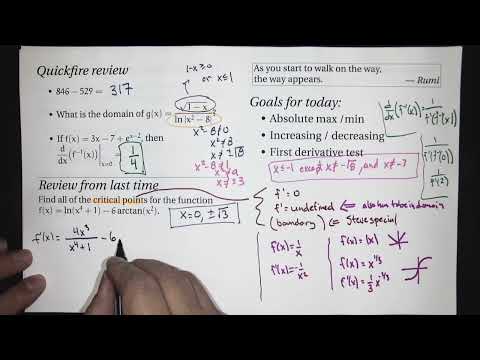
- Reviews the domain of a function involving √(1−x) and a logarithm in the denominator.
- Checks the square-root condition, the logarithm’s input, and values that make the denominator zero.
- Reinforces three common domain hazards: invalid square roots, invalid logarithms, and division by zero.
4:40
Inverse Derivative at Zero Using f⁻¹(0)
- Uses (f⁻¹)'(a)=1/f′(f⁻¹(a)) to evaluate the inverse derivative at 0.
- For f(x)=3x−7+e^(x−2), identifies f⁻¹(0)=2 by substitution.
- Computes f′(2)=3+1=4, giving (f⁻¹)'(0)=1/4.
6:52
Critical Points: Zero Derivatives and In-Domain Undefined Derivatives
- Defines critical points as in-domain locations where f′ is zero or undefined; includes interval boundaries when making an extrema candidate list.
- Contrasts 1/x, which is undefined at 0 along with its derivative, with |x| and x^(1/3), whose derivatives are undefined at points in their domains.
- For f(x)=log(x⁴+1)−6 arctan(x²), differentiates and factors the numerator to find critical points at 0 and ±√3.
14:50
Absolute Extrema: The Closed-Interval Guarantee
- States that a continuous function on a closed, bounded interval [a,b] must attain both an absolute maximum and an absolute minimum.
- Outlines the candidate-list method: find critical points in the interval, evaluate the function at each candidate, then compare the outputs.
- Connects mathematical understanding with practice, emphasizing that working problems—not only hearing explanations—builds skill.
19:38
Absolute Extrema Example on [−1, 2]
- For f(x)=12x^(1/3)−3x^(4/3), checks the endpoints −1 and 2 along with critical points inside the interval.
- Finds f′(x)=4x^(−2/3)(1−x), so x=1 makes the derivative zero and x=0 makes it undefined while remaining in the function’s domain.
- Compares f(−1)=−15, f(0)=0, f(1)=9, and f(2)≈7.559; the absolute minimum is −15 at −1 and the absolute maximum is 9 at 1.
28:39
Increasing and Decreasing Intervals from Derivative Signs
- Defines increasing behavior as outputs rising from left to right and decreasing behavior as outputs falling from left to right.
- Uses the tangent-line interpretation: f′>0 indicates increasing behavior, while f′<0 indicates decreasing behavior.
- Finds where f′ is zero or undefined, splits the domain at those critical points, and tests one convenient value in each interval.
- Notes that conventions differ on including interval endpoints; the required notation may depend on the instructor or problem.
34:15
Cubic Monotonicity: Sign Chart at −1 and 3
- For y=x³−3x²−9x+17, computes y′=3x²−6x−9=3(x−3)(x+1).
- Uses critical points −1 and 3 to divide the real line into three intervals and tests easy values such as −2, 0, and 4.
- Finds the function increasing on (−∞,−1) and (3,∞), and decreasing on (−1,3).
40:32
Rational Monotonicity: h(y)=(y+1)/(y²+8)
- Applies the quotient rule to obtain h′(y)=−(y²+2y−8)/(y²+8)².
- Factors the numerator as −(y+4)(y−2); the denominator is always positive, so the critical points are −4 and 2.
- Tests the intervals around −4 and 2 to find increasing behavior on (−4,2) and decreasing behavior on (−∞,−4) and (2,∞).
46:17
First Derivative Test: Classifying Local Extrema
- Classifies a critical point by checking the derivative signs immediately to its left and right.
- A positive-to-negative sign change means the function rises then falls, giving a local maximum; a negative-to-positive change gives a local minimum.
- Positive-to-positive and negative-to-negative sign patterns indicate no local extremum.
- Applies the test to the cubic: −1 is a local maximum and 3 a local minimum; for the rational function, −4 is a local minimum and 2 a local maximum.
Summary, takeaways, and chapters were generated by AI from the video's transcript and may contain errors. The video belongs to its creator, Beard Meets Calculus.