Mon Oct 12, 2026 Lecture (L19, NOT L20!) Stewart Section 3.6 Hyperbolic Functions
 Watch on YouTube →
Overview
The lecture develops Stewart Section 3.6 by connecting hyperbolic functions to familiar calculus and geometry: it reviews the graph-based meaning of the derivative of arctan, defines sinh and cosh from exponentials, and derives their identity and derivatives. It also compares the unit-circle parameterization (cos t, sin t) with the right branch of the hyperbola (cosh t, sinh t), then uses graphs to explain why tanh has derivative sech².
Key takeaways
- The graph of arctan makes d/dx(arctan x) = 1/(1+x²) visually plausible: arctan’s slopes remain positive, peak at 1 at x = 0, and approach 0 toward both ends.
- The exponential definitions sinh x = (eˣ − e⁻ˣ)/2 and cosh x = (eˣ + e⁻ˣ)/2 yield the identity cosh²x − sinh²x = 1, not the trigonometric sum-of-squares identity.
- The parameterization (cosh t, sinh t) traces the right branch of x² − y² = 1, and t equals twice the associated hyperbolic-sector area rather than the arc length.
- Hyperbolic derivatives have a distinctive pattern: (sinh x)' = cosh x, (cosh x)' = sinh x, and (tanh x)' = sech²x.
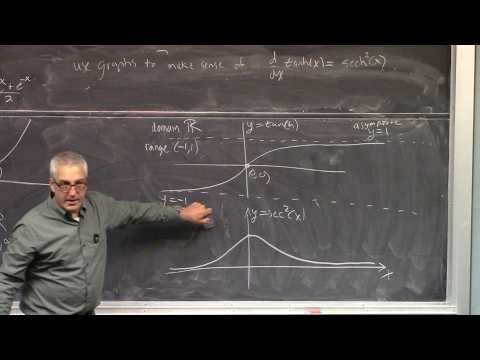
- Tanh is bounded between −1 and 1 and resembles arctan graphically; its derivative sech² is largest at x = 0 and tends to zero as x approaches either infinity.
Chapters
0:00
Arctan’s Derivative Read from Its Graph
- Reviews the rule d/dx(arctan x) = 1/(1+x²), previously derived using the inverse-function rule and a right triangle.
- Reflects the restricted tangent graph across y = x: arctan has domain all real numbers and range (-π/2, π/2).
- The graph of 1/(1+x²) stays positive, reaches 1 at x = 0, and approaches 0 as |x| grows, matching the slopes of arctan.
9:00
Exponential Definitions and Graphs of sinh and cosh
- Defines sinh x = (eˣ − e⁻ˣ)/2 and cosh x = (eˣ + e⁻ˣ)/2.
- Cosh passes through (0,1), has domain all real numbers, and range [1,∞); its ends grow like eˣ/2 on the right and e⁻ˣ/2 on the left.
- Sinh passes through (0,0), has domain and range all real numbers, and rises to the right while falling without bound to the left.
13:10
sinh End Behavior and the Fundamental Hyperbolic Identity
- Evaluates limₓ→∞ sinh x as ∞ because eˣ grows without bound while e⁻ˣ approaches zero.
- Expands cosh²x and sinh²x from their exponential definitions; the e²ˣ and e⁻²ˣ terms cancel in the difference.
- Obtains cosh²x − sinh²x = 1, contrasting with the trigonometric identity cos²x + sin²x = 1.
19:00
Unit-Circle Geometry: Angle, Arc Length, and Area
- The point (cos t, sin t) lies on the unit circle because x² + y² = 1.
- For a unit circle, t is both the angle in radians and the arc length along the circle.
- The sector area is t/2, so the angle or arc length t equals twice the sector’s area.
22:38
Hyperbola Geometry and the Meaning of the Parameter t
- The point (cosh t, sinh t) satisfies x² − y² = 1 and lies on the hyperbola’s right branch because cosh t is positive.
- The hyperbola opens left and right, passes through (1,0) and (−1,0), has no y-intercepts, and approaches the asymptotes y = x and y = −x.
- Unlike the unit-circle case, t is not the hyperbolic arc length; it equals twice the area of the hyperbolic sector.
27:18
Reciprocal Hyperbolic Functions and Related Identities
- Defines csch x = 1/sinh x, sech x = 1/cosh x, and tanh x = sinh x/cosh x.
- Dividing cosh²x − sinh²x = 1 by cosh²x gives 1 − tanh²x = sech²x.
- The exponential definitions provide a direct method for verifying further hyperbolic identities.
31:30
Derivatives of sinh, cosh, and tanh
- Differentiating sinh x = (eˣ − e⁻ˣ)/2 gives d/dx(sinh x) = cosh x; the chain rule makes the derivative of e⁻ˣ equal to −e⁻ˣ.
- Differentiating cosh x = (eˣ + e⁻ˣ)/2 gives d/dx(cosh x) = sinh x, with no leading negative sign.
- The quotient rule for tanh x = sinh x/cosh x produces (cosh²x − sinh²x)/cosh²x = sech²x.
39:14
Graph of tanh and the Shape of Its Derivative sech²
- Tanh passes through (0,0), has domain all real numbers, and has horizontal asymptotes y = 1 and y = −1, so its range is (−1,1).
- The graph of tanh resembles arctan more than the unbounded trigonometric tangent function.
- Since (tanh x)' = sech²x, the slope is positive, equals 1 at x = 0, and decreases toward 0 at both ends; sech² has its maximum value 1 at the origin.
Summary, takeaways, and chapters were generated by AI from the video's transcript and may contain errors. The video belongs to its creator, Barsamian's Math Videos.