Molarity and pH, BIO105 Introductory Biology, David Champlin, USM
 Watch on YouTube →
Overview
In BIO105, David Champlin connects concentration to biological interactions, explains molarity as moles per liter, and shows how water’s molecular behavior underlies pH. He defines pH as the negative logarithm of hydrogen-ion concentration, explains that each pH unit represents a tenfold change, and applies molarity to preparing glucose and sucrose solutions using their molecular weights.
Key takeaways
- Biological effects often depend on concentration rather than total molecule count because concentration determines how frequently molecules encounter cells, receptors, or other targets.
- Molarity is calculated as moles per liter, making it a practical unit both for comparing solutions and for preparing them in the laboratory.
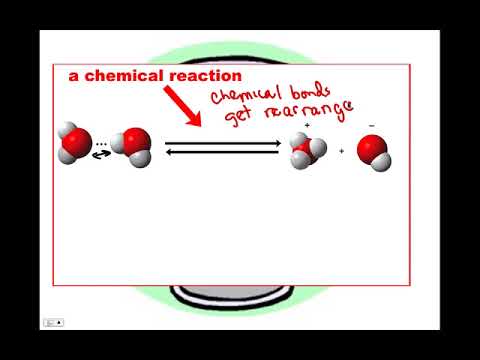
- Water’s partial charges allow neighboring molecules to attract one another, while continual bond rearrangement produces hydrogen ions relevant to pH.
- Because pH is the negative logarithm of H⁺ concentration, one pH unit corresponds to a tenfold change in hydrogen-ion concentration.
- Equal molarity means equal numbers of dissolved molecules per liter, not equal mass: one mole of glucose weighs 180 g, while one mole of sucrose weighs 342 g.
Chapters
0:00
Why Biological Systems Depend on Concentration and Molarity
- Cells from bacteria to plants and animals function in water, so the concentration of dissolved substances affects biological interactions.
- A bacterium encounters sugar more often when its concentration increases; doubling the water volume without adding sugar halves the concentration.
- Molarity, written with a capital M, measures moles of a substance per liter of solution.
- A mole is a very large counting unit used because biological samples contain vast numbers of molecules.
3:00
Water’s Molecular Interactions and the Logarithmic pH Scale
- Water is H₂O, with oxygen attracting shared electrons more strongly than hydrogen and creating partial charges that attract neighboring water molecules.
- Water molecules continually exchange hydrogen ions as bonds rearrange, creating a changing concentration of H⁺ ions.
- Square brackets denote concentration, and pH is defined as the negative logarithm of hydrogen-ion concentration.
- At pH 7, hydrogen-ion and hydroxide-ion concentrations are equal; acidic solutions have greater H⁺ concentration.
- A change from pH 4 to pH 5 means H⁺ concentration falls from 10⁻⁴ M to 10⁻⁵ M, a tenfold difference that can affect life.
10:00
Preparing One-Molar Glucose and Sucrose Solutions
- Equal molarities of glucose and sucrose contain equal numbers of molecules per liter, even though sucrose molecules are larger.
- Glucose has a molecular weight of 180 and sucrose 342; their gram molecular weights are 180 g/mol and 342 g/mol, respectively.
- To prepare a 1 M solution, dissolve one mole of the substance and bring the final solution volume to 1 liter.
- A 3 M glucose solution requires three moles, or 540 g using glucose’s 180 g/mol molecular weight, brought to a final volume of 1 liter.
Summary, takeaways, and chapters were generated by AI from the video's transcript and may contain errors. The video belongs to its creator, The New Evolution for Everyone.