MIME 4450 Lec 9 9 29 26
 Watch on YouTube →
Overview
William Evans explains how to configure Siemens TIA Portal V20 for course PLC work and teaches practical use of timers, counters, clock data, comparisons, arithmetic, and data moves. The central lesson is to choose PLC logic around real machine behavior: use timers for startup bypasses, motor restart delays, fault detection, and motion endpoints; distinguish ordinary part counters from high-speed position counters; and keep PLCs, robots, and vision systems coordinated through the PLC.
Key takeaways
- A Siemens TIA Portal timer measures elapsed time in milliseconds; use a non-retentive on-delay for most applications and reserve retentive timers for processes that must resume from their accumulated value.
- Timer bypasses and restart delays solve different machine problems: bypass a pump's low-pressure interlock during startup, and delay conveyor-motor restarts to avoid rapid cycling.
- A standard PLC counter can miss pulses shorter than its scan cycle; use high-speed counters with encoders for position control and ordinary counters for slower part totals.
- Timestamped PLC logs and synchronized controller clocks can establish the sequence of events during an industrial incident; modern systems can synchronize clocks to within milliseconds.
- In Allen-Bradley logic, a CTU and CTD sharing the same tag can form an up/down count, while Siemens provides a combined up/down counter option.
- PLC math expands ladder logic beyond Boolean conditions: comparisons can drive pass/fail logic, CALC or CPT blocks perform equations, and floating-point zero checks should use a tolerance.
Chapters
0:00
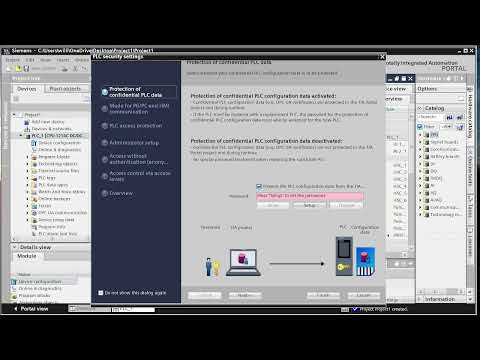
Downloading TIA Portal V20 and Transferring the 16 Licenses
- Download Siemens software directly from the Siemens website rather than a third-party source; the course uses Totally Integrated Automation Portal (TIA Portal) V20.
- The instructor describes two download routes and notes that the lengthy installation can take about 45 minutes.
- Use Automation License Manager to transfer the 16 license entries from a removable drive; retries or one-at-a-time transfers may be needed.
- Return borrowed license drives for reuse, and request another license if an entry does not work.
4:20
Creating a TIA Portal Project for the Available S7-1200 CPUs
- Create a new project, then select the controller that matches the hardware available in the lab.
- Most course units are S7-1200 CPUs such as the 1214C or 1215C; some are 2014-era models, and two S7-1500 units are also available.
- Select the correct firmware version—examples range from 4.0 to 4.7—and match fail-safe CPU configuration to hardware with the yellow marking.
- During project setup, disable the password option and skip synchronization for a single-computer project; multi-computer collaboration requires synchronization.
13:00
Course Scope: Timers, Counters, and the Demanding PLC Instruction Blocks
- The immediate focus is Chapters 7 and 8, with Chapter 11 as a possible additional topic; the class aims to finish the relevant material across two sessions.
- Chapters 17 and 19 contain complex instruction blocks that can require configuring 20–50 variables, where one incorrect setting may prevent operation.
- Students can use Siemens experience as a job qualification, while Evans notes that Allen-Bradley experience is valuable too.
15:00
PLC Timer Basics: Milliseconds, Presets, and Done States
- A PLC timer represents elapsed time numerically in milliseconds: 1,000 milliseconds equals one second.
- A timer uses an enable condition and preset, tracks an accumulated value, and provides a done status when timing completes.
- Timers create delays in logic and can be chained—for example, six timers can sequence the phases of a traffic-light controller.
- Allen-Bradley exposes a timer-timing bit; Siemens does not provide the same separate bit in the manner described.
22:00
Choosing TON and Retentive Timers Without Memorizing Every Variant
- The on-delay timer is the usual choice; Evans estimates it covers about 99% of timer applications discussed in class.
- A non-retentive timer resets to zero when its enabling condition turns off, while a retentive timer preserves elapsed time and needs an explicit reset.
- Evans's oatmeal example illustrates a retentive timer: pause cooking when oatmeal threatens to boil over, then resume from the accumulated time rather than restarting.
- An off-delay can often be built by using an inverted signal with an on-delay, and two timers can be combined to make a flashing circuit.
26:00
Timer Applications: Pump Startup, Conveyor Protection, and Motion Endpoints
- A pump may start below its low-pressure threshold, so a timed bypass lets pressure build before low-pressure protection becomes active.
- A high-level conveyor interlock stops upstream feeding, then adds a restart delay to prevent a large motor from rapidly cycling on and off.
- A proximity switch on a rotating shaft should produce recurring pulses; a signal stuck continuously on or off can indicate a failed conveyor or sensor.
- A delay after a photo-eye or endpoint sensor allows for placement tolerance, deceleration, and machine inertia before motion stops or reverses.
34:00
Why PLC Event Logs Need Synchronized Clocks
- PLC timers measure process delays; they should not substitute for a controller's clock when recording event times.
- Evans recounts the Cherry Street Bridge incident in Toledo, where flags obscured a pedestrian as the bridge tender opened the span.
- A programmer's timestamped records helped investigators determine that the incident resulted from the tender's error, illustrating the value of auditable event logs.
- Modern PLC systems can synchronize controller clocks to within milliseconds, making event sequences across multiple PLCs easier to reconstruct.
40:00
Handling Chattering Proximity Signals and Photo-Eye Timing
- A proximity switch can chatter as it detects a target, so the program must decide whether to act on the first brief pulse or wait for a stable signal.
- For high-throughput cyclic production, reacting to the first pulse may preserve output; requiring stability can improve certainty but reduce production speed.
- A fixed half-second debounce is not universally appropriate: repeated delays can substantially slow a production line.
- A photo-eye's trailing edge can start a timer that determines how far a conveyor carries an item before stopping.
45:00
PLC Scan Cycles and When to Use High-Speed Counters
- A PLC scan reads inputs, executes program rungs sequentially, writes outputs, and repeats; scan times discussed are roughly 1–10 milliseconds.
- Ordinary counters work when input pulses remain long enough for the scan to detect them—Evans uses roughly 10–20 milliseconds as a practical range.
- Shorter pulses can occur entirely between scans, requiring a dedicated high-speed counter.
- Use ordinary counters for part totals and high-speed counters with encoders for precise position control.
51:00
Siemens and Allen-Bradley Up/Down Counter Differences
- Siemens provides separate count-up, count-down, and combined up/down counter forms.
- Allen-Bradley uses separate CTU and CTD instructions; assigning both the same tag creates a shared up/down count.
- The paired Allen-Bradley instructions must use one of each type with the same address; duplicating two CTUs or two CTDs does not produce the same behavior.
- Evans previews a Chapter 8 conveyor-and-box example that uses an up/down count to track items entering and leaving.
55:00
PLC Math: Comparisons, Calculations, Limits, and Floating-Point Caution
- Chapter 8 adds numerical operations to Boolean logic: comparison instructions act as pass/fail conditions that can be combined with relay bits.
- Allen-Bradley offers the CPT compute instruction, while Siemens provides a CALC-style calculation block for equations.
- The LIM/limit instruction passes values inside a range when the minimum and maximum are ordered normally; reversing their order can test values outside the range.
- Floating-point arithmetic is useful for many calculations, but exact comparison with zero can fail because rounding may produce a tiny nonzero result; Evans recommends a small tolerance such as 0.00001.
1:01:00
MOVE Instructions for Transferring PLC Data
- MOVE instructions copy a value from one variable or location to another when a specified condition occurs.
- Data transfers between PLC logic and other devices require choosing compatible data types, such as integer or floating-point values.
- Evans emphasizes MOVE as a frequently used instruction, while noting that rounding, truncation, ceiling, floor, and swap operations are less common in his work.
1:03:00
The PLC as the Integration Hub for Robots and Vision Systems
- In a cell combining a PLC, robot, and vision system, the PLC commonly coordinates data and acts as the process's central control point.
- Ladder logic is presented as a fast way to prototype and bring a working control sequence online, even when the final system may use another language.
- Evans raises the engineering choice between prototyping with a PLC and camera system or implementing a production design in a higher-level environment such as ROS.
- For large-scale production—such as building a thousand units—he suggests purpose-built ROS tabletop systems may be more appropriate than replicating a PLC-and-camera prototype.
Summary, takeaways, and chapters were generated by AI from the video's transcript and may contain errors. The video belongs to its creator, Wm_T Evans.