MIME 4450 Lec 11 10 6 26
 Watch on YouTube →
Overview
The lecture connects PLC sequencing and memory circuits to machine-vision projects, then introduces Cognex In-Sight spreadsheet programming and inspection tools. It explains how to switch between a six-timer traffic-light sequence and a two-timer flashing mode at sequence boundaries, previews quiz topics, and demonstrates how PatMax, histograms, edge tools, blobs, and PLC-triggered image acquisition can support automation projects.
Key takeaways
- A mode change that must occur only at the end of an active sequence needs a memory circuit; a physical selector switch cannot guarantee the precise transition timing.
- The traffic-light exercise separates the six-timer regular sequence from the two-timer flashing sequence and uses the T2 and T6 completion conditions to control the mode memory.
- Cognex PatMax uses a trained reference pattern and a separate find operation; its match threshold controls how much similarity is required for a detection.
- Cognex In-Sight spreadsheet logic evaluates top to bottom like PLC ladder logic, while a PLC trigger can initiate image acquisition and pass inspection results to a robot.
- Histogram, edge, and blob tools measure different image properties: grayscale distributions, feature lengths, and counts of connected regions, respectively.
Chapters
0:00
Designing Regular and Flashing Traffic-Light Modes
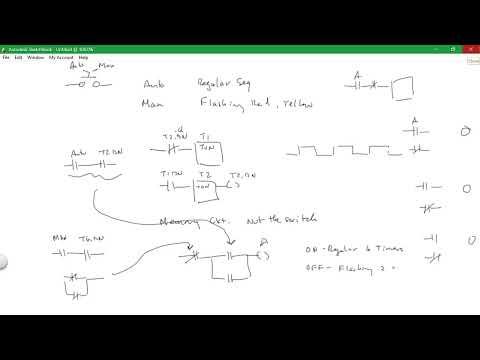
- The exercise requires a selector with regular, manual, and auto modes, including a flashing red-and-yellow sequence.
- Build the flashing sequence with two timers; setting each phase to 2 seconds creates a repeating on/off pattern.
- The regular sequence uses six timers, while the flashing sequence uses two.
1:20
Using a Memory Circuit to Switch at Sequence Boundaries
- A selector switch alone cannot safely change modes immediately; a memory circuit must wait until the current timing sequence finishes.
- The memory circuit represents regular operation as on and flashing operation as off.
- The example sets the memory state when the flashing sequence reaches T2 done and clears it at the regular sequence boundary using T6 done with the required inverted logic.
6:20
Applying Memory Logic and the 20-Minute Grading Rule
- Use the memory bit in both the timer-chain logic and the individual light-output logic so only the selected sequence can operate.
- A human operator cannot reliably switch modes at the exact timing boundary, which is why the circuit must perform the change automatically.
- The grading guideline rewards a correct memory circuit most highly: 50/50 for a working design, with partial credit for a close attempt containing the right components.
12:41
Preparing for the PLC Logic Quiz
- The upcoming quiz is expected to include three problems: verbal AND/OR logic translated into ladder logic, memory-circuit conversion, and a short scenario-based program.
- Students should practice converting seal-in circuits to set/reset instructions and vice versa using Chapter 6.
- The Chapter 8-style problem may alternate direction repeatedly, using a memory bit or number parity to choose right versus left; five reference sheets are allowed.
15:48
Finding Course Notes and Choosing Vision Projects
- The course site provides a 19-page notes document and an updated project list under MIME 4450.
- Potential project platforms include Cognex, FANUC vision, and HiWonder systems; a project without vision is also permitted.
- The instructor planned to bring a DVD player with Version 20 software to room 1100 at 11:00 and directed students to collect the required disc and materials.
20:25
Why Cognex Uses Spreadsheet-Style Vision Programming
- Cognex offers EasyBuilder, spreadsheet programming, and a more advanced procedural programming approach; the lecture focuses on the spreadsheet method.
- The demonstration uses In-Sight Explorer, while newer In-Sight Vision Suite software has similar fundamentals and additional capabilities.
- The course notes explain how to express AND, OR, and NOT logic in spreadsheet-style cells.
23:02
Machine Vision's Shift from Custom Systems to Lab Cameras
- Industrial inspection systems once cost hundreds of thousands of dollars and were often proprietary, returning only a pass/fail signal to the plant.
- Cognex and Keyence are common machine-vision brands in factories; Cognex is based in Boston, Massachusetts.
- The lab acquired Cognex cameras for about $6,000 each, compared with an estimated industrial installation price of about $15,000 per unit.
29:16
Cognex Camera Hardware, Wiring, and Available Platforms
- The In-Sight 7802 is a vision processor and camera system, not merely a camera; its Ethernet cable carries communications and it requires 24-volt power.
- The small power connector is fragile, with red as positive and black as negative; additional wires carry other control signals.
- The lab also has newer Cognex cameras, FANUC-integrated cameras, and HiWonder systems, but the lecture focuses on Cognex; a camera-based FANUC project can count as one of the required devices.
35:21
Connecting In-Sight Explorer and Opening Spreadsheet Mode
- Connect to the physical camera, such as Cam 1, instead of selecting the emulator.
- Use View → Spreadsheet to open the logic-oriented programming interface; View also toggles between Spreadsheet and EasyBuilder.
- Adjust image exposure and focus, then acquire a picture before trying to evaluate its contents.
40:00
Using Cognex Documentation and Training a PatMax Pattern
- The Cognex spreadsheet school materials include sample images, a lab exercise, and a manual; the manual covers connecting, image acquisition, and vision tools.
- PatMax requires two distinct operations: Train PatMax Pattern establishes a reference, and Find PatMax Pattern searches for that reference in later images.
- Add a vision function to a spreadsheet cell through the function menu; the trained region should outline only the target object, not surrounding items.
47:00
PatMax for Rotation, Scale, and Dice Recognition
- PatMax can locate patterns despite changes in orientation or scale and can even recognize a crumpled-and-unfolded paper pattern.
- For dice, PatMax can locate each die, identify the number of pips, and report orientation, making a Yahtzee robot project a possible application.
- Set a match threshold—such as 50%, 70%, or 90%—to determine the minimum similarity required for a positive detection.
54:48
Measuring Images with Histograms, Edge Tools, and Blobs
- A histogram counts grayscale pixel values within a selected region of interest.
- An edge tool measures a feature length, allowing a system to detect whether a part is out of specification.
- A blob is a connected region of similar grayscale values; counting one versus two blobs can reveal a broken filament or divided feature.
59:09
Writing Vision Logic and Triggering Inspection from a PLC
- Cognex spreadsheet programming resembles Excel logic but is Cognex software; its logic evaluates from top to bottom like a PLC scan.
- A PLC can send a trigger bit to the camera, which captures and analyzes an image before returning results for the PLC or robot to use.
- Inspection results can guide a robot directly—for example, locating dice, reporting their orientation, and directing an arm to pick and place them.
Summary, takeaways, and chapters were generated by AI from the video's transcript and may contain errors. The video belongs to its creator, Wm_T Evans.