MidTermPrep2. VectorAddition jjPHY203 FA26
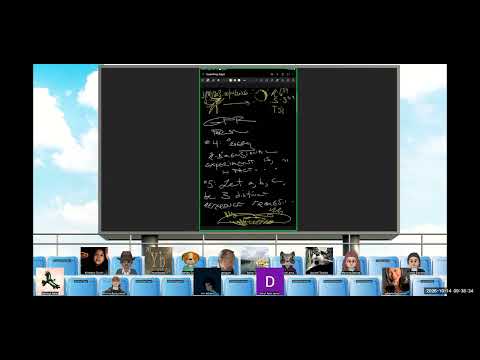 Watch on YouTube →
Overview
Dr. Yaverbaum prepares students for the PHY203 midterm by showing how to add two-dimensional vectors with tip-to-tail diagrams, perpendicular components, and an x-y tally. He then applies the same component method to velocity vectors, explaining that Galileo’s principle of relativity determines which velocities can be combined: velocities across linked reference frames add to give a third frame’s velocity.
Key takeaways
- For vector addition, place arrows tip-to-tail; the resultant begins at the first vector’s tail and ends at the last vector’s tip.
- Resolve every two-dimensional vector into signed horizontal and vertical components, add the x-values and y-values separately, then use the Pythagorean theorem and inverse tangent to recover magnitude and direction.
- For a 10 m displacement at 30° south of east, the components are approximately 8.66 m east and 5 m south; paired with 5 m north, the vertical components cancel and the net result is 8.66 m east.
- Galilean relative velocities add across linked frames: V_AB + V_BC = V_AC, so a person’s velocity relative to a train combines with the train’s velocity relative to the ground.
- To compare two velocities measured in the same frame, subtract them; cars moving at 60 mph and 40 mph in the same direction differ by 20 mph relative to each other.
- For the river example, label water, boat, and shore as separate frames and follow the subscript order; reversing a relative velocity flips its direction before applying the linked-frame addition rule.
Chapters
0:00
Midterm Logistics, Open-Resource Rules, and Class Context
- Dr. Yaverbaum says the exam will be posted by Friday at 8:00 PM and is due at the start of Wednesday’s class; students should communicate about emergencies in advance.
- Students may use resources and collaborate, but should produce work that shows their own understanding in the context of PHY203.
- Dr. Yaverbaum recommends reviewing this class’s past midterm walkthroughs and testing understanding by explaining the physics aloud to a classmate.
13:18
The Free-Float Problem Combines Vector Addition and Galileo’s Relativity
- Dr. Yaverbaum identifies the practice exam’s second-to-last, free-float problem as its most conceptually demanding question.
- The problem combines two skills: calculating vector sums in two dimensions and interpreting sums of velocity vectors through Galileo’s principle of relativity.
- He notes that the final airplane-and-bomb question is a horizontal projectile problem, comparable to Lab 4.
16:45
Lab 3 Displacement as a Model for Two-Dimensional Vector Addition
- A displacement example asks for the total result of walking 5 m north and then 10 m at 30° southeast.
- Total displacement means the vector from the starting position to the final position, not the total path length traveled.
- The Lab 3 approach provides a familiar foundation for a method that will later be applied to velocity.
19:24
Tip-to-Tail Diagrams Show the Resultant Vector
- Dr. Yaverbaum sets east as positive x and north as positive y, with west and south negative.
- To depict vector addition, place each vector’s tail at the previous vector’s tip; the resultant runs from the first tail to the final tip.
- A carefully scaled drawing can estimate the resultant’s magnitude and direction, though component calculations provide the analytical answer.
24:18
Resolve Each Vector into Perpendicular Components
- Treat each vector as the hypotenuse of its own right triangle, with horizontal and vertical legs representing its x- and y-components.
- A vector pointing directly north has zero x-component and a positive y-component; a southeast vector has a positive x-component and negative y-component.
- Component addition applies Galileo’s idea that two-dimensional motion can be analyzed as two independent one-dimensional motions occurring simultaneously.
28:04
Read Direction Angles and Draw Component Arrows Correctly
- “30° southeast” means 30° south of east; direction wording specifies the reference direction from which the angle is measured.
- Represent components as arrows placed tip-to-tail, rather than as unlabeled sides of a geometric triangle.
- Dr. Yaverbaum recommends drawing the horizontal component first and attaching the vertical component at its tip to keep the angle and component directions clear.
32:41
Use the Tail-to-Tail Angle for Direction
- Drawing the horizontal component first makes the relevant angle the angle between the original and resultant tails.
- This convention keeps the angle measured from a horizontal direction, producing descriptions such as “south of east.”
- Each diagonal vector should be resolved into two perpendicular arrows with explicit tips and tails.
37:50
Calculate Components with Sine and Cosine
- For a 10 m vector at 30° south of east, the horizontal component is 10 cos 30° ≈ 8.66 m east.
- The vertical component is 10 sin 30° = 5 m south, so its signed y-value is −5 m.
- Dr. Yaverbaum advises using degrees for PHY203 problems, which are presented in degrees; he contrasts this with Physics 204’s use of radians.
40:00
Add Signed Components in an X-Y Chart
- For the 5 m north plus 10 m at 30° southeast example, the component pairs are (0, 5) m and (8.66, −5) m.
- Adding each axis separately gives a net displacement of (8.66, 0) m: the north and south components cancel, leaving an eastward result.
- The x-y chart converts a two-dimensional vector sum into signed one-dimensional arithmetic.
43:01
Choose a Clear Submission Format and Mathematical Tools
- Dr. Yaverbaum accepts neat handwritten work that is scanned clearly or typed work that preserves the reasoning and diagrams.
- He warns that copied-looking text can obscure whether a student understands the physics.
- Overleaf is recommended as a free scholarly typesetting interface for LaTeX, though students should use it only if they can work with it effectively before the exam.
45:52
Rebuild the Resultant Triangle to Find Magnitude and Direction
- After adding x- and y-components, draw one final right triangle whose legs are the net horizontal and vertical displacements.
- Use the Pythagorean theorem for the resultant magnitude and inverse tangent, arctan(|y|/|x|), for its angle.
- State the quadrant and direction in words—for example, a vector with positive x and negative y points south of east.
58:30
Apply the Same Component Method to Every Vector Quantity
- The component procedure used for displacement also works for velocity, acceleration, and force vectors.
- Vector subtraction can be handled with the same signed-component arithmetic after accounting for the direction of the subtracted vector.
- For exam solutions, Dr. Yaverbaum expects diagrams that show each vector’s components and the final resultant triangle.
1:01:20
Galileo’s Relativity Rule for Adding Velocities
- Add velocities when they connect different but linked reference frames: velocity of A relative to B plus velocity of B relative to C gives velocity of A relative to C.
- For example, a person’s velocity relative to a subway can be added to the subway’s velocity relative to the ground to find the person’s velocity relative to the ground.
- Velocities of unrelated objects measured relative to the same observer are not automatically added just because both are velocity vectors.
1:05:27
Subtract Velocities to Compare Objects in the Same Frame
- Rearranging the relative-velocity equation shows that two velocities measured in the same reference frame can be compared by subtraction.
- If one car moves at 60 mph and another at 40 mph in the same direction relative to the highway, the first moves 20 mph faster relative to the second.
- The order of the subscripts and the English wording determine whether a relative velocity should be reversed or calculated by subtraction.
1:09:02
Set Up the River, Boat, and Shore Velocity Relations
- Label the three frames water (W), boat (B), and riverbank or shore (R); the example gives the shore relative to water as 3 m/s at 45° southeast and the boat relative to shore as 8 m/s at 30° northwest.
- Reversing a relative velocity flips its arrow: if the shore moves southeast relative to the water, the water moves northwest relative to the shore at the same speed.
- To find water relative to boat, use the linked-frame relation V_WB = V_WR + V_RB, reversing a given vector when its subscripts run the opposite way.
- Once the required relation is identified from the frame labels, resolve the relevant arrows into components and add them using the earlier x-y method.
Summary, takeaways, and chapters were generated by AI from the video's transcript and may contain errors. The video belongs to its creator, Dr. Yaverbaum.