MidTerm Overview jjPHY203 FA26
 Watch on YouTube →
Overview
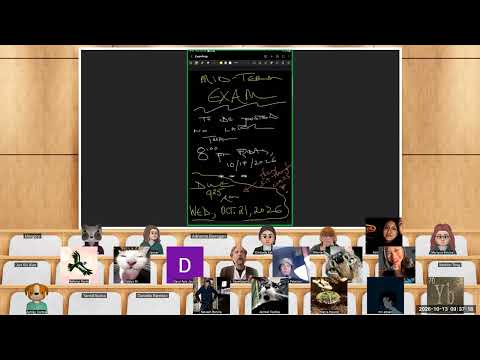
The midterm assesses kinematics through a take-home, open-world exam due Wednesday at 9:25 a.m.; solutions are expected to use the course’s five-step method and present an individual, self-sufficient explanation rather than copied answers. The review develops the central physics ideas needed for the hardest problems: multidimensional motion separates into independent one-dimensional axes, and Galileo’s principle of relativity explains reference frames, relative-velocity notation, and vector addition.
Key takeaways
- The midterm is an untimed, open-world take-home exam posted by Friday at 8:00 p.m. and due Wednesday at 9:25 a.m.; its grading emphasizes the five-step method and individually explained reasoning.
- Step 1 should describe the physical situation with a picture and fact pattern, labeling all symbols used later; graphs generally belong in the analysis stage rather than the initial diagram.
- Two-dimensional kinematics requires no new equations: solve the motion along each axis as an independent one-dimensional problem, then connect the axes through shared quantities such as time.
- A reference frame is an observer’s coordinate system and perspective on motion; v_AB denotes A’s velocity as measured by B, and an object’s velocity relative to itself is zero.
- Relative velocities reverse sign when observer and target are swapped, and velocities across three frames add as vectors: v_AC = v_AB + v_BC.
- When an exam offers a choice such as three problems out of four, students must commit to three complete solutions; extra answers earn no extra credit and may not be graded.
Chapters
0:00
Class Opening and Midterm Review Plan
- After greeting students, Dr. Yaverbaum frames the session as part of a two-day review for the Physics 203 midterm.
- The Google Classroom practice midterm is the curriculum guide, but the class will focus on concepts rather than solve every question point by point.
3:09
The Midterm Covers Kinematics and the Five-Step Method
- The exam covers kinematics, including motion definitions and equations, with one-dimensional problems extending into two-dimensional applications.
- Problems will resemble the practice document in format and content, but most are expected to call for a full five-step solution.
- Homework rubrics and recent assignments are intended to prepare students for the exam’s emphasis on showing reasoning.
4:22
Take-Home Exam Schedule and Monday Question Policy
- The exam will be posted in Google Classroom by Friday at 8:00 p.m. and is due at the start of class the following Wednesday, specified as 9:25 a.m.
- It is take-home, untimed, and open-world; students may consult online resources, AI tools, and one another.
- Monday’s class falls during the exam period: it will address useful material, and students may raise suspected errors or unclear wording without expecting a full exam review.
12:19
Open-World Work Must Show Individual Understanding
- Because answers and AI tools are readily available, grading focuses on whether the submitted work reflects the student’s own understanding and the class’s approach.
- The five-step method, especially the individuality criterion and Step 3’s setup, helps distinguish a class-grounded solution from a copied web solution.
- Treat the exam as a presentation: begin with a self-sufficient document that identifies the student, date, and exam, and explain the reasoning in a personal voice.
17:30
Attendance, Exam Choices, and Full Problem Commitments
- Students must attend class when the exam is due; Dr. Yaverbaum says missing or late attendance is an exam fairness issue, apart from emergencies.
- Use the five-step method unless the exam explicitly says otherwise; students may refer to earlier work, but should still present a complete solution.
- If instructed to choose three problems out of four, students must select and complete three: extra work earns no credit, and grading will follow the first three problems submitted.
24:07
Step One Diagrams Show the Situation, Not the Solution
- Step 1 is a diagram and fact pattern, not a place to begin analysis with a graph; graphs and vector diagrams generally belong later, especially in Step 4.
- A useful diagram places facts in physical space and labels every variable, constant, and symbol that will appear in Steps 3 and 4.
- For a motion problem like the Mercurio-and-Romeo example, label each object’s motion with symbols such as v_M and v_R, then list numerical givens beneath the picture.
- Graphs forced from isolated facts can misrepresent the situation because a graph usually communicates a trend across values.
33:30
Draft the Exam Like a Physics Presentation
- Use the five-day window to produce a rough draft and a revised final document instead of submitting the first attempt at writing the solution.
- In Step 3, identify principles and equations in the form used in class; add English explanations in Steps 3 and 4 to show how the setup leads to the answer.
- A recurring homework rubric deduction is worth clarifying before the exam, since the same expectations will apply to the submitted work.
35:41
Two-Dimensional Motion as Independent One-Dimensional Problems
- The Big Old Duck problem and Labs 3 and 4 introduce two-dimensional kinematics without requiring new motion equations.
- Galileo’s principle of relativity supports the idea that each axis follows the same physics independently, even when multiple axes are active at once.
- A two- or three-dimensional problem can therefore be separated into simultaneous one-dimensional problems, with the axes related through shared conditions such as time.
38:06
Lab 3 Vector Paths Resolve into Axis Components
- In the Lab 3 route-planning activity, diagonal trips can be decomposed into east-west and north-south components.
- East and west displacements cancel or combine independently of north and south displacements, regardless of the order of travel.
- The same axis-by-axis reasoning applies to the exam’s Big Old Duck-style problem and other multidimensional motion.
44:05
Use Galileo’s Principle to Set Up Relative-Motion Problems
- When setting up a problem such as the exam’s Big Old Duck variant, state why the axes can be analyzed independently before applying the one-dimensional equations.
- For relative-motion questions like the Romeo comparison, Galileo’s principle provides the class-grounded justification for comparing velocities.
- Step 3 can include English principles as well as equations; explaining the principle is preferable to inserting an unexplained formula found online.
46:10
Reference Frames and the Meaning of Relative Velocity
- A reference frame is a coordinate system and perspective on motion maintained by an observer regarded as at rest.
- In Galileo’s account, constant-velocity observers can each regard themselves as stationary; there is no absolute state of rest detectable by the laws of physics.
- The vector notation v_AB means the velocity of object A as measured in the reference frame of B, with A as the target and B as the observer.
56:24
When to Use Double-Subscript Velocity Notation
- Use relative-velocity notation when a problem compares objects or reference frames, especially when three objects appear.
- For a car reported at 50 miles per hour, the complete statement is that it moves at 50 miles per hour relative to Earth.
- The earlier Romeo problem involved Galileo’s principle, but students were not expected to use double subscripts before the notation had been taught.
1:03:28
Galilean Relative Velocity: Self-Speed Is Zero and Reversal Changes Sign
- Case 1: an object’s velocity relative to itself is always zero, such as v_AA = 0.
- Case 2: reversing the observer and target reverses the relative-velocity vector; if A sees B move east at 60 units, B sees A move west at 60 units.
- Both constant-velocity observers are valid under Galileo’s principle; neither frame is uniquely at rest.
1:07:46
Add Relative Velocities Across Frames as Vectors
- For three objects A, B, and C, the velocity of A relative to C equals the vector sum of A relative to B and B relative to C.
- For a person, subway, and Manhattan, the person’s velocity relative to Manhattan is the person’s velocity relative to the subway plus the subway’s velocity relative to Manhattan.
- On a down escalator moving at −10 mph, walking upward at +5 mph relative to the escalator gives a station-relative velocity of −5 mph.
- Vector addition also applies with negative signs and two-dimensional directions; the next class will work through the detailed mechanics for the practice exam.
Summary, takeaways, and chapters were generated by AI from the video's transcript and may contain errors. The video belongs to its creator, Dr. Yaverbaum.