Mathematical Foundations of AI Alignment, Lecture 9 (Omniprediction)
 Watch on YouTube →
Overview
Aaron Roth develops omniprediction as a way for one predictor to serve downstream decision makers with different actions and loss functions while offering guarantees against policies that use context directly. He shows that calibration protects best responses to forecasts, while multiaccuracy against tests derived from losses and benchmark policies controls the comparison to context-dependent alternatives; together, calibration error α and multiaccuracy error β yield an (α + β)-omnipredictor.
Key takeaways
- Calibration is self-referential: a constant 1/2 forecast is calibrated whenever the overall positive-outcome rate is 1/2, even if context perfectly identifies which cases are positive.
- No-swap-regret guarantees can be weak when a forecaster induces a constant action; they may compare only constant strategies and miss a better policy that conditions on context.
- In the binary-outcome setting, the real–fictional expected-loss gap for a policy equals a forecast residual weighted by that policy's change in loss between outcomes.
- Calibration controls the weighted-residual gap for forecast-based best responses because their actions depend only on the forecast; it does not generally control context-dependent benchmark policies.
- Multiaccuracy against tests derived from loss changes controls benchmark-policy transfer, and combined with calibration errors α and β gives an (α + β)-omniprediction guarantee.
- Blackwell approachability can enforce these residual constraints online with discretized forecasts and average error decreasing at O(1/√T), even in an adversarial setting with no assumed data distribution.
Chapters
0:00
From Calibration to a Shared Prediction Interface
- Roth frames alignment as giving many downstream decision makers a common prediction service despite their different actions and losses.
- Calibration is task-agnostic and supports guarantees for all decision makers, while decision calibration targets specified loss classes.
- Stacking decision makers increases the computational dimension and can worsen statistical bounds, motivating stronger but still practical guarantees.
7:00
Binary Outcomes, Context, and Calibration Definitions
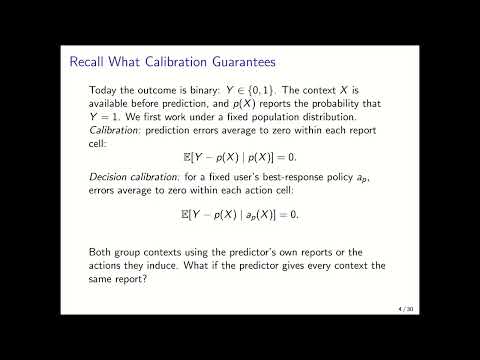
- For binary outcome Y and available context X, the predictor outputs P(X), interpreted as the probability that Y = 1.
- Calibration requires the average outcome to match the forecast conditional on each forecast value.
- Decision calibration asks only for unbiasedness conditional on the action induced by a forecast, so it is weaker than full calibration.
13:18
Why a Constant Forecast Can Be Calibrated but Uninformative
- If half of proposed systems are safe, always predicting 1/2 is calibrated even when context features perfectly distinguish safe from harmful systems.
- Calibration does not mention context, so it cannot require the predictor to use context that contains decision-relevant information.
- More discriminative forecasts impose stronger calibration conditions, while constant forecasts make the conditioning event vacuous.
16:07
Swap Regret Can Miss Better Context-Dependent Decisions
- In the deployment example, deploying a safe system has loss 0, deploying a harmful one has loss 1, and holding has loss 1/4.
- With the constant 1/2 forecast, the best response is always to hold; this can have no swap regret while ignoring context that identifies safe proposals.
- A policy that deploys safe proposals and holds harmful ones achieves expected loss 1/4, illustrating a benchmark that calibration and swap regret do not address.
21:22
Formalizing Losses and Context-Dependent Benchmark Policies
- Roth models a distribution over context-outcome pairs (X, Y), with each user choosing from an action set and minimizing a loss in [0, 1].
- A benchmark policy maps context directly to actions, potentially using features the shared predictor discarded.
- The goal is to show that a user's forecast-based best response performs at least as well as the best policy in a chosen benchmark class.
26:36
The Omnipredictor Guarantee Across Different Losses
- An ε-omnipredictor simultaneously guarantees, for every loss in a specified class, that best responding to its forecast is within ε of the best benchmark policy.
- The best response and the optimal benchmark policy can both vary with the user's loss function.
- For a forecast probability Q, squared Brier loss is minimized by reporting Q, whereas absolute loss is minimized by choosing 0 or 1 according to whether Q is below or above 1/2.
32:35
Constructing a Fictional World Where Forecasts Are Correct
- The fictional world keeps the context distribution but draws a synthetic outcome from a Bernoulli distribution with parameter P(X).
- In that world, the forecast is correct by construction, even if it is not the true conditional probability in the real world.
- The proof strategy compares real and fictional expected losses for both forecast-based best responses and benchmark policies.
36:56
Best Responses Are Optimal in the Forecast-Generated World
- A best response chooses the action minimizing expected loss under the forecast probability P(X).
- Because the fictional outcome is generated using P(X), that best response is pointwise optimal in the fictional world.
- Consequently, within the fictional world it cannot have greater expected loss than any policy in the benchmark class.
40:08
The Three-Step Transfer Proof for Omniprediction
- Start with the best-response policy in the real world and transfer its loss to the fictional world at a controlled cost.
- In the fictional world, switch to any benchmark policy without increasing loss, since best response is optimal there.
- Transfer the benchmark policy's loss back to the real world; controlling both transfers establishes the desired comparison.
46:20
Expressing Real–Fictional Loss Gaps as Weighted Bias
- For binary Y, action loss can be written as its loss at Y = 0 plus Y times the change in loss between outcomes 0 and 1.
- When comparing real and fictional risks, the outcome-independent loss term cancels.
- The remaining gap is the expectation of the forecast residual Y − P(X), weighted by the policy's loss-change function.
51:09
Calibration Controls the Best-Response Transfer
- The best-response action depends only on the forecast value, so conditioning on P(X) fixes the action and its loss-change weight.
- Expected calibration error measures the expected magnitude of outcome bias conditional on forecast values.
- For bounded losses, the weighted residual for any best-response policy is bounded by calibration error, allowing transfer between real and fictional risks.
57:46
Why Calibration Fails for Context-Using Benchmark Policies
- In the safe-versus-harmful example, the benchmark deploys only safe proposals even though the forecast is constantly 1/2.
- That policy's action and loss-change weight are correlated with the outcome even conditional on the forecast, so positive and negative residuals no longer cancel.
- The benchmark's weighted bias is −1/4 in the example, showing why calibration alone cannot control its real–fictional risk gap.
1:03:23
Multiaccuracy: Testing Forecast Residuals Against Context
- A test function maps context X to a value in [−1, 1]; multiaccuracy requires the residual Y − P(X) to have near-zero correlation with every test.
- Multiaccuracy error is the largest absolute test-weighted residual expectation over the chosen test class.
- The condition rules out detectable residual signal within that test class, without requiring the predictor to learn every true conditional probability.
1:08:23
Deriving the α + β Omniprediction Bound
- For each loss and benchmark policy, construct a test from the change in loss associated with the action selected at context X.
- Multiaccuracy error β controls the real–fictional transfer for benchmark policies, while calibration error α controls the best-response transfer.
- The three-step argument yields an (α + β)-omnipredictor for the specified loss and benchmark classes.
1:11:00
Iterative Corrections for Multiaccuracy Failures
- Blackwell approachability can enforce multiaccuracy because each test adds a linear constraint on the expected forecast residual.
- An iterative learner can use a test that witnesses an α-level failure to update the predictor and reduce squared error by at least α².
- Since squared error is nonnegative, this kind of witness can occur at most on the order of 1/α² times before no test in the class can find that level of failure.
1:18:26
Blackwell Approachability in the Online Adversarial Setting
- Each round, an adversary reveals context; the forecaster announces a distribution over forecasts, then observes the outcome and updates.
- The forecaster discretizes probabilities on an η-spaced grid and tracks a vector of test-weighted residuals, aiming to keep every coordinate near zero.
- The target set is response-satisfiable: if the outcome probability were known, a grid forecast within η would make each expected coordinate at most η in magnitude.
- Blackwell approachability drives average calibration and multiaccuracy errors down at an O(1/√T) rate without assuming an underlying distribution.
1:24:41
Omniprediction as a Practical Decision Interface
- One centralized predictor can serve users with different action sets and losses while letting each best respond to the same forecast.
- Context-dependent calibration-style tests provide stronger guarantees than ordinary calibration by accounting for features and benchmark policies.
- The approach avoids requiring exact conditional probabilities and extends to adversarial sequences through Blackwell approachability.
Summary, takeaways, and chapters were generated by AI from the video's transcript and may contain errors. The video belongs to its creator, Aaron Roth.