Mathematical Foundations of AI Alignment, Lecture 6 (Welfare Distortion)
 Watch on YouTube →
Overview
Aaron Roth studies how well social welfare can be optimized when the available data consists only of pairwise preference comparisons, not cardinal utilities. Under a shared-parameter Bradley-Terry model, he proves that the maximal lottery computed from the comparison matrix achieves worst-case distortion γ(β) = β / [4(σ(β) - 1/2)], and constructs indistinguishable instances showing no method can guarantee a smaller distortion.
Key takeaways
- Pairwise preference majorities do not determine social welfare: Bradley-Terry aggregation observes E[σ(βΔu)], while welfare depends on E[Δu], and nonlinearity can even reverse the sign of the comparison.
- For users sharing a Bradley-Terry parameter β, a maximum lottery guarantees welfare at least 1/γ(β) of optimum, where γ(β) = β / [4(σ(β) - 1/2)].
- The maximum lottery is minimax optimal under the model: a family of m indistinguishable instances with all comparison probabilities equal to 1/2 forces every algorithm to incur distortion at least γ(β) on some instance.
- The distortion bound approaches 1 as β approaches zero from above and grows like β/2 for large β; exactly β = 0 is a separate no-signal case.
- The result depends on individual users following Bradley-Terry choices with a common β; it does not require the population's aggregate preferences themselves to follow Bradley-Terry.
Chapters
0:00
From Pairwise Preferences to Social Welfare
- Earlier results address ordinal preferences from pairwise comparisons, including the maximum-lottery approach and aggregation impossibilities.
- Cardinal utility functions encode preference strength, making their sum a possible social-welfare objective.
- The central question is how closely pairwise data alone can guide welfare optimization when utilities are not observed.
6:00
Maximum Lotteries Are Strong Ordinal Choices, Not Welfare Guarantees
- A maximum lottery is a Nash equilibrium strategy in a zero-sum comparison game: no challenger lottery has positive expected margin against it.
- Its guarantee concerns how many users prefer one option over another, not how strongly they prefer it.
- A narrow majority with weak preferences can outweigh a smaller group of strong supporters in welfare, so ordinal victory alone does not imply higher social welfare.
15:30
Defining Population Welfare for Anonymous Service
- Each completion receives a utility between 0 and 1 for each user; the population is modeled as a distribution over utility functions.
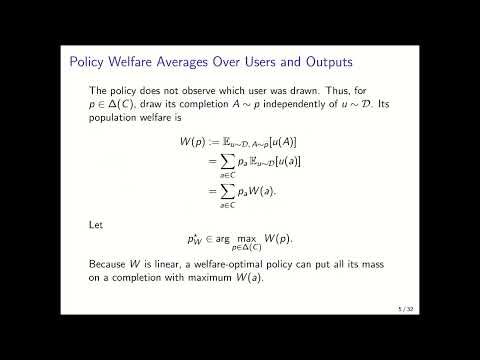
- The welfare of a completion is its expected utility for a randomly selected user, and a lottery's welfare is the probability-weighted average of its completions' welfare.
- If the utility distribution were known, linearity of expectation means a welfare-optimal lottery could place all its weight on a single highest-welfare completion.
- The anonymous-policy assumption gives everyone the same policy; personalization based on user information is deferred for later study.
21:00
The Shared-Parameter Bradley-Terry Observation Model
- For a user with utilities u(A) and u(B), the probability of choosing A is σ(β[u(A) - u(B)]), where σ is the logistic sigmoid.
- The parameter β controls choice sharpness: small β makes choices noisier, while large β approaches deterministic selection of the higher-utility option.
- The model applies to individual users, not necessarily to the population mixture, which can still produce cyclic aggregate preferences.
- The welfare guarantee depends on assuming users share the same β and follow this comparison model.
25:00
Worst-Case Distortion Measures Welfare Loss from Missing Utilities
- The observable comparison matrix gives the population probability that A is preferred to B, but does not directly reveal cardinal utilities.
- A policy's distortion is optimal population welfare divided by the welfare it achieves, with the worst case taken over utility distributions consistent with the data.
- Distortion 1 would mean attaining the welfare optimum; the goal is to minimize the largest possible ratio despite incomplete identification.
31:00
Why Bradley-Terry Mixtures Do Not Identify Welfare Differences
- With a linear choice model, averaging pairwise responses would expose average utility differences and identify the welfare-maximizing completion.
- Bradley-Terry instead averages σ(βΔu), so the expectation is outside a nonlinear function of each user's utility gap.
- Inverting the aggregate sigmoid cannot recover the average utility gap, and even the sign of aggregate preference can differ from the sign of the welfare difference.
35:00
Bounding the Logistic Margin with Linear Functions
- Roth defines h(z) = σ(βz) - 1/2, the individual comparison margin associated with utility gap z.
- Concavity on the relevant nonnegative range gives a tight tangent upper bound with slope β/4 and a chord lower bound with slope σ(β) - 1/2.
- These linear bounds make it possible to take expectations and connect comparison margins to average utilities.
40:00
The Wβ Weight Explains What Comparison Data Emphasizes
- The normalized margin can be written as a utility gap multiplied by a weight depending on the gap's absolute size.
- Because the Bradley-Terry sigmoid is nonlinear, large and small utility gaps receive different effective weights in aggregate comparisons.
- The data therefore contains a weighted average of utility differences, while welfare depends on the unweighted average.
45:00
Turning User-Level Choice Margins into Population Moments
- For each user, the A-versus-B margin is h(u(A) - u(B)); antisymmetry handles negative as well as positive utility gaps.
- Averaging over users gives the observed entry of the comparison matrix as an expectation of these nonlinear margins.
- The desired welfare gap is instead E[u(A) - u(B)], motivating bounds that relate the observed margin to welfare.
49:00
Apply Linear Margin Bounds to Any Pair of Completions
- For utility values x and y, the margin h(x - y) is bounded above by β times the upper-bound slope on x minus the lower-bound slope on y.
- A matching lower inequality follows by considering the reversed comparison and using h(-z) = -h(z).
- These inequalities work for every pair of utility values, so they remain valid after averaging over users and completion lotteries.
55:00
Aggregate the Bounds into Lottery Welfare Comparisons
- Averaging over users converts expected utilities of completions into population welfare; averaging over a lottery converts them into that lottery's welfare.
- The expected comparison margin between lotteries can therefore be bounded using weighted differences between their welfare values.
- The bounds supply the bridge needed to translate a maximum lottery's ordinal no-challenger condition into a welfare guarantee.
59:00
Maximum Lotteries Achieve the γ(β) Distortion Bound
- Define γ(β) as the ratio of the best linear upper-bound slope to the lower-bound slope: β / [4(σ(β) - 1/2)].
- A maximum lottery has nonnegative expected comparison margin against every challenger, including the population's welfare-optimal lottery.
- Combining that condition with the upper linear bound yields welfare(maximum lottery) ≥ welfare(optimum) / γ(β).
- The calculation does not require knowing the welfare-optimal lottery; it is used only to prove the guarantee.
1:02:00
How β Controls the Tightness of the Welfare Guarantee
- As β approaches zero from above, the sigmoid is nearly linear around the comparison range and γ(β) approaches 1.
- For large β, γ(β) grows approximately as β/2, so the worst-case welfare guarantee deteriorates as choices become sharper.
- At β = 0, comparisons contain no preference signal; the limiting guarantee as β approaches zero does not mean the exactly zero-signal case identifies welfare.
- The interpretation of β as inverse noise scale matters: lower β means noisier choices and a better bound under this model.
1:08:00
Why More Inference Cannot Beat the Bound in the Worst Case
- A more sophisticated algorithm might try to infer utility parameters or optimize over feasible utility distributions, but the theorem's lower bound rules out a better worst-case guarantee.
- The construction hides which completion is welfare-optimal while making all candidate instances generate the same observed comparison matrix.
- Since an algorithm receives identical data on these instances, it must choose the same lottery even when different choices would be needed for optimal welfare.
1:12:00
Constructing Indistinguishable Bradley-Terry Populations
- The lower bound uses m completions, with one hidden special completion A and m - 1 alternatives B₁ through Bₘ₋₁.
- Type-A users, present with probability α, value A at 1 and every alternative at 0; type-B users value A at 0 and each alternative at ε.
- The welfare of A is α, while the welfare of any alternative is (1 - α)ε.
- Choose α to balance type-A and type-B comparison margins, making every pairwise preference probability exactly 1/2.
1:18:00
The Lower Bound Matches the Maximum-Lottery Guarantee
- Because all m choices of the hidden special completion yield the same all-ties comparison matrix, any algorithm must output the same lottery on every instance.
- At least one completion receives lottery probability at most 1/m; the construction makes that least-weight completion the welfare-optimal special option.
- As ε approaches zero, the optimal-to-alternative welfare ratio approaches β / [4(σ(β) - 1/2)], exactly γ(β).
- Thus no mapping from the comparison matrix to a lottery can improve on the maximum lottery's worst-case distortion under the shared-β model.
1:24:00
Conclusion: Ordinal Data Has a Sharp Welfare Limit
- The maximum lottery is computable directly from pairwise comparisons and achieves distortion γ(β) under the Bradley-Terry assumption.
- The matching lower bound shows that this guarantee is minimax optimal, not merely a loose analysis of the maximum lottery.
- The result is conditional on the behavioral model, especially its shared β; alternative models or heterogeneous β values remain open extensions.
Summary, takeaways, and chapters were generated by AI from the video's transcript and may contain errors. The video belongs to its creator, Aaron Roth.