Mathematical Foundations of AI Alignment, Lecture 14 (AI Debate)
 Watch on YouTube →
Overview
Aaron Roth presents AI debate as a scalable oversight protocol: two computationally powerful agents argue opposite sides of a claim while a polynomial-time human judge checks a short, rule-bound transcript. The central result is that every PSPACE decision problem admits a debate protocol with perfect completeness and soundness, using binary search over a computation trace to reduce an exponentially long verification task to checking one step.
Key takeaways
- A polynomial-time judge can adjudicate a PSPACE decision problem by checking a short debate transcript rather than executing the underlying potentially exponential-time computation.
- The debate protocol halves a 2^m-step computation each round, requiring only m rounds before the judge checks one machine transition.
- Perfect completeness follows because a true computation has an actual midpoint that makes both subclaims true, regardless of which branch the opponent selects.
- Perfect soundness follows because every midpoint for a false claim creates at least one false subclaim, which a capable opponent can repeatedly select.
- The PSPACE result assumes strategically powerful agents: the judge remains polynomial-time bounded, but the debaters may need substantial computation to find winning strategies.
- Practical AI debate requires truth-preserving progress toward judge-checkable subclaims and agents capable of finding effective moves, not merely a protocol where such moves exist.
Chapters
0:00
From Decision Calibration to Scalable Oversight
- Aaron Roth shifts from earlier topics such as decision calibration and agreement protocols to cases where a model cannot be assumed perfectly aligned with its user.
- The goal is to benefit from AI systems that solve problems beyond human ability without simply trusting their claims of correctness.
- Roth frames AI debate as an early, stylized example of scalable oversight using multiple AI models.
4:43
AI Debate as a Trial Between Prosecutor and Defender
- A prosecutor model argues that a claim is true, while a defense model argues that it is false.
- Rather than checking a 10,000-page proof of the Riemann hypothesis line by line, the human judge aims to inspect a small disputed step.
- The interaction should narrow disagreement until the judge can verify the decisive detail directly.
13:05
Formalizing the Debate as a Zero-Sum Game
- The input is a bit string x, and the debate concerns whether a Boolean function f(x) equals 1 or 0.
- The proponent receives payoff J and the opponent receives payoff minus J, so each agent is rewarded for persuading the judge in its assigned direction, not necessarily for telling the truth.
- The protocol designer specifies allowed messages, turn order, and how the judge maps the transcript to a decision.
21:41
Perfect Completeness, Soundness, and the PSPACE Goal
- Perfect completeness requires the proponent to have a strategy that forces the judge to accept when f(x) = 1.
- Perfect soundness requires the opponent to force rejection when f(x) = 0.
- Roth states the main result: every problem in PSPACE has a debate protocol with a polynomial-time judge and these perfect guarantees.
30:44
Why PSPACE Exceeds Short-Certificate Verification
- Polynomial space allows a program to use memory polynomial in input length even when it takes exponential time to finish.
- For SAT, a satisfying assignment is a short certificate, but PSPACE also includes problems such as determining which player has a winning strategy in chess.
- The debate result reaches beyond NP-style short certificates, where a bounded verifier can check a compact proof directly.
35:25
Polynomial-Time Limits for the Judge and Transcript
- The judge must check protocol compliance and decide the winner in polynomial time.
- The number of debate rounds and the length of all messages must also be polynomial in the input size.
- The agents are modeled as computationally powerful, able to solve PSPACE problems, unlike the bounded judge.
40:35
Turing-Machine Configurations as Computation Snapshots
- Roth models a program with a Turing machine, which can be understood as a program interpreter such as Python.
- A configuration records the machine's full state, including memory needed to compute the next step.
- For a PSPACE computation, each configuration has polynomially many bits, and the transition rule M maps one configuration to the next.
46:22
Why a PSPACE Computation Takes at Most Exponential Time
- If configurations use at most m bits, there are at most 2^m distinct configurations.
- A halting computation cannot revisit a configuration, because repeating one would cause an infinite loop.
- Therefore, a polynomial-space computation halts within 2^m steps, allowing f(x) = 1 to be represented as reaching a canonical accepting state after that many steps.
51:13
The Debate Starts with a Long-Run Computation Claim
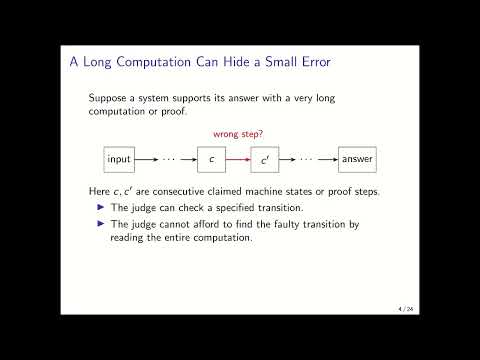
- The judge cannot simulate an exponentially long computation directly, but can inspect a polynomial-size configuration and run one transition.
- The initial public claim is that starting from the initial configuration and running for 2^m steps reaches the accepting configuration.
- Each later claim has the form: starting at configuration C, after 2^J steps the machine reaches configuration C prime.
57:00
Midpoint Configurations Split Claims in Half
- For a claim about 2^J steps, the proponent proposes a midpoint configuration Z after 2^(J-1) steps.
- The original claim is true exactly when both subclaims hold: C reaches Z in half the time, and Z reaches C prime in the remaining half.
- The opponent identifies which subclaim to continue debating, avoiding the exponentially large tree that checking both branches would create.
1:01:07
Protocol Update: Follow the Opponent's Chosen Half
- The public debate state contains configurations C and C prime plus an exponent J representing a 2^J-step claim.
- After the proponent gives Z, the opponent selects the left or right subclaim as the alleged point of failure.
- The judge updates the state to that subclaim and reduces J by one, so the disputed computation length halves each round.
1:08:24
At J Equals Zero, the Judge Checks One Machine Step
- Repeated halving reduces an exponentially long computation to a single transition after only m rounds.
- At J = 0, the judge checks directly whether one step from configuration C produces C prime.
- For a false arithmetic claim such as 0 plus 8 equals 9, the opponent keeps selecting a false subclaim until the judge can catch it.
1:14:22
Completeness: A True Claim Has a Real Midpoint
- When the current computation claim is true, the proponent supplies the actual configuration reached halfway through the computation.
- That midpoint makes both resulting subclaims true, so either choice by the opponent leaves a true claim for the next round.
- Repeating this strategy preserves truth through every round and lets the proponent win when f(x) = 1.
1:17:20
Soundness: The Opponent Preserves a False Claim
- If the current claim is false, no proposed midpoint can make both half-computation subclaims true.
- At least one subclaim must therefore be false, and the opponent can select that branch at every round.
- The false claim persists until the judge checks a single transition and rejects it, establishing perfect soundness.
1:20:44
Why Randomly Choosing a Branch Is Not Enough
- The judge's work is limited to polynomial-time bookkeeping and a final one-step simulation, while finding winning moves may require solving a PSPACE-hard problem.
- A stochastic judge that chooses a subclaim at random could accidentally follow a true branch and let a deceptive proponent win.
- The two-agent design relies on a strategically capable opponent to identify the false half at every round.
1:23:31
Three Requirements for Practical AI Debate
- A practical debate must make quantitative progress from a broad claim to narrower claims while preserving the relevant truth value.
- The process must eventually produce a subclaim that a human judge can verify independently.
- It is not enough for winning strategies to exist: debate agents must also be able to find them, an assumption Roth idealizes with PSPACE-capable agents.
1:26:23
AI Debate as One Approach to Scalable Oversight
- Roth identifies a gap between the complexity-theoretic theorem and realistic oversight of capable AI systems.
- The broader goal is to maintain human oversight when systems can solve problems whose answers people cannot directly verify.
- AI debate is one approach among several, and Roth points to ongoing research on relaxing its stylized assumptions.
Summary, takeaways, and chapters were generated by AI from the video's transcript and may contain errors. The video belongs to its creator, Aaron Roth.