Mathematical Foundations of AI Alignment, Lecture 13 (Hallucination and Calibration)
 Watch on YouTube →
Overview
Aaron Roth models factual hallucination using independent, arbitrary facts: each prompt has one correct answer among K+1 possibilities, and training data contains only correct answers but may leave substantial missing mass. He proves that hallucination rate plus a coarse calibration discrepancy is at least missing mass minus 2/K; because maximum-likelihood training favors calibration, it can favor hallucination over abstention when the model has not seen many prompts. He closes with the Good-Turing singleton estimator, which estimates missing mass from the fraction of training observations seen exactly once, with bias at most 1/n for a sample of size n.
Key takeaways
- With K incorrect answers and one correct answer per prompt, an unseen fact has only 1/(K+1) chance of being guessed correctly, regardless of the training algorithm.
- A lookup-table model that abstains on every unseen fact can have zero hallucination, but its calibration discrepancy can be as large as the missing mass.
- For any generator in the toy model, hallucination rate plus coarse calibration discrepancy is at least missing mass − 2/K.
- Maximum-likelihood training drives the coarse calibration discrepancy to zero when the model family can rescale high-confidence probabilities, leaving hallucination as the cost of substantial missing mass.
- The Good-Turing singleton fraction estimates expected missing mass for a sample of size n−1; for a size-n sample its bias is at most 1/n.
- The results apply to independent, arbitrary facts such as birthdays, not to questions whose answers can be deduced from learned rules, such as arithmetic.
Chapters
- Aaron Roth connects calibration to earlier results on agreement, including Aumann’s agreement theorem.
- The lecture asks why models trained to match a distribution may confidently state false facts instead of saying “I don’t know.”
- The proposed explanation uses only correct training facts, so hallucinations cannot be blamed on errors in the dataset.
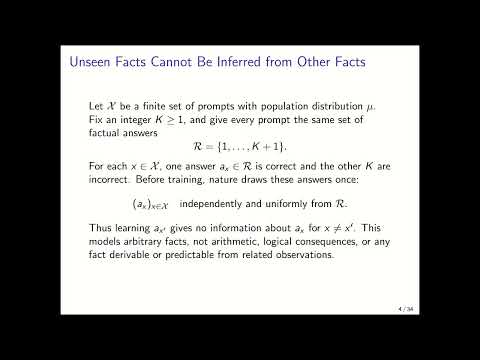
- The toy setting focuses on arbitrary facts, such as a person’s birthday, that cannot be inferred from unrelated facts.
- A model may learn mathematical rules and solve unseen arithmetic questions, but a birthday absent from its data has no such inferential route.
- For an unobserved birthday, the model has no evidence favoring one of the 365 month-and-day answers.
- Each prompt has K incorrect answers and one correct answer, for K+1 possible answers total.
- Nature selects each prompt’s correct answer uniformly and independently, so observing other prompts gives no information about it.
- Training consists of n independent prompt-answer samples; missing mass is the probability that a fresh prompt was not observed in training.
- For an unseen prompt, any predictor’s chance of choosing the correct answer is only 1/(K+1), because the true answer is independent of its training data.
- A system required to answer every prompt has error at least (1 − 1/(K+1)) times the missing mass.
- With birthdays, the unseen-prompt error is 364/365, multiplied by the fraction of people whose birthdays the model does not know.
- Allowing an “I don’t know” response lets a model answer known prompts from a lookup table and abstain on every unseen prompt.
- That lookup-table strategy can avoid all hallucinations, even though it cannot answer questions outside its training sample.
- The central issue becomes whether pre-training’s distribution-matching objective selects abstention or some other behavior.
- Nature’s distribution assigns probability 1 to the correct factual answer and 0 to incorrect answers or “I don’t know.”
- A generator produces an answer distribution conditional on each prompt, including the option to abstain.
- Hallucination rate is the probability that the generator returns an incorrect factual answer; both a correct answer and “I don’t know” are non-hallucinations.
- The lecture distinguishes a model that guesses uniformly on unseen prompts from one that says “I don’t know.”
- The guesser’s hallucination rate is (1 − 1/(K+1)) times missing mass, while the abstainer’s rate is zero.
- Reporting uncertainty is a possible alternative, but Roth notes challenges of usability and defining what an uncertainty estimate means for arbitrary factual queries.
- Nature and the generator share the same prompt distribution; they differ in their answer distributions conditional on each prompt.
- For each confidence value, semantic calibration compares the mass of question-answer pairs at that model confidence under the generator and nature.
- A model can be calibrated on each confidence level even when its factual behavior on unseen prompts is undesirable.
- The guessing model assigns probability 1 to memorized answers and 1/(K+1) to each answer on an unseen prompt.
- Its confidence-level masses match nature’s: known prompts have mass 1 minus missing mass, and unseen answers collectively have mass equal to missing mass.
- The abstainer assigns probability 1 to either a memorized answer or “I don’t know”; because nature never abstains, its calibration discrepancy can equal the missing mass.
- Roth coarsens confidence into a high-confidence set, where answer probability exceeds 1/K, and its low-confidence complement.
- The coarse calibration discrepancy is the absolute difference between nature’s and the generator’s mass on the high-confidence set.
- For any generator, hallucination rate plus this discrepancy is at least missing mass minus 2/K.
- The proof imagines a classifier whose examples are prompt-answer pairs, with a fair coin choosing positive or negative labels.
- A positive example pairs a prompt with its true answer; a negative example pairs it with a uniformly selected incorrect answer among K choices.
- On an unseen prompt, the label provides no information about which answer is correct, so every classifier has error at least 1/2 there.
- The constructed classifier accepts a prompt-answer pair as positive exactly when the generator assigns it probability greater than 1/K.
- That rule is equivalent to classifying the generator’s high-confidence set as valid and the low-confidence set as invalid.
- Since unseen prompts have classification error 1/2, the constructed classifier’s total error is at least half the missing mass.
- False positives are incorrect pairs in the high-confidence set; because their generator probability exceeds 1/K, their generated mass is at least twice their classification mass.
- False negatives are correct pairs in the low-confidence set; the low-set mass is bounded using the classifier’s false-negative rate and the coarse calibration discrepancy.
- At most 2/K mass in the low-confidence set can be assigned to the two non-hallucination outcomes: the correct answer and “I don’t know.”
- Combining the bounds yields hallucination rate at least twice classifier error minus calibration discrepancy minus 2/K, giving the tradeoff theorem.
- The tradeoff leaves two options when missing mass is large: accept substantial calibration error or incur a substantial hallucination rate.
- Roth argues that minimizing negative log-likelihood naturally selects low calibration error when the model family can adjust probability mass across confidence sets.
- Thus, likelihood-trained models can favor guessing over abstention on unseen factoids.
- The proof multiplies generator probabilities in the high-confidence set by a factor s, leaves other weights unchanged, then renormalizes.
- At s = 1 the model is unchanged; increasing or decreasing s shifts probability mass toward or away from high-confidence answers.
- The derivative of negative log-likelihood at s = 1 equals the difference between generator and nature mass on the high-confidence set.
- If the model is an interior likelihood optimum and can make this adjustment, the derivative must be zero, implying zero coarse calibration discrepancy.
- Missing mass is unknown by definition, but the number of prompts observed exactly once—singletons—provides a practical estimate.
- The Good-Turing estimator, historically used during World War II to estimate German tank production, uses the fraction of sample observations that are singletons.
- The singleton fraction is an unbiased estimate of expected missing mass for a sample of size n−1.
- Adding one observation can reduce missing mass by at most 1/n in expectation, so the estimator’s bias for a sample of size n is at most 1/n.
- For independent factoids, a model cannot avoid both hallucination and miscalibration when substantial probability mass remains unseen.
- Log-likelihood minimization favors calibration, so the theorem implies higher hallucination rates when missing mass is large.
- The Good-Turing singleton estimate offers a data-based way to assess whether the missing-mass regime is substantial.
Summary, takeaways, and chapters were generated by AI from the video's transcript and may contain errors. The video belongs to its creator, Aaron Roth.