Mathematical Foundations of AI Alignment, Lecture 11.2 (Tractable Agreement From Calibration)
 Watch on YouTube →
Overview
Aaron Roth develops a tractable agreement theorem for repeated human–AI forecasting, replacing the perfect Bayesian reasoning and common prior assumed by Aumann’s agreement theorem with conversation calibration. If each forecast is calibrated conditional on its own value and the other party’s previous forecast, disagreement must either improve squared error or end; with exact calibration, the fraction of conversations still unresolved after round R is at most 1/((R−2)ε²), and Blackwell approachability can enforce approximate calibration online.
Key takeaways
- Aumann’s agreement theorem requires common knowledge of posterior beliefs under a shared prior, whereas Roth’s sequential result works for arbitrary outcome sequences without any known probability distribution.
- Marginal calibration alone does not aggregate information: an AI can always predict 1/2 while a well-informed human predicts each binary outcome perfectly, and both remain calibrated.
- Conversation calibration conditions a forecast on its own value and the other party’s immediately previous forecast; for a finite ε-grid, this requires only about 1/ε² forecast pairs per round.
- With exact conversation calibration, the fraction of discussions unresolved after R rounds is at most 1/((R−2)ε²), because each unresolved disagreement forces at least ε² aggregate squared-error reduction.
- The squared-loss proof works by decomposing loss improvement into a squared forecast difference and a cross term; conditional calibration makes the cross term vanish when summed over forecast-pair bins.
- Blackwell approachability can enforce approximate conversation calibration online, avoiding Bayesian computation; sublinear cumulative calibration error contributes a vanishing per-case error term.
Chapters
0:00
Aumann’s Agreement Theorem and Common Knowledge
- Aumann’s theorem considers Bayesian agents with a commonly known joint prior over their evidence and a binary outcome.
- Common knowledge of each agent’s posterior means each knows the other’s belief, knows that the other knows, and so on.
- A graph of states connected by each agent’s indistinguishability relation represents common knowledge as the connected component containing the true state.
- If the agents’ beliefs are common knowledge, Aumann’s theorem says those beliefs must agree.
6:35
Why Bayesian Agreement Is Intractable in Practice
- A conversation can construct common knowledge by having agents repeatedly infer which observations could have produced earlier reports.
- With a finite state space, this process eventually converges, but may take as many rounds as there are states.
- The model requires a shared prior over potentially illegible human and AI observations, plus computationally demanding Bayesian updates.
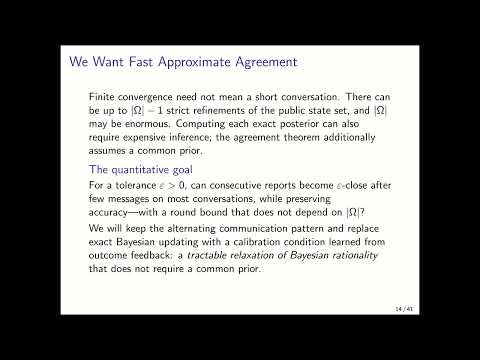
- Roth’s goal is a fast agreement result based on beliefs alone, without requiring perfect Bayesian reasoning or a known prior.
10:49
Approximate Agreement in Adversarial Sequences
- Roth relaxes exact equality to ε-approximate agreement: forecasts within ε count as agreement.
- Rather than assume a single stochastic conversation, the framework studies repeated conversations across days with arbitrary, potentially shifting outcomes.
- A stationary Bayesian setting with a known prior can be recovered as a special case by treating each day as a fresh draw.
- The central objective is fast agreement across a sequence, even when no stable data-generating distribution is assumed.
15:14
Human–AI Forecasting Protocol for Repeated Cases
- The motivating example is a doctor and an AI diagnostic system making probabilistic predictions for a new patient each day.
- The parties can use different private features; the binary outcome is revealed only after their discussion.
- The AI and human make unrestricted opening forecasts, then alternate messages on odd and even rounds.
- The conversation stops when consecutive forecasts differ by at most ε or when a preset message cap is reached.
24:06
Bayesian Rationality Reduced to Conditional Calibration
- A correct Bayesian agent is calibrated conditional on everything it knows, so any smaller collection of calibration tests is also satisfied.
- The theorem seeks a much weaker set of tests that is easy to satisfy without a shared prior or exact Bayesian updates.
- If only a polynomially sized set of conditions is needed, Blackwell approachability can enforce them in online adversarial settings.
- The design principle is to identify which limited Bayesian properties are actually necessary for agreement.
27:48
Why Marginal Calibration Alone Cannot Produce Agreement
- In the counterexample, outcomes are evenly split between 0 and 1, the AI always predicts 1/2, and an informed human predicts the outcome exactly.
- Both forecasters can be calibrated on their own predictions, yet the AI can ignore the human and the human can ignore the AI.
- Ordinary calibration therefore does not require either party to respond to the other’s forecast.
- Agreement requires conditioning on information revealed through the conversation.
30:25
Conversation Calibration Conditions on the Other Forecast
- The failure becomes visible when the AI’s 1/2 forecast is grouped by the human’s previous report of 0 or 1.
- Conversation calibration requires unbiased forecasts conditional on both the current speaker’s prediction and the other party’s immediately previous prediction.
- The condition uses only one round of conversational memory rather than conditioning on the full transcript.
- With a finite prediction grid, calibration need only cover roughly 1/ε² pairs of forecast values per round, rather than exponentially many full histories.
34:32
Forecast Bins and Conversation Calibration Bias
- For round k and forecast values P and Q, define a bin containing days that reach round k, follow a Q forecast, and then receive a P forecast.
- The bin’s calibration bias is the sum of P minus the realized binary outcome over those days.
- Exact conversation calibration sets every such bias to zero; approximate versions allow controlled, typically sublinear, bias.
- This condition is precisely calibration conditional on the current forecast and the previous message’s forecast.
40:00
Exact Calibration Gives a Fast Agreement Bound
- With exact conversation calibration, the fraction of conversations still unresolved after round R is at most 1/((R−2)ε²).
- To make the unresolved fraction at most δ, the displayed bound requires roughly 2 + 1/(δε²) rounds; a sharper analysis can replace 1/δ dependence with log(1/δ).
- The bound depends on the agreement tolerance ε, not on the forecasting task’s complexity or the agents’ initial methods.
- Long conversations are meaningful: under the proof, each sustained disagreement must reduce prediction error.
50:17
Proper Loss and Frozen Forecasts for Unequal Conversations
- To compare accuracy across rounds, forecasts from conversations that already ended are frozen and propagated to later rounds.
- Roth measures accuracy with squared loss, also called Brier loss, and notes that any proper loss such as cross-entropy can serve the same role.
- A proper loss is uniquely minimized by predicting the true probability, making it suitable for tracking information gains.
- Only conversations still active at round k can change the aggregate loss between rounds k−1 and k.
54:25
Squared-Loss Decomposition Reveals the Information Gain
- For a previous forecast f, a new forecast p, and outcome y, the loss reduction decomposes into (p−f)² plus a residual cross term.
- When the forecasts disagree by more than ε, the squared-difference term is at least ε².
- The cross term could erase that gain on individual days, so the proof controls it in aggregate using calibration.
- This decomposition connects conversational disagreement to measurable improvement in predictive accuracy.
57:48
Calibration Bins Cancel the Squared-Loss Cross Term
- Within a conversation-calibration bin, the current forecast P and previous forecast Q are fixed across all included days.
- That lets the proof factor the cross term into a constant proportional to P−Q times the bin’s summed calibration bias.
- Exact calibration makes the bias zero, so the cross terms vanish when summed over the bins.
- The aggregate loss decrease is therefore driven by squared differences between the successive forecasts.
1:01:35
Telescoping Error Bounds Limit Unresolved Conversations
- Every conversation that remains active must still have forecasts separated by more than ε, yielding at least ε² loss reduction at that round.
- Summing these reductions over rounds telescopes; total squared error starts at no more than the number of days and cannot fall below zero.
- The resulting cumulative bound limits the total number of active conversation-rounds to at most T/ε² for T days.
- Since conversations unresolved at the final cap were also unresolved at earlier rounds, the final unresolved fraction is bounded by 1/((R−2)ε²).
1:07:03
Linking Round Three Back to the Opening Forecast
- The basic calibration conditions begin at round three, so they guarantee improvement over round two but do not by themselves prevent loss of information from round one.
- Roth patches this gap by requiring the round-three forecast to be calibrated conditional on the AI’s opening forecast as well as the human’s round-two forecast.
- This adds another set of pairwise constraints without requiring a full three-round history or the larger 1/ε³ collection of triples.
- The added condition ensures round three is no less accurate than round one, while later rounds continue improving on adjacent rounds.
1:15:01
Long Conversations Certify Large Accuracy Gains
- Bayesian agents with a correct prior satisfy the conversation-calibration conditions because their forecasts are calibrated conditional on all available information.
- The theorem needs only the limited conditional-calibration properties, not a prior, Bayesian updates, or a stochastic environment.
- The cumulative argument also shows that long conversations entail substantial error reduction; if discussion adds little information, it should end sooner.
- The stronger accuracy statement relates improvement to the aggregate number of conversation-rounds that remain active.
1:19:29
Approximate Calibration and Blackwell Approachability
- In practice, calibration biases are not exactly zero; the proof carries their total magnitude as an additive error term.
- When calibration error grows sublinearly with the number of cases, its contribution per case vanishes asymptotically.
- Blackwell approachability can enforce the conditions online, with one coordinate for each pair of current and previous forecast values.
- The response-satisfiability check is straightforward: if the outcome’s expected value is known, predict it or the nearest value on the finite forecast grid.
1:26:12
Takeaway: Conditional Calibration Makes Disagreement Productive
- Aumann’s agreement result shows that sharing beliefs can suffice for eventual agreement without sharing all private observations.
- Roth replaces demanding Bayesian assumptions with calibration conditional on the other party’s previous forecast.
- Under that condition, a party that continues to disagree must add useful information and reduce prediction error.
- Because squared error cannot decrease indefinitely, the parties must reach ε-approximate agreement quickly.
Summary, takeaways, and chapters were generated by AI from the video's transcript and may contain errors. The video belongs to its creator, Aaron Roth.