Linear Algebra for Engineers lecture 23: Markov Chains and PageRank
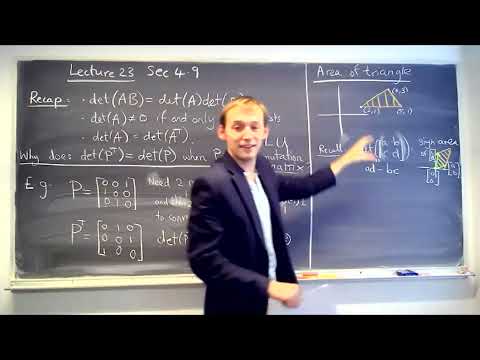 Watch on YouTube →
Overview
Alex Townsend connects linear algebra to Google PageRank by defining Markov chains as probability vectors repeatedly transformed by a column-stochastic matrix, then computing their steady states as normalized vectors in the null space of I minus A. A two-location jumping-spider example illustrates the calculation, while a four-page web graph shows how a steady-state distribution can rank pages by long-run visit probability; Townsend also reviews determinants and their use in calculating signed geometric areas and volumes.
Key takeaways
- With column vectors, a stochastic transition matrix has probability vectors as columns, and multiplying A by the current distribution produces the next distribution.
- A Markov chain's steady state solves A x = x, equivalently (I − A)x = 0, and must be normalized so its entries sum to 1.
- In the two-location spider example, the transition probabilities yield a steady state of (1/3, 2/3), giving the long-run location probabilities.
- PageRank models a random surfer who follows outgoing hyperlinks; the stationary probability of visiting a page supplies its rank.
- A page's importance depends on the influence of pages linking to it, not merely on its raw number of incoming links.
- Determinants provide signed areas and volumes: a triangle's area is half the absolute determinant of its side vectors, while the determinant's sign preserves orientation.
Chapters
0:00
Larry Page, John Kleinberg, and Linear Algebra in Search
- Larry Page co-founded Google, whose PageRank algorithm uses linear algebra to rank web pages.
- John Kleinberg developed a mathematically related page-ranking algorithm used by Ask Jeeves, though Townsend notes it was harder to scale to the full internet.
- Townsend frames PageRank as an application developed across the next lectures.
3:20
Permutation Matrices Explain Why Transposition Preserves Determinants
- A permutation matrix is formed by reordering the rows of the identity matrix, as in the row swaps used in PA = LU.
- Each row swap changes a determinant's sign; the example permutation matrix takes two swaps, so its determinant is 1.
- For permutation matrices, row swaps correspond to column swaps, helping explain why det(A) = det(Aᵀ).
9:00
Use Determinants to Calculate Triangle Areas and Signed Volumes
- For a 2×2 matrix, ad − bc gives the signed area of the parallelogram spanned by its column vectors.
- To find a triangle's area, use vectors along its sides rather than its absolute coordinates, then take half the parallelogram area.
- The example produces signed area −3, so the triangle's ordinary area is 3; the sign records orientation.
- Triangulating polygons and decomposing 3D shapes into tetrahedra extends the determinant method to computational geometry.
17:45
Probability Vectors and Column-Stochastic Matrices
- A probability vector has nonnegative entries that sum to 1, such as (1/3, 1/3, 1/3) or (1/2, 1/2, 0).
- A stochastic matrix is square and has probability vectors as its columns, so every column sums to 1.
- Under Townsend's column-vector convention, each matrix column describes the outcome distribution after starting in one particular state.
22:00
Define Markov Chains with the Jumping-Spider Example
- A Markov chain is a sequence of probability vectors linked by a stochastic transition matrix A, with xₖ₊₁ = A xₖ.
- In the two-location spider example, the transition probabilities are 0.6 and 0.4 from location one, and 0.2 and 0.8 from location two.
- Starting from either location's basis vector reveals the corresponding column of A; repeated multiplication generates the spider's probability distribution over time.
29:00
A Markov Chain's Steady State Is an Eigenvector
- A steady state is a probability vector x that remains unchanged after a transition: A x = x.
- If the chain reaches x, every later distribution remains x because applying A again leaves it unchanged.
- For the jumping spider, the steady state describes the long-run probabilities of finding it at each of the two locations.
32:25
Find the Spider's Steady State from the Null Space of I − A
- Rearranging A x = x gives (I − A)x = 0, so steady states lie in the null space of I − A.
- For the spider matrix with columns (0.6, 0.4) and (0.2, 0.8), row reduction gives a null-space direction proportional to (1/2, 1).
- Normalizing the entries to sum to 1 gives the probability vector (1/3, 2/3).
- The spider therefore spends one-third of the long run at location one and two-thirds at location two.
42:10
Model a Four-Page Website as a Random-Surfer Markov Chain
- Townsend represents four web pages as four states connected by directed hyperlinks, including links that do not have a reverse link.
- A random surfer at each page chooses uniformly among its outgoing links; three links from page one each receive probability 1/3.
- Each transition-matrix column records where the surfer goes after starting from its corresponding page.
45:20
Build the PageRank Transition Matrix from Web Links
- The four-page example uses a 4×4 stochastic matrix whose columns encode the link choices from pages one through four.
- From page two, the surfer moves to pages three and four with probability 1/2 each; from page three, the only link goes to page one.
- From page four, the surfer moves to page one or page three with probability 1/2 each, completing the transition model.
48:20
Rank Pages by Steady-State Visits and Address Ranking Ambiguity
- The example's steady-state probabilities have numerators that sum to 31; normalizing them yields the page ranking 1, then 3, then 4, then 2.
- Long-run visit probability captures not just the number of incoming links but also how influential the linking pages are.
- Some link structures may not produce a unique steady-state ranking; Townsend previews Google's teleportation idea as a way to address this issue.
Summary, takeaways, and chapters were generated by AI from the video's transcript and may contain errors. The video belongs to its creator, Alex Townsend.