Lecture 7: Passwords and For Loops
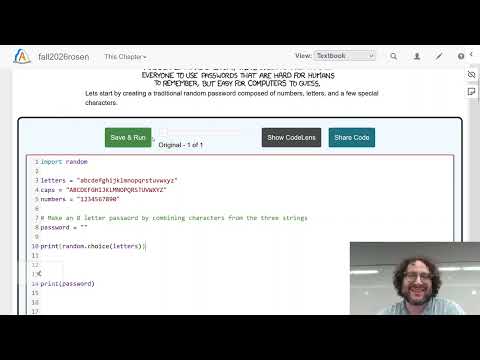 Watch on YouTube →
Overview
Professor Rosen teaches Python for loops through two password-generation exercises: an eight-character password drawn from letters, digits, and symbols, and a four-word passphrase drawn from lists. He connects these programs to password entropy, the fence-post problem, brute-force search, combinatorics, and the role of one-way hashing in password storage.
Key takeaways
- A long, memorable passphrase such as “correct horse battery staple” can be easier to remember and harder to guess than a short password built from predictable substitutions.
- Python’s random.choice selects with replacement, so password characters and passphrase words can repeat unless the program explicitly prevents repetition.
- Use an accumulator initialized before a for loop, then append one selected character or word per iteration; initializing it inside the loop erases prior results.
- For four words separated by spaces, only three separators are needed; adding a space on every iteration creates the classic fence-post error and a trailing space.
- An n-character password chosen from an alphabet of size k has k to the power of n possible combinations, so each added character multiplies the search space by k.
- Password databases should store salted outputs from dedicated password-hashing functions; SHA-256 illustrates one-way hashing but is not, by itself, the recommended password-storage method.
Chapters
0:00
OBS Setup and Module 4’s For-Loop Assignments
- Professor Rosen briefly describes using OBS for streaming because it is free, open source, and relatively light on CPU.
- Module 4 readings introduce more for loops and functions, with Project 5 focused on generating an XKCD-style password.
- A second monitor built into an Asus ZenBook Duo helps keep streaming controls separate from the recording.
2:26
XKCD’s Passphrase Argument: Length, Entropy, and Memorability
- The XKCD comic contrasts a short password such as a word with substitutions and appended digits against the memorable phrase “correct horse battery staple.”
- Professor Rosen explains entropy as a measure of uncertainty, related to how many possible password combinations exist.
- Temple IT’s policy allows fewer character restrictions as passwords get longer, making memorable passphrases more practical.
6:30
Python random.choice and the Eight-Character Password Plan
- Python’s random library supplies pseudorandom selections, which should be statistically distributed rather than necessarily unpredictable in a philosophical sense.
- The first password exercise uses an empty string as an accumulator and aims to append eight randomly selected characters.
- random.choice selects one item from a sequence, with replacement, so a character such as D can appear more than once.
9:05
Building Passwords with Concatenation and a For Loop
- Each loop iteration selects a character and concatenates it onto the existing password string.
- The loop uses range(8); placing the password initialization inside the loop would reset the accumulator and discard earlier characters.
- The print statement belongs outside the loop if the goal is to display only the completed password, not every partial version.
15:30
Combining Letters, Capitals, and Digits into One Character Pool
- Concatenating lowercase letters, uppercase letters, and digits creates one pool from which each password character can be selected.
- Choosing from the combined string avoids generating characters in a fixed sequence, such as lowercase first and digits last.
- The resulting eight-character password can contain mixed cases and numbers, though random selection may occasionally produce a readable fragment.
18:25
Python Lists as Ordered Sequences
- Lists use square brackets, commas separate their elements, and an empty list is written as [].
- A list can contain numbers, strings, variables, or even nested lists; the examples include [1, 2, 3] and lists of words.
- Lists are sequences, so they support concatenation and random.choice, much like strings.
23:40
Four-Word Passphrases and the Fence-Post Problem
- The passphrase exercise combines noun, verb, and adjective lists into a single words list, then selects four words with random.choice.
- Adding a space after every selected word makes the result easier to read but leaves an unwanted trailing space after the fourth word.
- That extra separator is the fence-post problem: four words need three spaces between them, not four.
- Possible fixes include looping three times and adding the final word separately, using a conditional, or trimming the last character with slicing.
37:00
String Immutability and Built-In Text Transformations
- Python strings are immutable: operations such as replace create a new string rather than modifying the original one.
- The result of word.replace must be assigned back, for example with word = word.replace(...), to retain the transformed text.
- Built-in methods such as upper, lower, and capitalize provide common case transformations.
40:35
A While Loop Simulates Random Password Guessing
- The extra-credit program repeatedly generates a random four-letter guess and compares it with a target password such as ABCD.
- A done Boolean controls while not done, and a two-equals comparison checks whether the guess matches the target.
- A guess counter must be incremented on each attempt; the initial test with a smaller character pool makes debugging faster.
- The program raises the execution limit with a system setting because a random search can exceed a browser interpreter’s default runtime.
50:00
Password Search Space Grows Exponentially with Length
- With 26 lowercase letters, an n-character password has 26 to the power of n possible combinations; each additional position multiplies the search space by 26.
- Expanding the pool to uppercase letters, digits, and symbols increases the number of choices per position, but increasing password length can have an even greater effect.
- Professor Rosen compares an eight-character mixed-character password with a longer passphrase made from four four-letter words, noting that the latter can produce a vastly larger search space.
54:50
How Password Hashing Supports Login Verification
- A well-designed website stores a password-derived hash rather than the password in plain text, then hashes a login attempt and compares the result.
- Professor Rosen uses SHA-256 and “correct horse battery staple” to illustrate a one-way transformation whose output changes dramatically when a character changes.
- The explanation is explicitly simplified; real password storage should use a salted, purpose-built password-hashing function rather than relying on a fast general-purpose hash alone.
- The class closes with reminders to share the code and complete the readings and exercises for credit.
Summary, takeaways, and chapters were generated by AI from the video's transcript and may contain errors. The video belongs to its creator, Professor Rosen.