Lecture 1 of Medical Physics 537, Human Physiology and Anatomy, with course instructor Marty Pagel
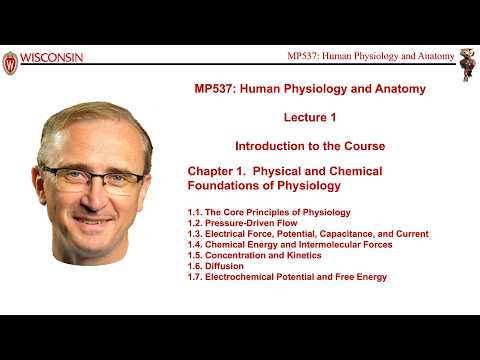 Watch on YouTube →
Overview
Marty Pagel introduces Medical Physics 537 at the University of Wisconsin, outlining its 28-lecture schedule, Canvas materials, weekly homework, anatomy exams at lectures 15 and 28, and a three-page research essay required of graduate students. He then surveys chapter 1 concepts that connect physiology to physics and chemistry, including homeostasis, flow and flux, electrical properties, molecular interactions, entropy, reaction kinetics, diffusion, and electrochemical potential, before reviewing foundational anatomy terms.
Key takeaways
- The course spans 28 lectures, with homework due one week after each class and anatomy exams around lectures 15 and 28; graduate students also complete a three-page essay linking research to course material.
- Pagel's recommended study method is retrieval practice: study labeled anatomy slides, put them away, complete the diagram from memory, then review missed terms and repeat.
- Homeostasis describes a dynamic steady state rather than thermodynamic equilibrium, maintained through inputs and outputs and regulated by negative, positive, anticipatory, and threshold feedback.
- Physiological transport depends on gradients and scale: diffusion can move molecules across micrometers in milliseconds but takes about 1.6 hours per millimeter, so circulation is necessary for long distances.
- Unsaturated lipid double bonds create kinks that prevent tight packing and increase membrane fluidity, while saturated lipid chains pack more closely and produce more rigid structures.
- Entropy is tied to the number of accessible microstates rather than visual disorder; a messy arrangement can have the same entropy as a neat one if the number of available states is unchanged.
Chapters
0:00
Medical Physics 537: Course Structure, Materials, and Grading
- Marty Pagel presents Medical Physics 537 as a two-credit survey of human physiology and anatomy, pitched around senior undergraduate level rather than medical-school depth.
- Canvas provides lecture slides, assignments, answer keys, course documents, and a PDF of the textbook; YouTube lectures are the exception.
- Homework assignments make up most of the course grade, alongside two anatomy exams and a graduate-only essay; Pagel describes the course as relatively easy while emphasizing that students can still learn substantial material.
9:00
Independent Study, Anatomy Exam Preparation, and the Graduate Essay
- Pagel frames graduate-level learning as the ability to think independently, recommending that students answer lecture homework while reading and practice anatomy labels from memory rather than copying them.
- The two exams occur around lectures 15 and 28, cover roughly half the lectures each, and draw on anatomy homework without duplicating it exactly.
- Graduate students write a roughly three-page, single-spaced essay linking their medical physics research interests to an interesting physiology or anatomy topic; undergraduates may submit one but are not required to.
- Homework is due one week after each lecture and should all be submitted by December 11, 2026; the university does not permit AI tools for homework.
16:20
Physiology, Homeostasis, and Feedback Control
- Pagel defines physiology as the study of integrated normal body function and focuses the course on organs and whole-body systems rather than cell biology.
- Homeostasis is a dynamic steady state, not thermodynamic equilibrium: the body takes in air, food, and drink and releases urine, feces, heat, and work.
- Feedback examples include negative feedback from sweating to cool the body, positive feedback in blood clotting, anticipatory saliva production when imagining food, and chemical thresholds involved in sleep and waking.
- Genotype shapes phenotype through gene expression and environmental interaction; Pagel uses variation in beard growth as a familiar example.
23:00
Flow, Flux, and Pressure in Physiological Transport
- Flow, denoted Q, measures an amount moving over time, while flux normalizes flow by area or volume and is therefore less dependent on the size of the system.
- Diffusion flux is driven by concentration gradients and scaled by a diffusion coefficient; pressure-driven flow moves from high pressure toward low pressure.
- Blood vessels can be modeled as pipes: volume flow depends on the pressure difference, vessel length, viscosity, and radius.
- The relation among vessel-wall tension, radius, and pressure helps explain why small-radius capillaries can sustain large pressure differences; spherical structures introduce a factor of two compared with a tube.
28:28
Electrical Forces and Membrane Capacitance
- Coulomb force depends on the product of two charges and their separation: like charges repel, opposite charges attract, and the surrounding dielectric affects the interaction.
- Electrical work between two charge states is a state variable, so the final energy difference does not depend on the path taken between states.
- A membrane stores electrical charge as a capacitor, with capacitance related to charge divided by voltage and increased by greater area or smaller separation between layers.
- Measurements of membrane capacitance helped estimate plasma-membrane thickness at about 3 to 7 nanometers.
32:27
Body Chemistry, Saturated Lipids, and Molecular Isomers
- Oxygen, carbon, hydrogen, and nitrogen account for most body composition; calcium, phosphorus, sulfur, and common ions such as potassium, sodium, chloride, and magnesium make up much of the remainder.
- Saturated lipid tails have no carbon-carbon double bonds and can pack tightly, while unsaturated tails contain rigid double-bond kinks that make membranes more fluid.
- Structural isomers share a chemical formula but differ in atom arrangement; cis and trans stereoisomers differ in the geometry around a double bond.
- Optical isomers have different three-dimensional handedness and can interact differently with polarized or circularly polarized light.
37:15
Molecular Interactions, Bond Energy, and Entropy
- Because most of the body does not undergo large changes in volume or pressure, Pagel emphasizes chemical bond energy over pressure-volume work in physiological systems.
- London dispersion forces arise from temporary induced dipoles; molecules attract at suitable distances but repel when their electron clouds are forced too close together.
- Entropy is described through the number of accessible microstates, not simply by whether a scene looks ordered or messy.
- Spilling cereal changes the kitchen's appearance without necessarily changing the system's number of microstates; constraining particles into a compact cluster reduces accessible states unless forces stabilize that arrangement.
43:28
Reaction Orders, Enzymes, and Activation Energy
- Zero-order reaction rate is independent of reactant concentration, first-order rate varies with one reactant, and second-order rate depends on two reactants or a squared concentration.
- Many biological reactions are pseudo-first-order when one reactant is so abundant that its concentration stays effectively constant as the limiting reactant is consumed.
- Enzymes act as catalysts: they lower the activation-energy barrier without being consumed, allowing reactions to proceed faster in either direction.
- Reaction rates depend on the activation barrier and temperature; raising temperature supplies more energy to help molecules cross the barrier.
49:08
Diffusion, Molecular Size, and the Limits of Passive Transport
- The Stokes-Einstein relation connects diffusion to temperature and molecular size: larger hydrodynamic radius slows diffusion, while higher temperature speeds it up.
- Mean squared molecular displacement grows with diffusion coefficient and time, allowing molecular size to be estimated from measured diffusion behavior.
- Using a cytoplasmic diffusion estimate, moving 1 micrometer takes about 6 milliseconds, 10 micrometers about 6 seconds, and 1 millimeter about 1.6 hours.
- Diffusion works over cellular distances but is too slow for long-range transport, motivating cardiovascular and lymphatic circulation and electrical signaling through nerves.
52:18
Electrochemical Potential and Ion Gradients
- Electrochemical potential combines concentration-driven and electrical contributions, so an ion's charge affects how it responds to a concentration gradient.
- Molecules distributed unevenly across a box tend to move toward a more even distribution; a region with nearly zero concentration creates a large concentration-related potential difference.
- Equal concentrations on both sides produce no concentration difference, while positive ions can attract negative ions and alter their distribution.
- Pagel skips the detailed Gibbs free-energy treatment, noting that the lecture has already introduced energy, volume-pressure assumptions, and entropy.
55:06
Anatomical Planes, Directional Terms, and Body Cavities
- The anatomy review distinguishes sagittal, coronal, and transverse planes, alongside directional terms such as medial, lateral, superior, inferior, and distal.
- Pagel recommends memorizing labels and then completing anatomy homework from memory, repeating practice until terms can be recalled without the labeled slides.
- Students should learn body-region names and major cavities, including pleural, pericardial, abdominal, and pelvic cavities.
- Advanced optional anatomy slides, such as detailed brain or cardiovascular anatomy, are not required for homework or exams but may help students working in MRI or ultrasound research.
Summary, takeaways, and chapters were generated by AI from the video's transcript and may contain errors. The video belongs to its creator, Marty Pagel.