Lec3 Sec1.4 M2001 XY Intercepts, Odd Even Functions
 Watch on YouTube →
Overview
Shahera Jannah reviews how to find x- and y-intercepts, including factoring polynomials, checking square-root domains, and excluding denominator zeros from rational-function intercepts. She then introduces graph symmetry and tests for even, odd, and neither functions, ending with parity shortcuts for sums of even or odd powers and examples where mixed powers require substitution.
Key takeaways
- Find an x-intercept by setting y = 0 and a y-intercept by setting x = 0; a square-root expression may have no real intercept if the required input makes its radicand negative.
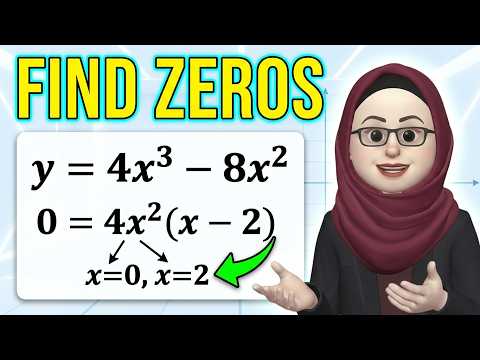
- For 4x³ − 8x² = 4x²(x − 2), the even-multiplicity root x = 0 produces a touch, while the simple root x = 2 produces a crossing.
- A rational function’s x-intercepts must make its numerator zero while keeping the denominator nonzero; 1/(x − 2) has a vertical asymptote at x = 2 and no x-intercept.
- Test evenness with f(−x) = f(x) and oddness with f(−x) = −f(x); if neither equality holds, the function is neither.
- Sums of even powers stay even, and adding a constant preserves evenness; sums of odd powers stay odd, but adding a nonzero constant generally removes odd symmetry.
- Expressions mixing even and odd powers require the substitution test; their parity cannot be inferred from only the highest power.
Chapters
0:00
Course Access, Homework, and Class Logistics
- Students access the online homework through Brightspace, under the Homework tab, which links to the platform.
- The platform provides a short trial before requiring an access code; Shahera Jannah offers help if login problems occur.
- The class reviews upcoming school closures and clarifies that the schedule affects students with Monday or Friday classes differently.
3:00
Review: Function Tests and Intercepts
- The vertical line test identifies a graph as a function when no vertical line crosses it more than once.
- A sideways parabola and a circle fail the vertical line test, while a standard parabola passes.
- To find intercepts, set y = 0 for x-intercepts and x = 0 for y-intercepts.
5:00
Finding Intercepts of 4x³ − 8x²
- For y = 4x³ − 8x², setting x = 0 gives the y-intercept (0, 0).
- Setting y = 0 gives 4x³ − 8x² = 0, which factors as 4x²(x − 2) = 0.
- The x-intercepts are (0, 0) and (2, 0), with the origin also serving as the y-intercept.
9:00
Factored Roots Predict Whether a Graph Crosses
- The function 4x²(x − 2) is cubic because its highest power of x is 3.
- A root with an even factor power, such as x² at x = 0, makes the graph touch the x-axis and turn back.
- A root with an odd factor power, such as (x − 2), makes the graph cross the x-axis.
13:00
Practice Set: Intercepts and Exam Preparation
- Students work in pairs on three intercept exercises before reviewing solutions as a class.
- Shahera Jannah emphasizes that finding intercepts is important exam material and may require checking whether a solution is valid.
- A substantial portion of the class is reserved for student work and attendance before the worked examples resume.
29:00
Exercise B: Roots at ±2
- For the exercise with roots at −2 and 2, students factor the x-intercept equation as (x + 2)(x − 2) = 0.
- The zero-product property gives x = −2 or x = 2, so the intercept points have y-coordinate 0.
- When solving x² = 4, students must include both square-root solutions, not only +2.
30:00
Exercise C: A Square-Root Function with No Y-Intercept
- For y = √(4x − 3), setting x = 0 places a negative value under the radical, so there is no real y-intercept.
- Setting y = 0 gives 4x − 3 = 0 and therefore the x-intercept (3/4, 0).
- The graph begins at its endpoint and stays to the right, so it does not cross the y-axis.
32:00
Exercise D: Rational Function and a Vertical Asymptote
- The rational expression (x + 2)/(x² − 4) simplifies to 1/(x − 2), while retaining the restriction x ≠ −2, 2 from the original denominator.
- At x = 2 the denominator is zero, creating a vertical asymptote rather than an x-intercept.
- Because the simplified numerator is 1, it never equals zero; the function has no x-intercept.
36:00
Exercise E: Rationalizing a Radical Y-Intercept
- For the radical-denominator exercise, the x-intercept comes from setting the numerator x − 2 equal to zero, giving (2, 0).
- At x = 0, the y-value is −2/√2; multiplying numerator and denominator by √2 gives −√2.
- Rationalizing removes the radical from the denominator without changing the value of the intercept.
41:00
Three Reflection Tests for Graph Symmetry
- The class distinguishes reflection across the x-axis, reflection across the y-axis, and symmetry about the origin.
- For x-axis symmetry, replace y with −y and check whether the relation remains unchanged.
- For y-axis symmetry, replace x with −x; for origin symmetry, both coordinates change signs.
47:00
Even Functions Reflect Across the Y-Axis
- A function is even when f(−x) = f(x), which corresponds to y-axis symmetry.
- The graphs of y = x² and y = |x| are examples of even functions.
- Replacing every x with −x and simplifying provides an algebraic test for evenness.
52:00
Odd Functions Reflect Through the Origin
- A function is odd when f(−x) = −f(x), corresponding to a 180-degree rotation about the origin.
- For an odd function, changing x to −x also changes the output’s sign; y = x³ is a standard example.
- Powers alone do not classify every expression: adding a constant to an odd power can destroy odd symmetry.
58:00
Classifying an Implicit Relation by Substitution
- For x − y² = 12, replacing x by −x does not reproduce the original relation or its negative.
- Replacing y by −y leaves y² unchanged, so the relation is symmetric about the x-axis.
- The three comparisons are the original relation, the result of changing x to −x, and the result of changing y to −y.
1:04:00
A Practical Order for Testing Even, Odd, or Neither
- Start with f(−x) and compare it with the original f(x); equality establishes evenness.
- If they differ, compare f(−x) with −f(x); equality establishes oddness.
- If neither comparison works, classify the function as neither; the x-axis symmetry test applies to relations rather than ordinary single-output functions.
1:07:00
Example: 1/(x² + 7) Is Even
- Substituting −x into f(x) = 1/(x² + 7) gives 1/((−x)² + 7).
- Since (−x)² = x², the result is the original function, so f is even.
- Parentheses matter when substituting −x, because the square must apply to the entire negative input.
1:13:00
Example: Cubic Parity and the Effect of Constants
- For f(x) = 2x³, substitution gives f(−x) = −2x³ = −f(x), so the function is odd.
- For f(x) = 2x³ − 8, f(−x) = −2x³ − 8, which is neither f(x) nor −f(x).
- The constant shifts the cubic vertically and removes its origin symmetry.
1:21:00
Parity Shortcuts for Sums of Powers
- Sums or differences of even powers, such as x⁴ + x² − x⁶, remain even.
- Adding or subtracting a constant from an even function preserves evenness; for example, x² − 2 is still even.
- Sums or differences of odd powers remain odd, but adding a nonzero constant to an odd function generally makes it neither.
1:27:00
Mixed Even and Odd Powers Require the Full Test
- An expression mixing even and odd powers, such as x⁴ − x³, cannot be classified by the single-parity shortcuts.
- Compute f(−x) and compare it with both f(x) and −f(x) to determine whether the result is even, odd, or neither.
- For rational expressions with odd powers in the numerator and even powers in the denominator, apply substitution rather than guessing from one part.
Summary, takeaways, and chapters were generated by AI from the video's transcript and may contain errors. The video belongs to its creator, Shahera Jannah's Math World! 😁😎.