Lec17 Chp5 M2001 Summer26 Simplifying Trig Expression & Solving Trig Equations
 Watch on YouTube →
Overview
Shahera Jannah reviews trigonometric identities, demonstrates how to simplify expressions by rewriting functions in sine and cosine, and teaches how to solve trigonometric equations using algebra, graphs, and the unit circle. Key procedures include converting answers to radians, accounting for domains and periodicity, factoring equations, and using the period of 2π for sine and cosine versus π for tangent and cotangent.
Key takeaways
- Rewriting reciprocal and quotient functions in sine and cosine exposes common factors, making cancellation the most reliable first move in many trig simplifications.
- The Pythagorean identities connect sin²x + cos²x = 1, 1 + tan²x = sec²x, and 1 + cot²x = csc²x; selecting the identity that matches the expression can shorten the algebra.
- For an unrestricted equation, repeat sine and cosine solutions with 2πn, but repeat tangent and cotangent solutions with πn because their periods differ.
- A graph helps count intersections and identify which quadrants contain solutions, while the unit circle supplies exact angles; convert final degree-based reference angles into radians.
- When factoring a trig equation, set each factor to zero and check whether every resulting value is within the trig function's range, such as rejecting cos x = 2.
- Interval endpoints matter: on [0, 2π), include 0 but exclude 2π, even though both angles represent the same point on the unit circle.
Chapters
0:00
Chapter 5 Agenda, Exam Review, and Assignment Deadlines
- Shahera Jannah plans to finish Sections 5.1 on identities and 5.3 on solving trigonometric equations.
- The final exam is scheduled for Thursday, and missing homework is reopened until the following night so students can reserve Wednesday for studying.
4:48
Reciprocal, Quotient, and Pythagorean Identities
- The core identities include reciprocal pairs such as secant = 1/cosine and cosecant = 1/sine, plus tangent = sine/cosine and cotangent = cosine/sine.
- The Pythagorean identity sin²x + cos²x = 1 leads to 1 + tan²x = sec²x and 1 + cot²x = csc²x.
7:34
Odd, Even, and Shifted Trigonometric Functions
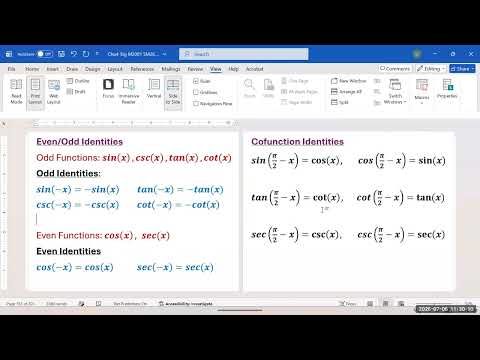
- Sine, tangent, cosecant, and cotangent are odd functions: replacing x with −x changes the sign of the function value.
- Cosine and secant are even, while shifting sine and cosine by π/2 relates their graphs; tangent and cotangent are likewise related by a phase shift.
10:33
A Three-Step Method for Simplifying Trig Expressions
- Jannah recommends converting tangent, cotangent, secant, and cosecant into sine and cosine whenever possible.
- After rewriting, cancel common factors, arrange the remaining expression clearly, and apply another identity only if it helps.
13:22
Reciprocal Cancellation: Secant and Cotangent Examples
- Rewriting secant as 1/cosine and cotangent as cosine/sine exposes factors that cancel.
- The examples illustrate that reciprocal conversions can reduce a product or quotient to a single function, such as cosecant or cosine.
16:25
Independent Practice with Identity-Based Simplification
- Students work through seven Section 5.1 expressions, practicing reciprocal identities, cancellation, and Pythagorean identities.
- Jannah reminds the class to use logarithm properties when simplifying expressions involving ln.
27:51
Simplifying a Secant-Cotangent Quotient
- The worked expression rewrites secant as 1/cosine and cotangent as cosine/sine.
- Canceling the cosine factors leaves sine, illustrating why a consistent sine-and-cosine form makes simplification easier.
29:03
Cosecant and Secant Powers Reduce by Cancellation
- Jannah rewrites cosecant as 1/sin x, secant as 1/cos x, and tan²x as sin²x/cos²x.
- In the examples, canceling matching sine and cosine powers leaves cosecant cubed in one case and cosecant in another.
33:33
Using the Pythagorean Identity in a Complex Fraction
- To simplify a difference of reciprocal-square terms, the numerator and denominator are combined using a common denominator.
- The identity 1 − cos²x = sin²x then cancels matching factors, producing sec²x.
40:04
A Shorter Simplification with 1 + tan²x = sec²x
- Replacing sec²x − 1 with tan²x reduces a longer fractional expression to 1/cos²x, or sec²x.
- For an expression containing 1 + tan²x, substituting sec²x makes cosine factors cancel directly.
44:48
Logarithm Rules and Difference-of-Squares Factoring
- The log rule ln(cos x) − ln(sin x) combines to ln|cos x/sin x|, which is ln|cot x|.
- Factoring cos²x − 9 as (cos x + 3)(cos x − 3) allows a common factor to cancel, leaving 1/(cos x + 3).
49:50
The Algebra-First Strategy for Trig Equations
- Solve trig equations with familiar algebraic steps such as combining like terms, taking square roots, and factoring.
- Once a trig function is isolated, find every angle that satisfies it; if no domain is specified, include the function's periodic repetitions.
52:25
Finding Both Sine Solutions and Writing General Answers
- For sin x = 1/2 on one cycle from 0 to 2π, the solutions are π/6 and 5π/6.
- Without a restricted domain, add 2πn to each solution, where n is any integer; write trig equation answers in radians unless degrees are requested.
57:58
Quadratic Forms, Factoring, and Domain Restrictions
- A trig equation with a squared function and a linear term can often be factored, with each factor set equal to zero.
- A stated domain limits the answer set; without one, use the general periodic solution, and allow n to range over all integers.
1:00:52
Solving a Linear Cosine Equation on the Unit Circle
- Combining like terms in the example reduces the equation to cos x = −1/2.
- Cosine is negative in Quadrants II and III, giving 2π/3 and 4π/3 on 0 to 2π, with 2πn added for general solutions.
1:09:31
Using Graph Intercepts and Periods to Count Solutions
- For sin x = 0 on the inclusive interval from 0 to 2π, the intercepts are 0, π, and 2π.
- Sine and cosine repeat every 2π, while tangent and cotangent repeat every π, so the function's period determines the general-solution increment.
1:13:31
Cotangent Equations and the π Period
- The example 3cot²x − 1 = 0 becomes cot x = ±1/√3 after isolating the square and taking the positive and negative square roots.
- Cotangent's π period means solutions separated by π are repetitions; the four corresponding angles across 0 to 2π can be represented by two base angles plus πn.
1:20:49
Classifying Practice Equations Before Solving
- Jannah sorts the practice set into greatest-common-factor, like-term, and quadratic equation types.
- For quadratic cases, she advises using identities first to express the equation with a single trig function before factoring.
1:37:50
Factoring a Sine-Cosine Equation with a Common Factor
- The equation 2sin x cos x − cos x = 0 has cosine as a common factor, so it becomes cos x(2sin x − 1) = 0.
- On 0 to 2π, cos x = 0 gives π/2 and 3π/2, while sin x = 1/2 gives π/6 and 5π/6.
1:41:26
Sine GCF Solutions and Quiz Preparation
- Factoring a sine common factor creates separate cases, including sin x = 0 and an equation that reduces to sin x = −1/2.
- On the interval [0, 2π), the sine zeros are 0 and π, while sin x = −1/2 gives 7π/6 and 11π/6; 2π is excluded by the open endpoint.
1:47:36
Solving a Linear Cosine Equation with Two Positive Roots
- Combining the cosine terms and constants reduces the example to cos x = 1/2.
- Cosine is positive in Quadrants I and IV, so the solutions on 0 to 2π are π/3 and 5π/3.
1:54:51
Converting a Mixed Sine-Cosine Equation to One Function
- For an equation containing sin²x and cos x, Jannah uses sin²x = 1 − cos²x to express everything in cosine.
- The substitution turns the equation into a quadratic in cos x, which can then be solved using ordinary algebra.
1:58:10
Reordering the Cosine Quadratic Before Factoring
- After distributing the coefficient and collecting terms, the equation is arranged in descending powers of cosine.
- Multiplying through by −1 can make the leading coefficient positive, but the constant term must still be checked to ensure the quadratic factors correctly.
2:01:07
Reviewing the AC Method and Grouping
- For 2x² − 3x − 2, the AC method multiplies 2 by −2 to get −4, then finds −4 and 1 because they multiply to −4 and add to −3.
- Splitting the middle term and grouping produces 2x(x − 2) + 1(x − 2), which factors to (2x + 1)(x − 2).
2:04:19
Rejecting an Impossible Cosine Root
- Applying the factoring pattern to 2cos²x − 3cos x − 2 = 0 gives candidate roots cos x = 2 and cos x = −1/2.
- Cosine cannot equal 2 because its range is [−1, 1]; cos x = −1/2 gives 2π/3 and 4π/3 on one cycle.
2:09:30
Final Exam Timing and Chapter 5 Wrap-Up
- Jannah reminds students that the final exam is at the usual class time, 11:00, and directs them to review the Chapter 5 material.
- The closing review confirms the lesson covered Sections 5.1 and 5.3: simplifying trig expressions and solving trig equations.
Summary, takeaways, and chapters were generated by AI from the video's transcript and may contain errors. The video belongs to its creator, Shahera Jannah's Math World! 😁😎.