Lec14 Sec2.7, Chp3 M2001 Solving Inequalities, Exponential Functions Transformation, Solving Exp Eq
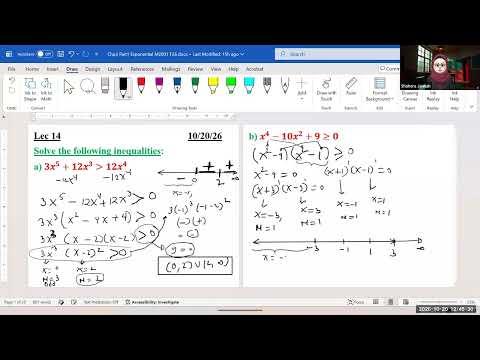 Watch on YouTube →
Overview
Shahera Jannah reviews Section 2.7 inequality sign analysis, then introduces Chapter 3 exponential functions, their transformations, and methods for solving exponential equations. The lesson covers multiplicity-based sign changes, exponential graph features and reflections, and equation strategies that rewrite bases when possible or apply logarithms when they cannot be matched.
Key takeaways
- For polynomial inequalities, factor the expression, locate every root, and use multiplicity to determine sign behavior: odd roots flip the sign, while even roots preserve it.
- An unshifted exponential bˣ passes through (0, 1) and has horizontal asymptote y = 0; bases greater than 1 increase, while bases between 0 and 1 decrease.
- In an exponential transformation, constants outside the exponential shift the graph vertically and move its horizontal asymptote, while changes to x inside the exponent control horizontal movement or reflection.
- For exponential equations, first try rewriting both sides with a common base; if that is impossible, apply logarithms and use the power rule to bring the exponent down as a coefficient.
- When graphing a transformed exponential, track the original anchor point (0, 1), apply reflections before shifts, and use the asymptote and curve shape to verify the result.
Chapters
0:00
Course Check-In and Exam Planning
- Shahera Jannah opens with a check-in and mentions that speaking during in-person classes has been difficult because of coughing.
- The next exam is scheduled for Friday the 30th; the class will decide its coverage after the current week.
- A review sheet is in progress, and the exam will have no notes or formula sheet under the department's lower-level math rules.
5:53
Inequality Sign Analysis with Repeated Roots
- For an inequality, first move every term to one side so the expression can be compared with zero.
- The example factors into terms with roots at x = 0 and x = 2, with multiplicities 3 and 2.
- Odd multiplicity changes the sign across a root, while even multiplicity preserves it; for a strict positive inequality, exclude roots where the expression equals zero.
10:07
Factoring a Quadratic-in-Powers Inequality
- The expression x⁴ − 10x² + 9 is treated as a quadratic in x² because its powers have a 2-to-4 relationship.
- Factoring gives (x² − 1)(x² − 9), then roots at −3, −1, 1, and 3.
- The four roots divide the number line into intervals; test a value in one interval and use multiplicity to determine signs elsewhere.
15:00
How Multiplicity Determines Inequality Signs
- The multiplicity of an x-intercept comes from the exponent on its factor, such as x³ giving a triple root at zero.
- Odd multiplicity means the graph crosses the x-axis and the sign flips; even multiplicity means it touches and turns back without a sign change.
- For the roots −3, −1, 1, and 3 in the quartic example, all roots have multiplicity one, so signs alternate across each intercept.
19:12
Chapter 3: Exponential and Logarithmic Inverses
- Chapter 3 focuses on exponential functions and logarithms, which are inverse functions and reflect across the line y = x.
- An unshifted exponential has y-intercept 1 and a horizontal asymptote; an unshifted logarithm has x-intercept 1 and a vertical asymptote.
- Planned topics include transformations, graphs, simplification, solving exponential and logarithmic equations, and real-world applications.
24:07
Exponential Function Form and the Natural Base e
- The standard form is f(x) = a · bˣ, where a is the leading coefficient and b is the base; if no coefficient appears, a = 1.
- Unlike a polynomial, an exponential function has a numerical base and a variable exponent.
- The special base e is approximately 2.7, and its inverse logarithm is written ln; other bases use logarithm notation such as log.
29:10
Evaluating Exponential Functions at Negative, Zero, and Positive Inputs
- For f(x) = 2 · 5ˣ, substituting x = −2 gives 2 · 5⁻² = 2/25.
- At x = 0, the same function gives 2 · 5⁰ = 2; at x = 2, it gives 2 · 25 = 50.
- These values illustrate how a small increase in x can produce rapid growth when the base is greater than 1.
31:20
Vertical Shifts Move the Exponential Asymptote
- Adding a constant outside the exponential shifts the graph vertically and changes its horizontal asymptote.
- For 2ˣ + 1, the asymptote moves from y = 0 to y = 1; for 2ˣ − 2, it moves to y = −2.
- The original anchor point (0, 1) moves with the graph, becoming (0, 2) for 2ˣ + 1 and (0, −1) for 2ˣ − 2.
38:56
Transformation Rules for Exponential Functions
- A negative sign outside the function reflects the graph across the x-axis; a negative on x inside the exponent reflects it across the y-axis.
- A constant added after the exponential shifts the graph up, while a constant subtracted shifts it down and sets the new horizontal asymptote.
- A change inside the exponent shifts the graph horizontally in the opposite direction: x + 1 moves left one, while x − 1 moves right one.
40:45
Sketching Exponential Graphs with Vertical Shifts
- For 2ˣ − 1, the horizontal asymptote is y = −1, and the anchor point (0, 1) shifts to (0, 0).
- For 2ˣ + 1, the asymptote is y = 1 and the anchor point becomes (0, 2).
- With a base between 0 and 1, the same shift rules apply, but the exponential curve decreases rather than increases.
46:46
Horizontal Shifts and the Exponential Anchor Point
- A term such as eˣ⁺¹ shifts the untransformed eˣ graph one unit left, while eˣ⁻¹ shifts it one unit right.
- The original anchor point (0, 1) moves horizontally with the curve; the asymptote remains y = 0 when there is no vertical shift.
- For eˣ⁺¹, the y-value at x = 0 is e, approximately 2.7, although an exact decimal is not needed to show the transformation.
51:05
Reflecting Exponential Graphs Across the Axes
- A negative coefficient in front of an exponential reflects the graph across the x-axis, changing the anchor value from 1 to −1.
- Replacing x with −x reflects across the y-axis and preserves the y-intercept because x = 0 remains unchanged.
- A negative exponent also makes the base's effective power reciprocal, which produces a decreasing shape when the original base exceeds 1.
53:33
Combining Exponential Shifts and Reflections
- For a combined expression such as 2^(−x + 1) − 2, the outside subtraction sets the horizontal asymptote at y = −2.
- The inside changes determine horizontal movement and reflection, while the outside changes control vertical movement and reflection.
- Shahera Jannah demonstrates moving the original anchor point through the transformations and checks a transformed y-value by substituting x = 0.
57:47
Apply Reflections Before Shifts
- For a graph with a negative sign in front, reflect the original exponential across the x-axis before applying left, right, up, or down shifts.
- In the worked example, the original anchor point (0, 1) first becomes (0, −1), then moves left one and down three.
- The vertical shift also moves the horizontal asymptote, so the final graph must respect the new boundary.
1:09:25
Practice Combined Transformations and Identify Asymptotes
- A worked graph combines an x-axis reflection, a left shift of two units, and a downward shift of three units.
- The downward shift places the horizontal asymptote at y = −3; the reflected anchor point is then shifted to its new location.
- A second example uses a negative exponent for y-axis reflection and an upward shift of four units, moving the asymptote to y = 4.
1:13:01
Read Exponential Graphs Back into Equations
- A graph lying below the unshifted eˣ curve indicates a downward shift, which can be identified by comparing its asymptote with y = 0.
- For a reflected graph, distinguish choices with the same shape by checking the y-intercept.
- For 2eˣ, substituting x = 0 gives y = 2, which separates the correct graph from a similar option with a different intercept.
1:14:50
Solve Exponential Equations by Matching Bases
- When both sides contain a single exponential term with the same base, equate the exponents and solve using algebra.
- The example 2²ˣ = 2³ˣ⁺² becomes 2x = 3x + 2, giving x = −2.
- If bases differ but one can be rewritten as a power of the other, rewrite it first; for example, 16 = 2⁴.
1:17:17
Rewrite Related Bases or Use Logarithms
- For equations involving 8 and 4, rewrite them as 2³ and 2² to create a common base, then equate the resulting exponents.
- A fraction base can be converted to a whole-number base by using a negative exponent, as in 1/9 = 9⁻¹; 9 and 27 can then both be rewritten using base 3.
- When no common-base rewrite is available, take natural logarithms of both sides; for 7ˣ⁻² = 3, this gives (x − 2) ln 7 = ln 3 and x = 2 + ln 3/ln 7.
Summary, takeaways, and chapters were generated by AI from the video's transcript and may contain errors. The video belongs to its creator, Shahera Jannah's Math World! 😁😎.