Lec13 Sec2.6,7 M2001 Graphing RAtional Function, VA, HA, Domain, XY int, Solve Poly Inequalities,
 Watch on YouTube →
Overview
Shahera Jannah reviews Section 2.6 by showing how to find a rational function’s domain, vertical and horizontal asymptotes, intercepts, and removable discontinuities, then graph the function from those features. She introduces Section 2.7 polynomial inequalities, using real zeros, interval sign tests, multiplicity, and interval notation to solve factored and unfactored examples.
Key takeaways
- For a rational function, the domain comes from the original denominator, but vertical asymptotes come from the simplified denominator; a cancelled denominator factor remains excluded from the domain and creates a hole.
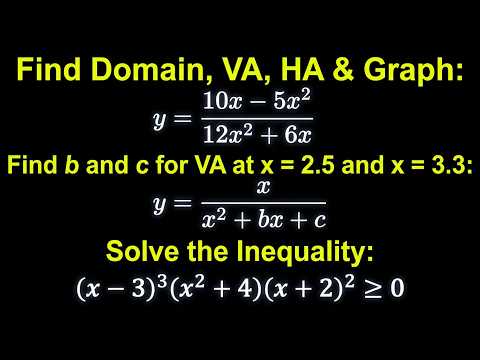
- The function (10x − 5x²)/(12x² + 6x) simplifies to 5(2 − x)/[6(2x + 1)], with domain excluding 0 and −1/2, a hole at (0, 5/3), vertical asymptote x = −1/2, horizontal asymptote y = −5/12, and x-intercept (2, 0).
- For horizontal asymptotes of rational functions, compare polynomial degrees: a lower numerator degree gives y = 0, equal degrees give the ratio of leading coefficients, and a higher numerator degree gives no horizontal asymptote.
- Polynomial-inequality solutions can be found by ordering all real zeros, testing one point per interval, and tracking multiplicity: odd powers flip signs across roots, while even powers do not.
- Endpoint notation encodes whether roots are included: use brackets for included zeros, parentheses for excluded endpoints and infinity, and curly braces for isolated values such as {−2}.
- When solving an unfactored inequality, first move all terms to one side and factor; for 2x⁵ − 18x³ ≤ 0, factoring yields the solution (−∞, −3] ∪ [0, 3].
Chapters
0:00
Class Opening and Plan for Sections 2.6–2.7
- Shahera Jannah opens with a brief check that students can hear her and explains that seasonal allergies and acid reflux have made her cough worse.
- She plans to review a Section 2.6 graphing problem before introducing polynomial inequalities in Section 2.7.
3:27
Section 2.6 Recap: Domain and Rational-Function Asymptotes
- For the domain, use the original denominator and exclude every x-value that makes it zero.
- Find vertical asymptotes by setting the denominator of the simplified function equal to zero.
- Use the numerator and denominator degrees to determine whether a horizontal asymptote exists.
5:36
Three Horizontal-Asymptote Rules
- If the numerator’s degree exceeds the denominator’s, there is no horizontal asymptote.
- If the degrees are equal, the horizontal asymptote is the ratio of the leading coefficients.
- If the denominator’s degree is greater, the horizontal asymptote is y = 0.
11:23
Cancelled Factors, Holes, and Intercepts
- A factor cancelled during simplification creates a removable discontinuity, or hole; set that factor to zero to find the hole’s x-coordinate.
- Substitute the hole’s x-coordinate into the simplified function to find its y-coordinate.
- Find x-intercepts from zeros of the simplified numerator and the y-intercept by evaluating the function at x = 0.
15:03
Example Function: Start with the Original Denominator
- For y = (10x − 5x²)/(12x² + 6x), the original denominator factors as 6x(2x + 1).
- The denominator is zero at x = 0 and x = −1/2, so both values must be excluded from the domain.
- In interval notation, the domain is (−∞, −1/2) ∪ (−1/2, 0) ∪ (0, ∞).
19:25
Simplify the Rational Function and Find Its X-Intercept
- Factor the numerator as 5x(2 − x) and the denominator as 6x(2x + 1).
- After cancelling x, the simplified expression is y = 5(2 − x)/[6(2x + 1)].
- Setting the simplified numerator to zero gives the x-intercept x = 2.
20:47
Find the Vertical and Horizontal Asymptotes
- The simplified denominator 6(2x + 1) is zero at x = −1/2, giving the vertical asymptote x = −1/2.
- The numerator and denominator have equal degree, so compare their leading terms, −5x and 12x.
- The horizontal asymptote is y = −5/12; asymptotes should be written as x = value or y = value.
24:30
Find the Y-Intercept and the Hole at x = 0
- Evaluating the simplified function at x = 0 gives y = 10/6 = 5/3.
- Because x was cancelled, (0, 5/3) is a hole rather than an actual y-intercept on the original graph.
- The hole’s coordinates come from the cancelled factor x = 0 and the simplified function’s value there.
27:42
Sketch the Rational Graph from Its Key Features
- Plot the x-intercept (2, 0), the hole (0, 5/3), the vertical asymptote x = −1/2, and the horizontal asymptote y = −5/12.
- The graph must break at x = −1/2 and leave an open point at (0, 5/3).
- To determine which side of an asymptote a branch occupies, test a convenient x-value in the original function.
35:11
Section 2.6 Practice and Homework Reminder
- Shahera notes that an exam problem may ask for the rational function’s features and graph, while a final exam may assess only selected parts.
- She reminds students that Chapter 2 homework is due at the end of the month and encourages completing it after each class.
38:07
Recover a Quadratic Denominator from Two Vertical Asymptotes
- A function with vertical asymptotes at x = 2.5 and x = 3.3 has denominator factors (x − 2.5)(x − 3.3).
- Multiplying the factors gives x² − 5.8x + 8.25, so the corresponding coefficients are −5.8 and 8.25.
- The asymptote values become denominator factors by moving each value to the x-side and setting the factor to zero.
44:20
Horizontal Asymptote from Leading Terms with Decimals
- For the worked expression, the highest-degree terms are 108x in the numerator and 0.08x in the denominator.
- Since the degrees match, divide the leading coefficients: 108/0.08 = 1350, giving y = 1350.
- Lower-degree terms are irrelevant to this horizontal-asymptote calculation.
48:04
Section 2.7: Interpret Polynomial Inequalities
- A polynomial inequality asks which x-values produce positive, negative, or zero y-values.
- The graph-based interpretation is to identify where the polynomial lies above or below the x-axis.
- For example, y ≥ 0 includes both positive outputs and zeros, while y < 0 includes only negative outputs.
54:51
Interval Notation: Parentheses, Brackets, and Singletons
- Use parentheses for excluded endpoints and for ±∞; infinity always takes a parenthesis.
- Use brackets when an inequality includes equality and the endpoint is a zero of the polynomial.
- Write an isolated solution such as x = −2 with curly braces: {−2}.
57:45
Build a Sign Chart from Polynomial Zeros
- Move all terms to one side, find the polynomial’s real zeros, and place them in order on a number line.
- Test one x-value in each interval to determine the sign, or use multiplicity to infer sign changes.
- Odd-multiplicity zeros change the sign across the root; even-multiplicity zeros preserve it.
1:00:05
Factored Inequality Example with an Irrelevant Quadratic Factor
- For (x − 3)³(x² + 4)(x + 2)² ≥ 0, x² + 4 has no real zeros because it would require x² = −4.
- The real zeros are x = −2 with multiplicity 2 and x = 3 with multiplicity 3.
- Testing x = −3 gives a negative value; the even root at −2 preserves the sign, while the odd root at 3 reverses it.
1:04:46
Solve the First Inequality with Multiplicity and Set Notation
- For (x − 3)³(x² + 4)(x + 2)² ≥ 0, positive values occur for x > 3, and x = 3 also qualifies because equality is included.
- The root x = −2 gives zero and must be included as an isolated solution.
- The solution is {−2} ∪ [3, ∞).
1:09:28
Sign Chart for a Polynomial with Roots −1, 0, and 4
- The factored example has roots x = −1 with multiplicity 2, x = 0 with multiplicity 1, and x = 4 with multiplicity 1.
- Testing x = −10 gives a positive sign; the even root at −1 keeps the sign positive, and the odd roots at 0 and 4 reverse it.
- For the inequality ≤ 0, include the interval [0, 4] and the isolated zero at −1.
1:21:00
Factor an Unfactored Inequality Before Making a Sign Chart
- For 2x⁵ − 18x³ ≤ 0, factor out 2x³ and then use the difference of squares: 2x³(x − 3)(x + 3) ≤ 0.
- The ordered real roots are −3, 0, and 3; each has odd multiplicity, so the sign alternates at every root.
- The negative intervals and included zeros give (−∞, −3] ∪ [0, 3].
1:30:00
Practice Assignment and Preview of the Next Exam
- Shahera assigns practice on unfactored polynomial inequalities and recommends reviewing factoring before identifying zeros and signs.
- Students may test every interval directly or use multiplicity to avoid repeated substitutions, but they must show their work.
- The next class begins Chapter 3; the upcoming exam will include Chapter 2, Chapter 3, and material taught since the previous exam.
Summary, takeaways, and chapters were generated by AI from the video's transcript and may contain errors. The video belongs to its creator, Shahera Jannah's Math World! 😁😎.