L9 Quantum Register and Data Processing
 Watch on YouTube →
Overview
Hiu-Yung Wong explains how an n-qubit quantum register forms a 2^n-dimensional Hilbert space, with computational basis states labeled by binary strings or equivalent decimal indices. He builds from tensor-product basis states and orthonormality to normalized superpositions, then describes data processing as unitary transformations acting across the register’s superposed basis states.
Key takeaways
- A quantum register is often a conceptual grouping of qubits rather than a physical memory unit; n qubits span a 2^n-dimensional state space.
- Computational basis labels can be written as binary strings or decimal indices, with each bit contributing its value times the corresponding power of two.
- Multi-qubit basis inner products factor into single-qubit inner products, so a mismatch in any qubit makes the full basis states orthogonal.
- A valid n-qubit state assigns a complex amplitude to each of its 2^n basis states and must satisfy Σ|c_x|² = 1.
- Quantum gates implement unitary transformations on the register, transforming all components of a superposition together; useful quantum algorithms exploit this behavior.
Chapters
0:00
Quantum Registers as Groups of Qubits and 2^n-Dimensional Spaces
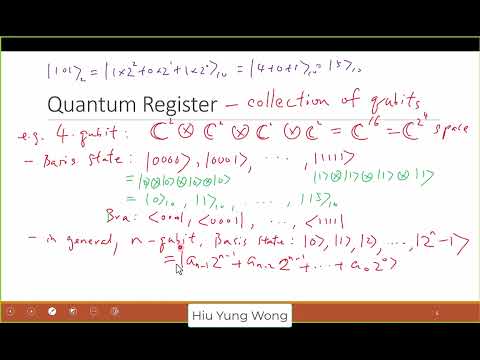
- A quantum register often means a collection of qubits, not a physical storage device made from flip-flops.
- Four qubits form the tensor product of four C2 spaces, yielding a C16 space with 16 computational basis states.
- Each four-qubit basis state, such as |0000> or |1111>, is a tensor product of individual qubit basis states.
5:00
Binary Labels and Decimal Indices for Register Basis States
- An n-qubit register has basis states indexed from 0 through 2^n − 1, or equivalently represented as n-bit binary strings.
- A binary label is converted to decimal by weighting each bit a_k by 2^k; for example, 101₂ = 1×2² + 0×2¹ + 1×2⁰ = 5.
- The decimal labels are names for computational basis states: for four qubits, 8 corresponds to |1000> and 9 to |1001>.
8:32
Orthonormality from Individual Qubit Inner Products
- Computational basis states are orthonormal: the inner product of labels u and v is 1 when they match and 0 otherwise.
- For |1000> and |1001>, the tensor-product inner product factors into four single-qubit inner products; the final <0|1> term makes the result zero.
- If even one corresponding qubit differs, the full multi-qubit basis states are orthogonal; each basis state also has unit norm.
14:57
Superposition Coefficients and State Normalization
- A general n-qubit state is |ψ> = Σ from x=0 to 2^n−1 of c_x|x>, with one complex amplitude for each basis state.
- Normalization requires Σ|c_x|² = 1, so an n-qubit register’s state uses 2^n amplitudes subject to this condition.
- For two qubits, 0.5|0> + 0.5|1> + 0.5|2> + 0.5|3> is normalized because the four squared magnitudes sum to 1; decimal label 3 denotes |11>.
21:41
Unitary Gate Processing and Quantum Parallelism
- Data processing applies unitary transformations—implemented by quantum gates—to rotate a register state in its 2^n-dimensional space.
- A superposition contains multiple basis components simultaneously, so applying a function represented by a sequence of rotations transforms those components together.
- For a two-qubit equal-amplitude superposition, the function acts on all four basis components in one state transformation, illustrating quantum parallelism.
- The lecture frames this as a foundation for later algorithms, where carefully designed operations make the parallel processing useful.
Summary, takeaways, and chapters were generated by AI from the video's transcript and may contain errors. The video belongs to its creator, Quantum Computing, TCAD, Semicond by Hiu-Yung Wong.