L8 Representing a Matrix in a Given Basis
 Watch on YouTube →
Overview
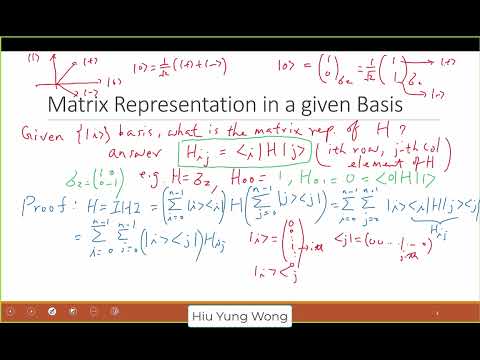
Hiu-Yung Wong explains that an operator’s matrix depends on the chosen basis, with each entry given by the matrix element ⟨i|H|j⟩. He derives this formula from completeness and applies it to express the Pauli X operator in its own eigenbasis, where its representation is diagonal with eigenvalues +1 and −1.
Key takeaways
- The matrix representation of an operator depends on the basis, and its row i, column j entry is ⟨i|H|j⟩.
- Completeness, I = Σᵢ |i⟩⟨i|, gives the reconstruction formula H = Σᵢⱼ ⟨i|H|j⟩|i⟩⟨j|.
- A one-qubit operator has a 2 × 2 representation because a qubit basis contains two states.
- The Pauli X matrix changes from [[0, 1], [1, 0]] in the computational basis to [[1, 0], [0, −1]] in its eigenbasis.
- Matrix operations require all vectors and operators to be expressed in a consistent basis; basis conversion is necessary before combining representations.
Chapters
0:00
Vector Coordinates in the Computational and Pauli X Bases
- A vector’s coordinates change with the basis: |0⟩ has coordinates (1, 0) in the computational (Pauli Z) basis.
- In the Pauli X basis, |0⟩ is an equal superposition of |+⟩ and |−⟩, so its coordinates are (1/√2, 1/√2) for normalized states.
- The same basis-dependence applies to matrix representations, not only to vectors.
3:20
Define Operator Matrix Entries as ⟨i|H|j⟩
- For basis vectors |i⟩ and |j⟩, the row i, column j entry of operator H is ⟨i|H|j⟩.
- An n-dimensional basis produces an n × n matrix; a one-qubit system has two basis states and therefore a 2 × 2 matrix.
- In the computational basis, the Pauli Z matrix has diagonal entries +1 and −1 and off-diagonal entries 0.
6:46
Derive the Matrix Expansion Using Completeness
- Completeness gives the identity operator as I = Σᵢ |i⟩⟨i| for a complete basis.
- Inserting this identity on both sides of H yields H = Σᵢⱼ |i⟩⟨i|H|j⟩⟨j|.
- Each scalar ⟨i|H|j⟩ multiplies the outer product |i⟩⟨j|, which contributes to the matrix’s row i, column j position.
- The expansion reconstructs H by summing the contributions from every pair of basis states.
16:51
Set Up the Pauli X Matrix in Its Eigenbasis
- The Pauli X operator is [[0, 1], [1, 0]] when written in the computational basis.
- To represent it in the Pauli X eigenbasis, use |+⟩ = (|0⟩ + |1⟩)/√2 and |−⟩ = (|0⟩ − |1⟩)/√2.
- The four required entries are ⟨+|X|+⟩, ⟨+|X|−⟩, ⟨−|X|+⟩, and ⟨−|X|−⟩.
20:47
Evaluate the Eigenbasis Entries and Keep Bases Consistent
- Using the computational-basis matrix for X to evaluate the sandwiches gives diagonal entries +1 and −1 and zero off-diagonal entries.
- The Pauli X matrix in its eigenbasis is therefore [[1, 0], [0, −1]], with its eigenvalues on the diagonal.
- Every multiplication must use representations in the same basis; combining computational-basis components with Pauli X-basis components without converting is invalid.
Summary, takeaways, and chapters were generated by AI from the video's transcript and may contain errors. The video belongs to its creator, Quantum Computing, TCAD, Semicond by Hiu-Yung Wong.