L19 Energy Use During Exercise I
 Watch on YouTube →
Overview
Chris Black explains how exercise physiology measures energy use and how the body shifts between aerobic and anaerobic energy production during a single exercise bout. He compares direct calorimetry with indirect calorimetry, then covers resting metabolic rate, oxygen uptake kinetics, oxygen deficit, EPOC, and how respiratory exchange ratio indicates fuel use.
Key takeaways
- Direct calorimetry measures heat production and is highly accurate, but its cost, room-based setup, and limited ability to capture rapid changes make indirect calorimetry more practical for exercise testing.
- Indirect calorimetry estimates aerobic energy use by comparing inhaled and exhaled oxygen and carbon dioxide; it cannot directly measure anaerobic ATP production from phosphocreatine or glycolysis.
- At exercise onset, oxygen uptake takes time to meet the immediate energy demand; the resulting oxygen deficit estimates the anaerobic contribution, and a warm-up can reduce that gap.
- Steady-state oxygen uptake is generally possible below lactate threshold, while exercise above threshold can produce a slow upward drift in VO₂.
- EPOC reflects elevated oxygen use during recovery as the body restores phosphocreatine and oxygen stores, processes lactate, and returns temperature, breathing, and heart rate toward baseline.
- RER near 0.70 indicates greater reliance on fat and RER near 1.00 greater reliance on carbohydrate, but a higher calorie burn during jogging can outweigh a lower carbohydrate share when comparing total fat energy used per hour.
Chapters
0:00
Direct Calorimetry Measures Exercise Energy as Heat
- Direct calorimetry estimates energy expenditure by measuring heat production, since roughly 60% of energy is released as heat.
- A calorimeter room circulates water through its walls; the water temperature change indicates how much heat a person produces.
- The method is highly accurate but expensive, restrictive, and too slow for tracking rapid changes during exercise.
6:00
Indirect Calorimetry Uses VO₂ and VCO₂ to Estimate Metabolism
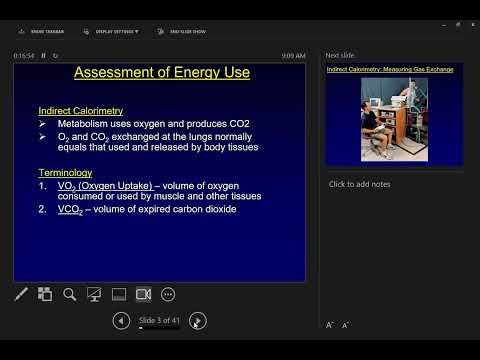
- Indirect calorimetry measures oxygen uptake, VO₂, and carbon dioxide output, VCO₂, from expired air.
- A metabolic cart compares room air with exhaled air to estimate gas exchange occurring in muscle tissue.
- VO₂ can be measured at rest, during walking or jogging, and at maximal exercise; lab testing also uses it to assess VO₂max.
9:40
Resting Metabolic Rate, Daily Energy Use, and Their Influences
- Resting metabolic rate, or RMR, is energy expenditure at rest; basal metabolic rate describes the minimum energy needed to maintain essential functions under strict basal conditions.
- Daily energy expenditure adds activity above resting needs, including walking, exercise, and other daily movement.
- Muscle mass, body size and surface area, body temperature, and hormones such as epinephrine, norepinephrine, and thyroid hormone influence RMR.
- Black cautions that people may overestimate their resting calorie needs, and notes that RMR can be measured in a research lab.
16:07
Exercise Raises Energy Demand Before Aerobic Metabolism Catches Up
- Energy demand rises immediately when exercise begins and increases with muscular force, workload, and exercise intensity.
- Walking requires less energy than running, while increasing cycling power or running speed generally raises oxygen uptake.
- Indirect calorimetry measures aerobic energy production, not anaerobic ATP production from phosphocreatine or glycolysis directly.
- For bouts lasting several minutes, anaerobic and aerobic systems overlap: the lecture estimates about 70% anaerobic contribution at 60 seconds, roughly equal contributions at 2 minutes, and predominantly aerobic energy after about 4 to 5 minutes.
24:28
VO₂ Kinetics, Steady State, and the Slow Component
- During a maximal exercise test, oxygen uptake rises roughly linearly with power output until VO₂max, where further workload increases do not produce additional oxygen uptake.
- At low to moderate intensities, VO₂ initially lags behind the sudden energy demand, then levels off at a steady state.
- Steady-state VO₂ is generally attainable below lactate threshold; above threshold, VO₂ may continue to creep upward.
- This upward drift is the slow component of VO₂, associated in the lecture with lactate production and changes in exercise efficiency.
29:37
Oxygen Deficit at Exercise Onset and EPOC After Exercise
- Oxygen deficit is the gap between immediate exercise energy demand and the slower rise in aerobic oxygen uptake.
- The deficit estimates energy supplied anaerobically, including contributions from phosphocreatine and glycolysis.
- A warm-up can reduce oxygen deficit by stimulating aerobic metabolism before the main exercise bout.
- After exercise stops, oxygen uptake remains elevated; this excess post-exercise oxygen consumption is called EPOC and can last longer after harder exercise.
36:51
EPOC Restores Phosphocreatine and Other Systems
- EPOC supports recovery processes such as resynthesizing muscle phosphocreatine, restoring oxygen stores, and processing lactate.
- Elevated body temperature, heart rate, breathing, and stress hormones also contribute to post-exercise energy expenditure.
- Black notes that EPOC can remain elevated for up to about 48 hours after particularly intense exercise, while aerobic training tends to reduce its size.
- The recovery oxygen-consumption curve can be used to estimate phosphocreatine resynthesis: faster recovery corresponds to faster replenishment.
40:00
RER Shows the Balance of Fat and Carbohydrate Use
- Respiratory exchange ratio, or RER, is expired VCO₂ divided by VO₂ and helps estimate fuel use during aerobic metabolism.
- An RER near 0.70 indicates predominantly fat oxidation; an RER near 1.00 indicates predominantly carbohydrate oxidation.
- An RER around 0.85 represents an approximate 50/50 mix of fat and carbohydrate; resting values are often around 0.82 to 0.83.
- Recent carbohydrate intake can raise RER, so the measured value depends partly on what a person has eaten.
45:13
Exercise Intensity Changes Fuel Mix and Calories Burned
- As exercise intensity increases, the proportion of energy from carbohydrate generally rises and RER moves closer to 1.0.
- The lecture distinguishes fuel percentage from total energy use: jogging can burn more calories per hour than walking even when a larger share comes from carbohydrate.
- The illustrated fat-oxidation pattern varies with intensity, so the fuel mix alone does not determine how much fat energy is used over a workout.
Summary, takeaways, and chapters were generated by AI from the video's transcript and may contain errors. The video belongs to its creator, Exercise Physiology with Dr. Chris Black.