L17 Metabolism IV
 Watch on YouTube →
Overview
Chris Black explains how aerobic metabolism converts acetyl-CoA into ATP through the Krebs cycle and mitochondrial electron transport chain, then connects pathway speed and regulation to exercise intensity. The lecture compares approximate yields of 2.5 ATP per NADH and 1.5 per FADH₂, describes fat oxidation and the carbohydrate-fat crossover, and explains how ADP, PFK, phosphorylase, LDH, and PDH regulate fuel use.
Key takeaways
- Metabolic pathways do not switch on one at a time: creatine phosphate, glycolysis, and aerobic oxidation all operate simultaneously, while ATP demand and pathway speed determine which contributes most.
- The Krebs cycle yields one ATP, three NADH, and one FADH₂ per acetyl-CoA; the electron transport chain converts those reduced carriers into most of aerobic metabolism’s ATP.
- Approximate oxidative phosphorylation yields are 2.5 ATP per NADH and 1.5 per FADH₂, giving a lecture estimate of roughly 33 to 34 ATP per glucose versus about 2 to 3 from glycolysis alone.
- Fat is an abundant but comparatively slow fuel: beta-oxidation supplies acetyl-CoA for aerobic metabolism, so carbohydrate use increasingly dominates as exercise intensity rises.
- Rising ADP signals energy demand and stimulates several pathways, including creatine kinase, glycogen phosphorylase, and PFK; high hydrogen-ion levels can inhibit PFK during intense exercise.
- Lactate production increases when pyruvate forms faster than PDH and aerobic metabolism can process it; warming up gives PDH time to activate and can reduce early reliance on lactate formation.
Chapters
0:00
Class Plan: Aerobic Metabolism and Pathway Rate Control
- Chris Black sets out to review the Krebs cycle and electron transport chain before tackling how the body regulates pathway speed.
- The central question is how simultaneous energy pathways contribute different amounts of ATP as exercise demands change.
1:47
Krebs Cycle Inputs: Acetyl-CoA, Carbon Dioxide, and Electron Carriers
- Acetyl-CoA enters the Krebs cycle after pyruvate is converted during the transition from glycolysis.
- Fatty acids also supply acetyl-CoA through beta-oxidation, which removes two-carbon units from fatty acid chains.
- For each acetyl-CoA, the cycle produces two CO₂, one ATP, three NADH, and one FADH₂.
5:39
Electron Transport: Oxygen, Proton Gradients, and ATP Synthase
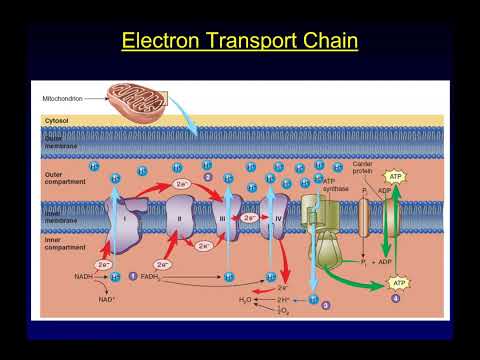
- The electron transport chain sits in the inner mitochondrial membrane, while the Krebs cycle produces NADH and FADH₂ in the matrix.
- NADH and FADH₂ donate electrons at different points in the chain; electron transfer powers proton pumping across the inner membrane.
- Oxygen is the final electron acceptor and combines with electrons and hydrogen to form water; without sufficient oxygen, electron flow backs up.
- Protons flow back through ATP synthase, which uses that energy to convert ADP and inorganic phosphate into ATP.
12:20
Aerobic ATP Yield: From Glucose to Roughly 33 or 34 ATP
- The lecture gives approximate yields of 2.5 ATP per NADH and 1.5 ATP per FADH₂, with NADH yielding more because it enters the chain earlier.
- A glucose molecule produces two pyruvate molecules, so the transition step and Krebs cycle run twice per glucose.
- The worked estimate is roughly 33 to 34 ATP per glucose aerobically, compared with about 2 to 3 ATP through glycolysis alone.
- A 16-carbon fatty acid can yield around 70 to 80 ATP in the lecture's illustrative estimate, depending on its breakdown.
20:36
Triglycerides, Lipolysis, and Aerobic Beta-Oxidation
- Triglycerides, made from glycerol and three fatty acid chains, are the main form of stored fat in adipose tissue.
- Lipolysis breaks triglycerides into glycerol and free fatty acids; the lecture estimates body fat stores at roughly 120,000 to 300,000 kcal.
- Beta-oxidation breaks fatty acids into acetyl-CoA units that enter the Krebs cycle and electron transport chain.
- Fat metabolism depends on aerobic conditions and is too slow to supply much energy during high-intensity exercise.
25:05
The Crossover Point: Fuel Use Shifts from Fat to Carbohydrate
- The graph relates exercise intensity, expressed as a percentage of VO₂ max, to fuel use estimated from respiratory exchange ratio.
- At rest, roughly 55 to 65 percent of energy may come from fat, with the remainder mainly from carbohydrate.
- As exercise intensity rises, carbohydrate use increases and fat use decreases; the crossover marks the point where their contributions are approximately equal.
- At high intensities, carbohydrate supplies most energy because fat oxidation cannot match the faster ATP demand.
29:36
Why Metabolic Pathways Run Together, and Why Creatine Phosphate Is Fastest
- All energy pathways are active at the same time; the dominant pathway depends on ATP demand and how quickly each pathway can supply it.
- The speed hierarchy presented is creatine phosphate first, glycolysis to lactate second, and aerobic oxidation of carbohydrate or fat third.
- Creatine kinase is the rate-control enzyme for the one-step creatine phosphate reaction, and rising intracellular ADP stimulates it.
- During repeated high-intensity efforts such as lifting to failure, creatine phosphate can become depleted.
36:24
Glycolysis Regulation: Phosphorylase, PFK, and ADP
- Muscle phosphorylase releases glucose-6-phosphate from stored glycogen; calcium, AMP, ADP, and epinephrine or norepinephrine stimulate its activity.
- Phosphofructokinase, or PFK, is identified as the third-step, rate-limiting enzyme of glycolysis and an allosteric control point.
- ATP, creatine phosphate, hydrogen ions, and citrate inhibit PFK, while ADP, AMP, inorganic phosphate, and ammonia activate it.
- Rising ADP during exercise stimulates both phosphorylase and PFK, increasing glycogen breakdown and glycolytic flux.
43:08
Pyruvate’s Fate: LDH, PDH, and the Exercise Warm-Up
- Lactate dehydrogenase (LDH) converts pyruvate to lactate and regenerates NAD⁺ so glycolysis can continue.
- Pyruvate dehydrogenase (PDH) sends pyruvate toward acetyl-CoA and aerobic metabolism; calcium, ADP, and pyruvate activate PDH, while free fatty acids inhibit it.
- At exercise onset, PDH activation takes time, so more pyruvate may initially become lactate; a warm-up can help PDH become active sooner.
- The lecture notes that fast-twitch muscle fibers have more active LDH and can direct more pyruvate toward lactate than slow-twitch fibers.
47:17
Pyruvate Overflow: When Lactate Production Outpaces Aerobic Disposal
- Glycolysis is regulated both by how quickly glucose becomes pyruvate and by whether pyruvate is directed toward lactate or acetyl-CoA.
- Lactate production rises when pyruvate forms faster than aerobic metabolism can process it through PDH and the Krebs cycle.
- The closing card analogy contrasts slower aerobic processing with faster lactate formation, illustrating how excess pyruvate is routed when demand rises.
Summary, takeaways, and chapters were generated by AI from the video's transcript and may contain errors. The video belongs to its creator, Exercise Physiology with Dr. Chris Black.